

 Advice for cardiology healthcare professionals: management of abnormal uterine bleeding in women with heart disease
- All clinicians should engage in open discussion about menstrual symptoms when required and offer treatment options which are safe and effective.
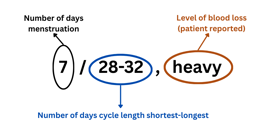
- The Menstrual symptoms and normal parameters table, below, provides an overview of typical menstrual parameters, based on The International Federation of Gynaecology and Obstetrics (FIGO) system 1 guidance (Munro et al., 2018): frequency, duration, regularity and volume of menstruation and how to document these concisely in clinical notes. For example, 7/28-32, heavy = duration 7 days/ shortest-longest frequency + volume.
- Intermenstrual bleeding, post coital bleeding and post-menopausal bleeding are red flag symptoms that always require further investigation and referral to GP or gynaecology, please refer to the Menstrual symptoms and normal parameters table, below.
- Women who commence anticoagulants e.g. apixaban, may notice a change in menstrual bleeding parameters. It is important to counsel patients about this possibility and encourage them to report problematic menstrual bleeding symptoms.
- The Healthy Optimal Periods for Everyone (HOPE) website is a resource which provides information on menstruation and can be shared with patients: www.ed.ac.uk/hope

- Patients can also be signposted to NHS inform links on periods and heavy periods .
Discussing menstruation and normal parameters

Warning
One in three women of reproductive age experience abnormal uterine bleeding (AUB) (Fraser et al., 2015) which is defined as bleeding from the uterus that is abnormal in duration, volume, frequency and/or regularity.
This definition includes the symptom of heavy menstrual bleeding (HMB) (Munro et al., 2018).
Many women do not seek medical help for symptoms of AUB (da Silva Filho et al., 2021). This is likely due to a combination of factors including normalisation of symptoms, fear of dismissal from healthcare professionals and social taboos.
AUB can have a significant impact on quality of life and, of particular relevance to women with heart disease, can lead to anaemia (Fraser et al., 2015).
HMB is the leading cause of iron deficiency anaemia in women of reproductive age (Percy et al., 2017).
Please note that the table below may need to be scrolled horizontally or vertically in order to view all information, depending on your device.
| Parameter | Normal |
| Frequency – how many days does a typical menstrual cycle last? Day 1 is the first day of menstrual bleeding. | 24-38 days |
| Duration – how many days do you bleed for? | Up to 8 days |
| Regularity – over the last few months, how many days was your shortest cycle and how many days was your longest cycle? | Regular variation (shortest to longest, less than or equal to 9 days) |
| Volume (patient determined) – would you describe your periods as light, normal or heavy? | Normal |
Intermenstrual bleeding – do you have any bleeding between periods?  |
None |
| Unscheduled bleeding on progestins ± oestrogen – do you have any irregular bleeding episodes? | Not applicable if not on hormonal medication or none |
| Postcoital bleeding – do you have bleeding after intercourse? |
None |
| Suggested system for recording duration, cycle length and volume |
7 represents the number of days of menstruation. Followed by a forward slash. Then the shortest number of days in a cycle to the longest number of days in a cycle. Then a comma. Followed by the reported level of blood loss for example, medium or heavy. |
Note: Red flag symbol denotes symptoms which always require further investigation to exclude gynaecological cancer.