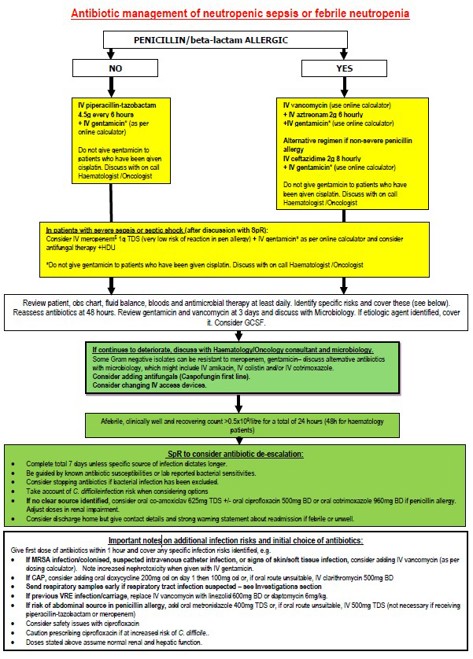
- Prompt antibiotic therapy is essential in neutropenic sepsis. The first dose of gentamicin can be given without knowledge of current renal function (see guidance on front of gentamicin chart). Doses should be calculated on the online calculator, which should be printed off and kept in the patient’s notes. NHS Borders gentamicin prescribing, administration and monitoring chart should be used. After the first dose gentamicin levels should be monitored, entered onto the gentamicin chart, and doses adjusted as specified in the guidelines.
- Duration of treatment with gentamicin should be limited to minimise toxicity. All prescriptions should be reviewed daily in conjunction with microbiology results. Renal toxicity is more likely in those who are septic, hypotensive or who are also on other potentially nephrotoxic drugs such as NSAIDs, ACE inhibitors or diuretics, regardless of initial eGFR. If possible these drugs should be withheld when septic.
- The first dose of piperacillin / tazobactam 5g IV is safe whatever the renal function. Thereafter, if the creatinine clearance (CrCl) is less than 40ml/min, dosing frequency should be adjusted according to renal function as specified below:
|
CrCl (ml/min)
|
Dosing frequency of piperacillin / tazobactam
|
|
>40ml/min
|
6 hourly
|
|
20-40ml/min
|
8 hourly
|
|
<20ml/min
|
12 hourly
|
- Use of vancomycin requires assessment of renal function and monitoring of drug levels, as per NHS Borders Antibiotic Prescribing Guidelines in Adults.
Doses should be calculated on the online calculator, which should be printed off and kept in the patient’s notes.
NHS Borders Vancomycin prescribing, administration and monitoring chart should be used.
After 3 days on vancomycin, consider stopping the drug if no relevant culture isolates obtained (discuss with microbiology).
- If there is a clear cut history of severe reaction to any β-lactam drugs (e.g. anaphylaxis, angioedema, bronchospasm) then all β -lactam drugs carry risk, including the penicillins co-amoxiclav and piperacillin-tazobactam, and all the cephalosporins.
- Avoid ciprofloxacin if previous cipro resistant Gram negative cultures, recent exposure to cipro as prophylaxis, C. difficile carriage or infection in the past 12 weeks (equivocal or toxin positive stool), suspected MRSA or VRE, and only use with extreme caution in the frail elderly.
- Document indication for antibiotics and length of treatment in patient notes wherever possible.
- Patients will have a handheld SACT record – ask to see this as part of initial assessment
- Refer all patients to Acute Oncology/Haematology inbox.
- Contact details:
Acute Oncology
Mon-Fri 9am-4:30pm Bleep 3041
Out of hours: On-Call Oncology Reg, 07798 774842 or via NHS Lothian switchboard 0131 537 1000
Haematology On Call
BGH: bleep 6246
Out of Hours: via NHS Borders switchboard.
- For further guidance on SACT toxicities/cancer complications, see NHS Borders Cancer Intranet site.


 Antimicrobial prescribing: NHS Borders