What happens in an asthma attack and how will it be treated?

Asthma can usually be controlled with medicines, but sometimes triggers can lead to asthma attacks that can be serious.


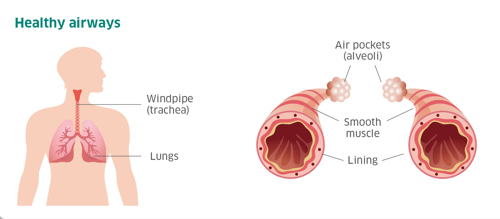
Healthy airways image


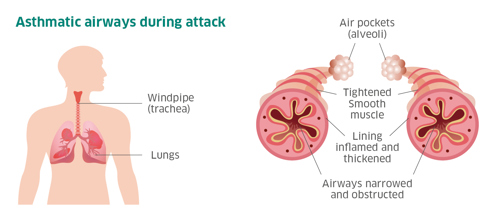
Image of asthmatic airways during attack

 An asthma attack happens when your airways become swollen and the muscles around the airways become very tight, making breathing more difficult. Asthma attacks don’t usually come out of the blue. Most are triggered by allergens (such as pollen or dust), or by viral infections, particularly the group of viruses called rhinoviruses that cause the common cold.


You will probably feel your asthma getting worse for a few days before the attack, for example:

  • you may be coughing and wheezing more
  • your chest may start to feel tight
  • you may be waking up more often in the night coughing, wheezing or with a tight feeling in your chest
  • you may need to use your inhaler as a reliever more often.

An asthma attack is also known as acute asthma.

How will I know I’m having an asthma attack?

You are having an asthma attack if any of the following happen:

  • Your asthma symptoms are quickly getting worse.
  • Your reliever inhaler is not helping as much as usual or you need more of it.
  • You’re finding it difficult to walk or talk.

If you are having an attack, follow the advice in your asthma action plan.

If you don’t have an action plan or can’t find it, follow the advice from Asthma and Lung UK in the box below.

Asthma attack advice for someone using a MART and AIR inhaler:

  1. Sit up and try to keep calm.
  2. Take one puff of your inhaler every 1 to 3 minutes. Total: up to 6 puffs.
  3. If you feel worse at any point or you do not feel better after 6 puffs, call 999 for an ambulance.
  4. If the ambulance has not arrived after 10 minutes and your symptoms are not improving, repeat step 2.
  5. If your symptoms are no better after repeating step 2, and the ambulance has still not arrived, contact 999 immediately.
If you do not have your inhaler, call 999 straight away


Asthma attack advice for blue reliever inhaler:

  1. Sit up and try to keep calm.
  2. Take one puff of your blue reliever inhaler every every 30-60 seconds. Total: up to 10 puffs.
  3. If you feel worse at any point  or you do not feel better after 10 puffs, call 999 for an ambulance.
  4. If the ambulance has not arrived after 10 minutes and your symptoms are not improving, repeat step 2.
  5. If your symptoms are no better after repeating step 2, and the ambulance has still not arrived, contact 999 immediately.
If you do not have your blue reliever inhaler, call 999 straight away


Will I need to go to hospital if I have an asthma attack?

You don’t always have to go to hospital if you have an asthma attack. In most cases your symptoms will settle within 30 minutes of taking your reliever inhaler. You should still make an appointment with your healthcare professional for the same day, even if you are feeling better.

If you are showing signs of serious life-threatening asthma (increased wheezing, chest tightness and breathlessness), and finding it difficult to talk even after using your reliever inhaler, you need to go to hospital for urgent medical attention.


Recommendation based on the research evidence

You should be offered at least one review appointment in the hospital asthma clinic if you have an asthma attack that is severe enough for you to be admitted. 


What treatment will I be given if I have an asthma attack?


Treatment How treatment is given

Oxygen

SIGN thumbs up icon

Your healthcare professional will check your oxygen levels.

If they are low, you will be given oxygen through a mask.

Reliever medicine

SIGN thumbs up icon

You will be given a high dose of reliever medicine through an inhaler and spacer or a nebuliser.

A nebuliser creates a mist of medicine that you breathe in through a mask. Occasionally, in hospital you may be given reliever medicine through a drip or given frequent nebulisations. Nebulisers have the same role as an inhaler but are usually only used in hospital rather than at home.

You may be given another reliever medicine in the nebuliser if your asthma attack is severe or is not responding to the first reliever medicine alone

Steroid tablets

SIGN thumbs up icon

You will be given steroid tablets until you have recovered from your asthma attack (this will be for at least five days).

Magnesium sulphate

SIGN thumbs up icon

You may be given this through a drip if you have life-threatening asthma. It will help to reduce asthma symptoms.

Aminophylline

SIGN thumbs up icon

In hospital, your specialist may give you this medicine through a drip. This opens the airways and helps to treat shortness of breath and wheezing.


Antibiotics don’t usually help treat asthma symptoms as most asthma attacks are usually triggered by viral infections (such as the common cold) rather than bacteria.


To help decide when you are well enough to leave hospital, your healthcare professional will:

  • check your breathing with a peak flow meter regularly to see if it improves
  • discuss with you how to look after your asthma. This will include helping you monitor your asthma
  • check how you use your inhaler

Before leaving hospital, you should be given a written personal asthma action plan if you don’t have one, or your current one should be discussed with you and updated. This is very important.

The hospital should also arrange a follow-up appointment at the hospital for you within a month. If your symptoms do not settle within 48 hours of discharge, you should make an appointment with your healthcare professional who helps you to look after your asthma.