In this section, you will find health guides and digital tools that have been checked by experts. This means you can trust the information and use it to help make choices about your health.


These guides and tools will help you talk with your healthcare team about what treatment and care are best for you.

Key information resources

NHS Inform is the first place to go for trusted Scottish health information about conditions, symptoms, and treatment options.

www.nhsinform.scot 


Cochrane Library

The Cochrane Library has easy-to-read summaries made by patients, researchers, and health professionals. These summaries use strong research and are trusted by experts. Cochrane reviews are known for being the best and highest quality information in healthcare.

www.cochrane.org/evidence


SIGN

The Scottish Intercollegiate Guidelines Network (SIGN) gives healthcare guides for NHS Scotland. SIGN also has booklets for patients. These booklets explain the guides so people can understand the latest information about their diagnosis, treatment, and how to look after themselves.

www.sign.ac.uk/patient-and-public-involvement/patient-publications/

Feel free to look at these trusted websites and their advice, but always talk to your healthcare team and ask questions if you need help.

Digital tools and apps

This short list provides examples of digital tools and apps approved for use by the NHS or by Scottish Government. This list does not include absolutely everything, it contains examples of good and reliable sources of medical advice.

NHS inform provides a collection of quality assured tools and apps.

NHS 24 online app allows you to find your nearest services and to assess your symptoms to find out what you should do next.

Near Me is a video consulting service that enables people to attend appointments from home or wherever is convenient. Many people in Scotland use Near Me for healthcare issues. You need a mobile phone, tablet or computer that can make video calls. The

NHS inform Self-Help Guides contains guides that can help you with common health problems. They ask you easy questions and give you advice on what you can do to feel better or when to see a doctor. The guides can help with body problems like cough, headache, sore shoulder, fever, and more. They also help with feelings like sadness, worry, trouble sleeping, pain, and anger.

NHS inform Mental wellbeing (Silvercloud platform)

Scottish Government provides national access via NHS inform to online wellbeing courses on the Silvercloud platform. The courses can help you with:

  • coping with difficult situations
  • sleeping better
  • feeling less stressed
  • managing anger
  • coping with the coronavirus.

These courses teach you new things and give you support to help you change and feel better. To use a course, you need to give your email, make a password, and use the access code NHS24 from the NHS inform website. There are other online tools for mental health, like Beating the Blues for depression, but you need a referral from your healthcare team to access them.
Discover Digital guide

The Discover Digital guide explains how you can navigate and use digital tools and services. The Health and Social Care Alliance Scotland (the ALLIANCE) created it.

Click this link to find out more about the guide.

If you have questions about it, ask your healthcare team.

Discover digital guide

Evaluating health information

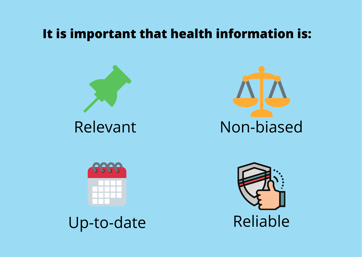
When you find health information on the internet, it is important to check if it is safe and true.

Evaluating health information

Below there is a checklist from MedlinePlus. It is a list of simple questions you can use to help you decide if health information is good and safe to use. A copy can be downloaded here.

checklist 1

Questions:

  • Who is responsible for the website? Look for an “About Us” page. This page usually tells you who runs the website and why they made it.
  • Is it a UK website? UK websites often end with “.uk” in their web address.
  • Is it a registered charity?
 
checklist 2

Questions:

  • Who pays for the website?
  • Are there adverts? Adverts are pictures or messages that try to sell you something. If you see adverts, the website might get money from companies.


checklist 3

Questions:

  • Who writes the content? Is it reviewed by health professionals? Good websites show where they got their facts.
  • When was it created? Is it up to date? Check if the website says when the page was made or last updated.
  • Is the author trying to promote a particular view? Good websites give facts, not just opinions.
  • Does it have quality accreditation or information standard?
 

Information in different languages and formats

NHS inform gives health information in different languages and formats. This means you can ask for information in:

  • British Sign Language (BSL)
  • easy read (with simple words and pictures)
  • large print (with bigger letters)
  • other languages (like Polish, Urdu or Chinese).

You can also translate health information using an online translator. However, online translators are good for short words and sentences. They may not always get the meaning right for longer or complex medical information.

If you want to find health information in your language or in a different format, you can visit https://www.nhsinform.scot/translations/