What is a blood-borne virus (BBV)?

Blood-borne Viruses (BBVs) are infections which are transmitted through exposure to infected blood or bodily fluids.

The blood-borne viruses that will be tested as part of this programme are:

  • HIV
  • Hepatitis B (HBV)
  • Hepatitis C (HCV)

Further information on BBVs can be found on Turas Learn

Why is BBV testing happening in Emergency Departments?

The Scottish Government has committed to the elimination of HCV by 20251 and ending HIV transmissions by 20302. This is in line with the World Health Organisation (WHO) strategic goals to end new HIV transmissions and eliminate viral hepatitis as a public health threat by 20303.

To meet these goals there needs to be increased testing to identify people with a BBV who are undiagnosed or previously diagnosed but not linked into care services.

Identification of people earlier in the disease course improves survival and stops onwards transmission4 leading to better health outcomes.

Routine opt-out BBV testing is intended to be an opportunistic, population level testing programme.

Key findings from England

Opt-out testing has been very successful in England5.

​Programme rolled out in April 2022 across 34 sites. ​

Over period April 2022 to December 2024, almost 4 million people attended the ED of which 2.4 million (60.6%) had a blood test and thus considered eligible for opt-out BBV testing.

Details of the calculations related to uptake and test positivity can be found in the full report, available here.


Attendees tested or diagnosed

HIV HCV HBV

Number tested

1,377,299

1,060,035

879,724

Number (%) tested positive

8,624 (0.63%)

1,597 (0.15%)

7,048 (0.80%)

Number (%) tested positive (newly diagnosed)

719 (0.052%)

831 (0.078%)

3667 (0.42%)

Number (%) tested positive (previously diagnosed and not in care)

483 (0.04%)

659 (0.06%)

Not available

Number needed to test to newly diagnose one person

1,916

1,276

240

Number of attendees (aged 16+) tested and testing positive for HIV, HCV and HBV (24 sites)

Scottish pilots

Three HBs, funded by the Scottish Government, undertook pilots in local EDs in 2024. These were NHS Grampian, NHS Highland & NHS Lothian.

Case Study: NHS Grampian

ED: Aberdeen Royal Infirmary

Time Period: January 2024 – May 2024

Number of attendees tested – 4500 (some individuals maybe have been tested more than once if repeat attendance over the course of this period)

Attendees tested +ve or diagnosed (aged 16+)

HIV HCV HBV

Number (%) tested positive (newly diagnosed)

0

14

9

Number tested positive (previously diagnosed and not in care)

<5

0

0

Clinical Outcome

Re-linked to care <5

Linked to care-7

Not engaged- 6

Treated- 5

Linked to care -8

Not engaged <5

Treatment commenced - 5

Number need to test per case undiagnosed/not in care*

4,602

329

511

* The numbers needed to test to diagnose one person were less than expected


Who is being tested?

Adults aged 16 years and over who are having blood taken as part of their care in the ED.

In some Health Boards, an upper age limit applies; for example, in NHS Greater Glasgow and Clyde, the testing age range is 16–69 years.

Patients who do not wish to be tested can opt out by notifying a member of ED staff.

Where opt-out testing is not applicable

Opt-out BBV testing is a population level testing programme and is therefore not applicable where there is concern that a patient’s presentation in ED is BBV-related.

  • Where someone presents with a condition that is suspected to be related to HIV, HBV or HCV, including HIV seroconversion and acute hepatitis, ED staff should follow locally agreed arrangements which involve BBV testing (outwith the opt-out programme) and involvement of specialist teams as appropriate.
  • Similarly, if there is concern that a patient attending ED is particularly at risk for a BBV (for example, due to the patient disclosing a recent risk), then there should be clear signposting to the relevant specialist service. This could be to the local sexual health clinic, or other relevant service, for testing and appropriate support, including discussions about prevention and any repeat testing. Staff should follow locally agreed arrangements which involve BBV testing (outwith the opt-out programme) and involvement of specialist teams as appropriate.

Is consent needed?

This is an opt-out programme. Informed consent for opt out BBV testing is based on pre-test information provided by posters displayed in waiting rooms and information available online.

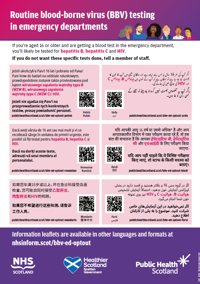
A single multi-language poster is available alongside the main English poster. EDs should have received these directly from the printers or local BBV teams.

Due to space constraints within EDs, leaflets are available online in various languages and can be accessed via specific QR codes on the multi-language poster. Further information on BBVs is also available on NHS Inform.

Staff are not required to provide pre-test counselling or specific verbal prompts or reminders.

What should I say if asked “why” by a patient?

Occasionally, a patient may ask why they are being tested for BBVs. The recommended response is:

“We now routinely test everyone for the common viruses: HIV, Hepatitis B and Hepatitis C along with the other blood tests you are having in A&E. If you would prefer not to have these tests done today, you can opt out”

Remember – you are not required to provide any further information; patients will have access to posters and other online resources.

Further FAQs can be found here.

What will Emergency Department staff need to do?

Take an additional tube of blood for the purpose of testing for BBVs.

Local arrangements will determine how tests are ordered on existing systems.

ED staff are not expected to manage results from BBV testing, nor are they expected to inform or counsel people about a reactive test result. See Good practice guidance for further information.

BBV opt-out testing should have minimal impact on ED staff efficiency and patient flow in the department.

What if a test is not performed after the sample is taken?

There are instances where due to valid reasons, a blood sample is taken but BBV testing cannot be performed.

This can occur when a BBV test is taken in the ED but not processed due to technical issues or human error, such as an insufficient blood sample, test not requested etc.

Local protocols will determine what action should be taken when an issue with testing has occurred. ED staff are not expected to manage invalid tests. This will be the responsibility of the local BBV team.

What if the patient is unconscious or otherwise lacks capability to opt out?​

All reasonable steps should be taken to support the patient in making their own decision.

In the absence of an appointed power of attorney, the NHS Chief Legal Office advises that Scottish Law permits BBV testing in a person who is unconscious or lacks capacity, when it is necessary for that patient’s own health.

Where practically feasible, clinicians should complete a Section 47 certificate under the Adults with Incapacity (Scotland) Act before testing.

If a patient regains capacity after testing, the responsible clinician should, where feasible, inform them and/or direct them to the relevant poster or NHS Inform for further details on the ED Opt-Out Programme.

Whilst principles will be broadly similar, local practice may vary across sites and boards. Local SOPs should be consulted in instances where clarification is required.


Resources for patients

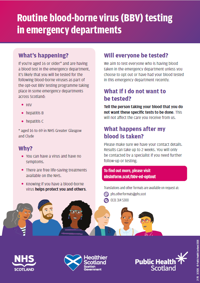
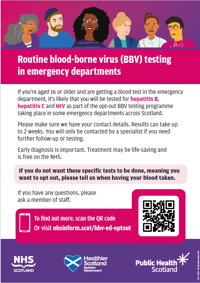
Routine BBV testing poster   

Click on images to enlarge


Posters displayed in EDs are also available online: Routine blood-borne virus (BBV) testing in emergency departments – poster and screen assets - Publications - Public Health Scotland

Leaflets in various languages and formats are available online: <NHS Inform link> . These leaflets can also be accessed via the QR codes found on the multi-language poster.

Other resources for staff