

 Borders Ref Help Toolkit

Who to refer:
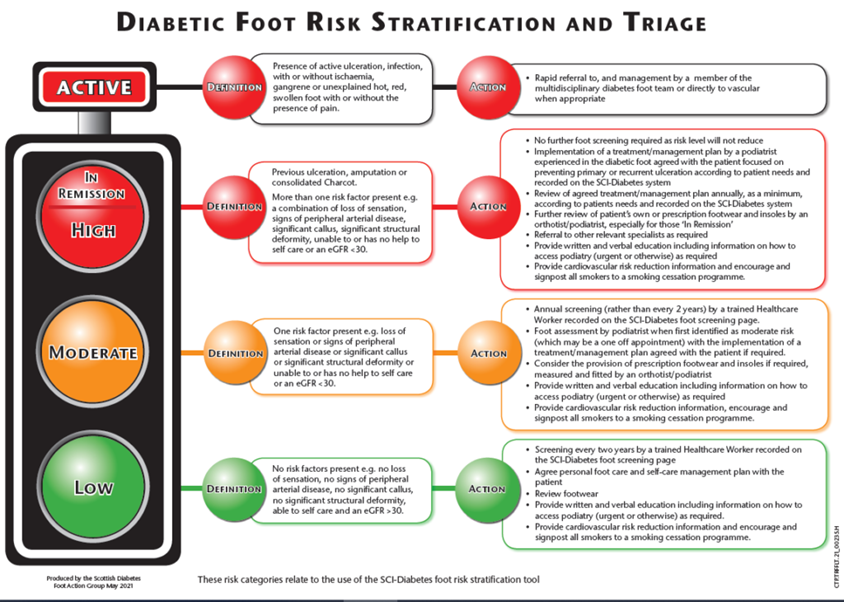
Please only refer those with diabetes who fall into the following categories to diabetes podiatry:
Routine outpatient referral
- Moderate Risk – has at least one risk factor, for example, loss of sensation, signs of peripheral arterial disease, unable to or has no help to self-care or an eGFR <30. Refer to podiatry routinely when first identified as moderate risk for an agreed treatment and management plan to be put in place. This may be a one-off appointment.
- High Risk – more than one risk factor present.
- In Remission – has had previous ulceration, amputation or a consolidated Charcot joint.
Urgent outpatient referral
- Active foot disease – has current ulceration.
If a person has a limb-threatening or life-threatening diabetic foot problem, refer them immediately to acute services.
Examples of limb-threatening and life-threatening diabetic foot problems include the following:
- Ulceration with fever or any signs of sepsis +/- osteomyelitis – refer to medicine at Borders General Hospital
- Ulceration with limb ischaemia (see the NICE guideline on peripheral arterial disease) - in the presence of extensive or wet gangrene or a white, cold, pulseless foot then refer to vascular registrar at Royal Infirmary of Edinburgh
- Clinical concern that there is a deep-seated soft tissue infection (with or without ulceration) - if an abscess/collection is suspected, and no significant vascular compromise, then refer to orthopaedics at Borders General Hospital
- Gangrene (with or without ulceration) - in the presence of extensive or wet gangrene then refer to vascular registrar at Royal Infirmary of Edinburgh
For all other active diabetic foot problems, refer the person within one working day to the diabetic foot clinic for triage within one further working day
Who not to refer:
- Low risk or newly diagnosed individuals who do not have a podiatric need – any appropriately trained healthcare professional or clinical support worker can carry out foot screening.
- Ulceration that is above the level of the foot.
- Ulceration in people without diabetes
How to refer:
- Diabetic Foot Clinic for active ulceration – email to adam.smith@nhs.scot AND copying in podiatryadmin@borders.scot.nhs.uk ideally with photo. In case of requirement for urgent discussion with podiatry, bleep Adam Smith on 6510
- Moderate/High/In Remission – Podiatry Community Clinics via email podiatryadmin@borders.scot.nhs.uk