Warning

Patients at High Risk of Type 2 Diabetes

Prediabetes is characterised by the presence of blood glucose levels that are higher than normal but not yet high enough to be classed as diabetes. If undiagnosed or untreated, prediabetes can develop into Type 2 Diabetes (T2D).

For this reason, prediabetes is often described as the grey area between normal blood sugar and diabetic levels and is a risk factor for cardiovascular disease and future Type 2 Diabetes.

Diagnosing Prediabetes

Prediabetes can be diagnosed using a single HbA1c (HbA1c 42-47 mmol/mol).

A fasting glucose may also be used.

Prediabetes includes impaired glucose tolerance and impaired fasting glycaemia.

So although Impaired fasting glucose/prediabetes/impaired glucose tolerance are all distinct entities based on which diagnostic test you use, their clinical management is sufficiently similar that, in primary care, we can consider them to be one condition.

Who to refer, who not to refer, how to refer

Who to refer to weight management team for diabetes prevention advice:

Patients with pre-diabetes can be referred to the dieticians in the weight management team.

Refer patients with Pre-diabetes (HBA1C 42 – 47 or impaired fasting glucose or impaired glucose tolerance) or patients who are at high risk of developing diabetes for other reasons (see under primary care management tab for advice regarding risk stratification).

Patients that have had previous Gestational Diabetes (GDM) are at increased risk of future T2D and may also benefit from the programme.

Patients with PCOS are often high risk. Consider risk stratification and testing.

Who not to refer for diabetes prevention advice:

  • Patients already diagnosed with T2D.  The ‘Control It’ programme is designed to provide early intervention and education for those newly diagnosed.
  • Patients with only a low/moderate risk of Diabetes (See details in Primary Care Management section)
  • Patients who do not have a diagnosis of prediabetes but may require weight management support (to be referred to weight management in the usual way).

How to refer:

Patients can be referred for diabetes prevention advice via sci-Gateway Diabetes Prevention:

Borders General Hospital -> Weight Management Team -> Diabetes Prevention Support

Patients can also self-refer on the weight management website:

https://www.nhsborders.scot.nhs.uk/patients-and-visitors/our-services/general-services/borders-adult-weight-management-team/referrals-and-how-to-contact-us/

Please visit the Weight Management pages on RefHelp for further details.
Primary care management

Primary care teams play a significant role in the identification of patients who are at High risk of diabetes (Prediabetes) but also those at moderate risk of developing diabetes.

At risk groups include those known to be at increased risk of T2D, due to the risk factors below.

Risk Factors:

  • Age: Over 40 years old (white Caucasian) or over 25 years old (African-Caribbean, Black African or South Asian)
  • Family history:  2-6 times more likely to develop T2D if a parent, brother, sister or child has diabetes
  • Ethnicity: T2D is 2-4 times more likely in people of South Asian descent and African-Caribbean or Black African descent*
  • Overweight: BMI over 25 (white Caucasian) or over 23 (African Caribbean, Black African or South Asian)
  • Waist circumference:
    • Women: 31.5 (80-cm) inches or over
    • Men:  35 (90 cm)  inches in south Asian men           37  (94cm) inches in white or black men
  • High blood pressure or previous heart attack or stroke
  • Polycystic ovary syndrome
  • Previous gestational diabetes*
  • Severe mental health problems including those prescribed Clozapine and Olanzapine which are known to induce weight gain and increase risk of T2D.


If a patient has a number of the above, the more at risk they are of developing T2D.

Patients may wish to help and calculate their score online; this requires weight, height and waist circumference.

  1. Calculate and code RISK score:

This can be calculated via the Diabetes UK Know Your Risk Tool, which requires patients to measure height, weight and waist circumference.

NICE guidelines encourage keeping an up to date register of RISK scores, along with introducing a recall system to invite those at risk of Type 2 Diabetes in for regular review. This is also an opportunity to support patients to manage lifestyle changes and encourage goal setting.


  1. Manage RISK score:

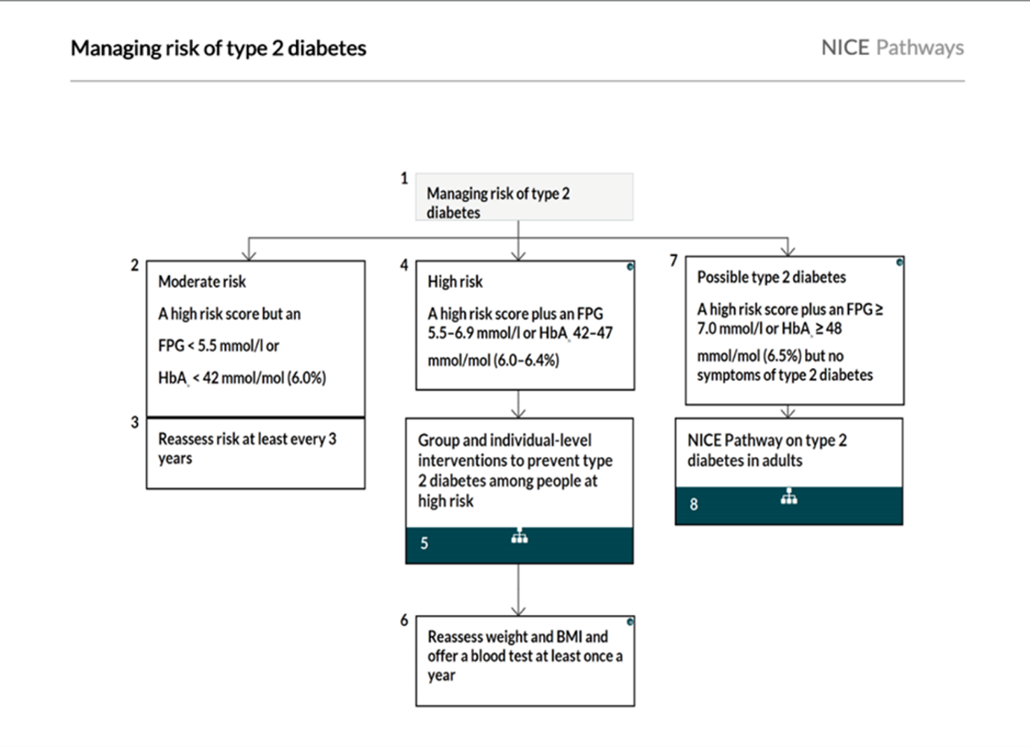
The summary diagram is as follows. Please view interactive NICE guidelines for further details.

Click for full size

  1. Lifestyle changes

Lifestyle changes with the aim of managing excess weight and increasing exercise are pivotal to the prevention of diabetes, but consider all the pillars of health


  1. Monitoring of Prediabetes

Prediabetes is monitored with an Annual HbA1c, unless symptoms develop prior to this.

Advise patients to look out for the following:

  • Polyuria
  • Polydipsia
  • Change in eyesight
  • Weight loss
  • Lethargy
  • Thrush oral/genital

Resources and links

Local service details

Borders Weight Management Team

Room 2DK30b

Borders General Hospital

MELROSE

TD6 9BS

Telephone Number: 01896 827236 or

Email: BordersWeight.ManagementTeam@borders.scot.nhs.uk

Editorial Information

Last reviewed: 06/06/2025

Next review date: 06/06/2027

Author(s): Siobhan Pacitti.

Author email(s): Siobhan.pacitti@nhs.scot.