Management of long term high dose steroid therapy

Warning

Please see NHS Borders Steroid Safety Bundle 

Patient information sheet in bundle document above

Information

This guideline is aimed at all clinical health care professionals and nursing staff in NHS Borders. It is designed to provide safe, practical guidance in the screening, diagnosis and management of complications related to long term high dose steroid therapy initiated in primary or secondary care.

Abbreviations: PPI = proton pump inhibitor, BGM = blood glucose monitoring, CGM = continuous blood glucose monitoring (such as dexcom or libre devices), BG = blood glucose, SU = sulphonylurea.

LONG TERM HIGH DOSE STEROID THERAPY = ≥ 10mg prednisolone (or equivalent) for > 14 days

Prednisolone 10mg approx equivalent to:

  • Hydrocortisone 40mg
  • Dexamethasone 2mg
  • Methylprednisolone 8mg
  • Betamethasone 2mg

THINGS TO DO AT COMMENCEMENT OF LONG TERM STEROID THERAPY (see Steroid Safety Bundle to which page numbers refer – link below)

  • PERFORM an HbA1c and warn patient of symptoms of hyperglycaemia
    • Hyperglycaemia is a potentially severe side effect of long-term steroid therapy particularly in the elderly and those with pre-existing diabetes.
    • See screening and treatment guidance pages 2-3 of Steroid Safety Bundle, and advice in Primary Care Management below. Give patient information sheet appendix 1
  • GIVE ADVICE ON ‘SICK DAY RULES’ and give STEROID EMERGENCY CARD (see patient information sheet, appendix 1) – For advice on how to safely withdraw long term steroids see page 5. See Primary Care Management below
  • GASTROPROTECTION: PPI (proton pump inhibitor) therapy should not be given routinely but should be considered for people at high risk of gastrointestinal bleeding or dyspepsia. (e.g. previous GI bleed, known GORD/peptic ulcer disease, currently on anticoagulation or active cancer). 
  • BONE PROTECTION: For advice on assessment and treatment see Page 7 of steroid safety bundle 

ASSESSMENT AND MANAGEMENT OF STEROID-INDUCED HYPERGLYCAEMIA

See Primary Care Management below

STEROID WITHDRAWAL ADVICE

See Primary Care Management below

STEROID ‘SICK DAY RULES’

See Primary Care Management below

Who to refer, who not to refer, how to refer

Who to refer:

To diabetes liaison nurses (Diabetes.LiasonNurse@borders.scot.nhs.uk; phone 07973 631628)

  • People with steroid-induced hyperglycaemia who may require insulin therapy i.e those not controlled on oral gliclazide as per guidance in Primary Care Management below, or in whom gliclazide is inappropriate.
  • People with glucose levels > 20 mmol/l who are clinically unwell or in whom glucose levels remain above 20 mmol/l for three days in a row despite rapid uptitration of gliclazide as per guidance in Primary Care Management

If a patient is ketotic or running glucose levels above 30 mmol/l and is clinically unwell (i.e. concern regarding either DKA or HHS) then please refer for acute assessment under the general medicine take, but it is helpful if the diabetes nurses are also updated by email in this situation

To endocrinology for email advice (via email dr@borders.scot.nhs.uk)

  • When advice required about interpretation of cortisol levels, or request for organisation of synacthen test, as per steroid withdrawal advice below. We expect to be able to give advice and assistance with interpretation remotely rather than bringing people to a formal endocrinology appointment for the majority

To endocrinology for clinic review (via SCI Gateway, routine referral)

  • People with confirmed adrenal insufficiency lasting > 3 months who remain on steroids despite weaning attempts as per guidance in Primary Care management below. This would usually be after endocrine advice by email regarding cortisol levels as above

Who not to refer

  • People whose steroid-induced hyperglycaemia can be managed with gliclazide
  • People who cannot wean steroids down to 4 mg prednisolone or equivalent, or whose main issue with weaning below that level is reactivation of the condition for which steroids were started rather than steroid deficiency

Primary care management

Steroid Therapy Pathway 1

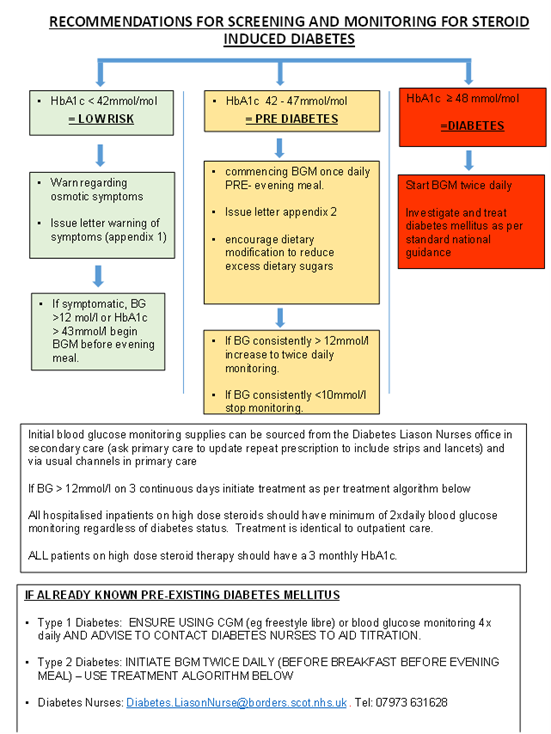
Click for full size flowchart (Recommnedations for screening and monitoring for steroid induced diabetes)
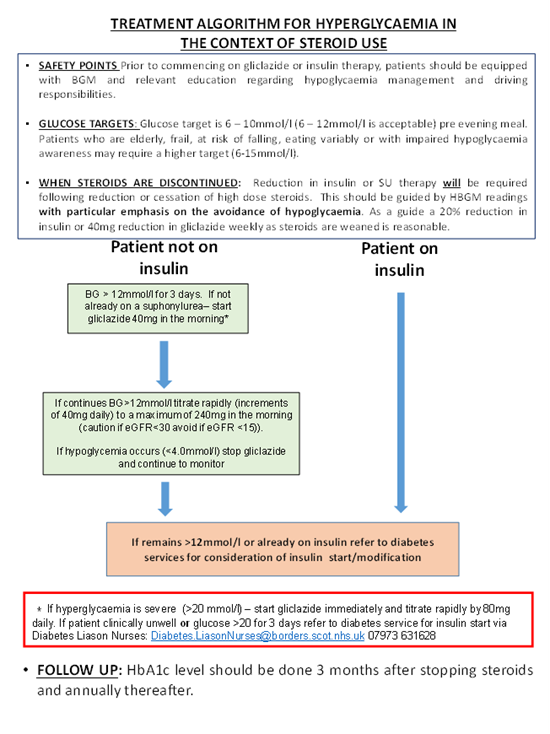
Click for fullsize treatment Algorithm (Treatment Algorithm for hyperglycaemia in the context of steroid use)


STEROID WITHDRAWAL ADVICE

  • NICE Guidelines (Adrenal insufficiency: identification and management) 2024 Section 1.9 covers managing glucocorticoid withdrawal to prevent adrenal insufficiency
    • Decisions to taper glucocorticoid should be made by the treating team
    • Suggested tapering regimens are outlined, including a faster taper for those who have been on glucocorticoids for 4 – 12 weeks and a slower taper for those on glucocorticoids for more than 12 weeks
    • Temporary symptoms including fatigue, reduction in appetite, low mood should be expected when tapering below physiological dose (e.g. 4mg).
    • If signs and symptoms of adrenal insufficiency develop below physiological dose (e.g. 4 mg) on faster weaning regimen then increase to double physiological dose (e.g. 8 mg) for 1 week then reduce to 4 mg prednisolone for 1 week then wean as per slower tapering regimen
  • When weaning down and withdrawing long term steroids, patients who develop symptoms or signs of adrenal insufficiency on slow weaning can be risk stratified by a morning cortisol sample (brown tube, order on Trak or by handwritten form) taken prior to steroid dose and having omitted prednisolone the previous day. This should be done once prednisolone dose reaches 4mg or less. Prednisolone should be restarted after the blood test pending results.
  • Interpretation of the 9 am cortisol is as per Table below
RISK

MORNING CORTISOL (nmol/l)

ACTION
HIGH RISK <275

Continue 4mg prednisolone and refer to endocrinology services.  (If already in secondary care, perform short synacthen test pre morning steroid does if possible)

MODERATE RISK 275-425

Can wean and stop prednisolone if treated medical condition allows.  Sick day dosing of 10mg prednisolone (or seek medical attention if unable to take) as per steroid emergency card for 3 months.

LOW RISK >425 Can stop prednisolone


STEROID ‘SICK DAY RULES’

Patients prescribed steroids at >5mg/day prednisolone (or equivalent) for over 4 weeks are at risk of adrenal suppression and therefore may be at risk of adrenal crisis.

Steroid Dose Equivalent
Prednisilone 5mg per day or more
Methylprednisilone 4mg per day or more
Hydrocortisone 15mg per day or more
Dexamethasone 500 micorgram per day or more

Patients at risk of adrenal crisis should be issued a STEROID EMERGENCY CARD  (found in patient information leaflet appendix 1 and can be found at www.endocrinology.org/adrenal-crisis or obtained from Pharmacy.

Sick day rule dosing for patients at risk of adrenal crisis is as follows (N.B. – if taking prednisolone 10mg daily or more, this is sufficient for rule 1 ‘moderate intercurrent illness’ cover and double dose not required)

Sick day rules

Patient taking <10mg prednisolone (or equivalent) 10mg prednisolone or more (or equivalent)
Fever, infection needing antibiotics, surgery under local anaesthetic Increase dose to 10mg prednisolone (or equivalent) whilst unwell or on day of procedure Continue usual glucocorticoid dose
Persistent vomiting, preparation for colonoscopy, acute trauma, surgery under anaesthetic 100 mg Hydrocortisone IM/IV at onset/presentation/start of procedure then 50mg hydrocortisone IV QDS.  Patient should be admitted for ongoing parenteral hydrocortisone if required. 100mg Hydrocortisone IM/IV at onset/presentation/start of procedure then 50mg hydrocortisone IV QDS.  Patient should be admitted for ongoing parenteral hydrocortisone if required.
Patients with confirmed adrenal insufficiency lasting >3 months should be seen in endocrine clinic for education about sick day rules and emergency hydrocortisone injection.


For perioperative and obstetric management please discuss with the anaesthetic team and consult national guidance (Management of glucocorticoids during the peri-operative period for patients with adrenal insufficiency | Association of Anaesthetists – www.anaesthetists.org). 

 

Resources and links

Editorial Information

Next review date: 04/06/2027

Author(s): Rachel Williamson.

Author email(s): rachel.williamson@nhs.scot.