Warning

This is a single referral point for requesting a colon test in patients with symptoms that suggest colorectal cancer (CRC) or inflammatory bowel disease (IBD).  Referral to Gastroenterology or Colorectal Surgery is more appropriate for other patients with lower GI symptoms.

SCI gateway referrals to Borders Colon Service are initially divided by age:

  • All patients 70 and over will be triaged for CT colon and the referral looked at by specialist radiographers who can liaise with GI consultant if needed.
  • All patients under 70 are vetted by GI consultant

Patients will then be booked for colonoscopy, flexible sigmoidoscopy or CT colon: 

  • QFIT >400 booked on next available list (usually <3 weeks)
  • Positive bowel screening test and other referrals booked as urgent (usually 6-8 weeks)

Colon test carried out:

  • The arrangements for patient follow up are different between colonoscopy and CT colon
  • Colonoscopy and flexible sigmoidoscopy results are explained to the patient after the procedure and the endoscopist will arrange any follow up required.
  • CT colon result is only available after the patient has left the department and is sent to referring clinician who is responsible for arranging any follow up and explaining the findings to the patient.
  • The reporting radiologist usually will contact gastroenterology if there are significant findings.  This is indicated on the report as “copy to BOR gastro.colon.advice”  Gastroenterology will then arrange colonoscopy follow up (e.g for polypectomy or contact colorectal surgery (e.g. if tumour on CT colon) and if they do they will copy in the referring clinician. 
  • Although secondary care may pick up follow up as described above, ultimately the referring clinician remains responsible for arranging follow up of all CT colon findings and passing on CT colon result to the patient. 


Notes on CT colon protocol :

Age >70          CT colon with restricted diet, plenvue prep, omnipaque tagging and colonic air insufflation

Age 80-85      CT colon with restricted diet and omnipaque faecal tagging colonic air insufflation but no prep

Age >85          CT abdo/pelvis with omnipaque faecal tagging

Information on comorbidity and mobility issues allows radiology to place patients in appropriate prep category.


Who to refer, who not to refer, how to refer

Who to refer

Factors more likely to indicate the presence of colorectal cancer

  • Age over 40years (risk rises aged 50 and rises sharply over 60 years)
  • New symptoms rather than flare of previous symptoms
  • Progressive symptoms > 4 weeks

Symptoms suggesting colorectal cancer  

  • Bleeding
    • Repeated rectal bleeding without an obvious anal cause
    • Blood mixed with the stool
  • Bowel habit
    • Persistent change in bowel habit especially to looser stools (more than 4 weeks)
  • Mass
    • Right-sided abdominal mass
    • Palpable rectal mass
  • Iron deficiency anaemia
    • Unexplained iron deficiency anaemia (ie not menstrual blood loss)
  • Presence of unexplained weight loss accompanied by any of:
    • Rectal bleeding
    • Iron deficiency anaemia

Following symptoms are low risk for colorectal cancer

  • Change to constipation
  • Single episode of rectal bleeding
  • Abdominal pain without lower GI alarm symptoms


Who not to refer:

  • Patients with other lower GI symptoms not suggestive of IBD or Colorectal Cancer
  • Patients who have not had QFIT test, FBC and PR examination.


How to refer:

Refer via SCI gateway Borders Colon Service pathway:

Borders -> Borders Non-GP Locations/Providers -> Borders Colon Service -> Colonic Investigation Referral


Referrals must include:

QFIT result (QFIT value rather than QFIT result pending, or reason why it is not available)

Hb result

PR examination findings
Primary care management

QFIT is an important adjunct to the clinical assessment of patients with lower GI symptoms.  Organise a QFIT at the point you are considering referral for a colon test.  This generally will be for patients who have had concerning symptoms for > 4 weeks.  Do not organise a QFIT for young patients (age < 40) or where the symptoms are long standing or when the symptoms are acute (e.g. episode of gastroenteritis or diverticulitis). 

A QFIT value (rather than QFIT result pending) must be included with the Borders Colon Service referral or a reason why it is not available. 

Counterintuitively QFIT has been shown to still be a useful triage test even for patients presenting with rectal bleeding and remains reliable in this situation.

If the QFIT comes back blood not detected reconsider if referral for colon test is required especially if symptoms are low risk or settling.

Guide to QFIT interpretation

QFIT value Utility Interpretation
>20 Very High Rules out CRC (<1%)
>400 Very High High risk of pathology (>50%)
80-399 Reasonable Increasing chance of pathology?
10-79 Low

Ignore, base any decision to investigate on symptoms alone


Notes

  1. If ongoing concern it is reasonable to do a second QFIT best taken within 6 weeks of the first.
  2. A weak positive QFIT (10-79) is not an indication to investigate in itself
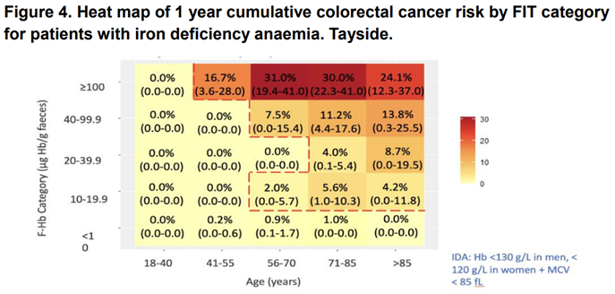
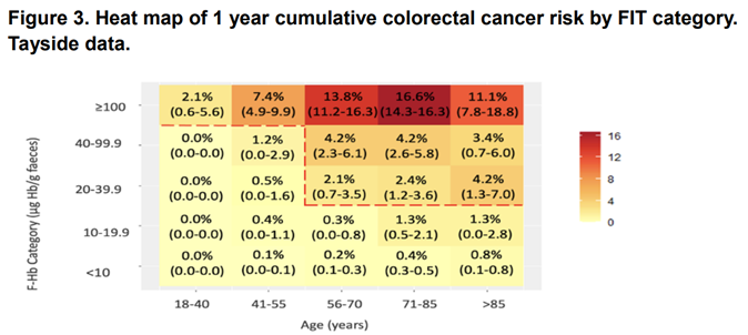
  3. See heat maps for CRC risk by QFIT category. Investigation generally only suggested when CRC prevalence is >2%

Example heatmaps from Tayside are seen below, taken from national guidelines group:

Fig 3 heat map

Fig 4 Heat map


Local service details

bor.gastroenterology@borders.scot.nhs.uk

Editorial Information

Last reviewed: 02/02/2024

Next review date: 01/02/2026

Author(s): Jonathan Fletcher, Angus Wallace.

Author email(s): bor.gastroenterology@borders.scot.nhs.uk.