

 Borders Ref Help Toolkit

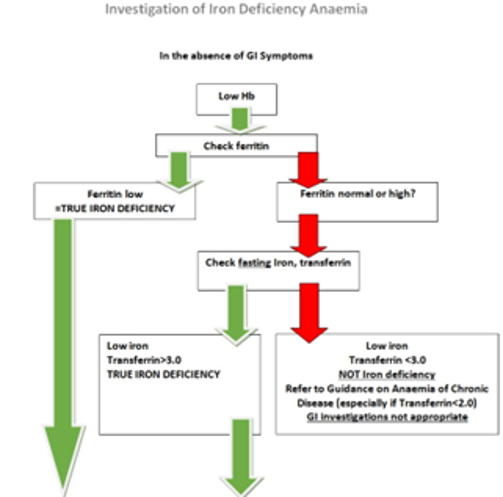
| Refer all males and non-menstruating females for appropriate investigations (see below) |
Yield for significant pathology varies considerably between iron deficiency and IDA even in patients aged over 50.
| ID | IDA | |
| Age > 50 | 1.3% | 6% |
| Age > 65 | 2.3% | 9% |
CRC risk in IDA with negative QFIT is very low <1% (Tayside,Fife and Lothian data)
- Individuals with IDA should be referred for appropriate GI investigations if sufficiently fit to undergo them
- Localising symptoms should direct investigation to upper GI endoscopy or colon test
- Patients without localising symptoms should be referred for a colon test
- Appropriate investigation will be at the discretion of the secondary care team and will depend on a patient’s age and general fitness
- CT colonography will be offered to patients age >70 and less fit patients or those who cannot tolerate colonoscopy*
- Minimal prep CT (no purgative laxative preparation) will be reserved for the most frail patients where any investigation at all is appropriate*
- *It is useful to have up to date U&E’s for frail patients or those >80 years
Who not to refer:
GI investigations are not appropriate in other types of anaemia unless there are clear GI symptoms to be investigated
- Menstruating females should not undergo GI investigation in the absence of GI symptoms or a family history of colon cancer
- Testing for Coeliac disease is appropriate in these patients
How to refer:
To refer for upper GI endoscopy:
Borders General Hospital -> Endoscopy -> Endoscopy B
To refer for colon test:
Borders General Hospital -> Borders colon service
(See Borders Colon Service page for further information)