

 Borders Ref Help Toolkit
Please perform clinical examination and arrange urgent pelvic USS prior to referral
Post-menopausal bleeding

Warning
Guidance for women who have postmenopausal bleeding. There is different guidance for women who are taking and those who are not taking HRT.
Postmenopausal bleeding in women who are not taking HRT
Please organise an urgent transvaginal ultrasound (to measure endometrial thickness and exclude ovarian cysts).
The report will have instructions about whether referral is needed. If the endometrium measure >4mm, or is not clearly seen, please refer to gynaecology (urgent suspicion of cancer).
Please examine the woman to exclude a vulval, vaginal or cervical cancer. If any suspicious lesions seen please refer urgent suspicion of cancer. Please refer to colposcopy if suspected cervical cancer.
If the endometrium measures 4mm or less in thickness, there are no ovarian abnormalities, and examination is normal, the patient can be reassured that the risk of a gynaecological cancer is very low and that referral is not needed.
If no abdominal pain or bloating, and USS does not show ovarian pathology, Ca125 testing is not required.
Tamoxifen
Women taking tamoxifen have an increased risk of endometrial cancer, and scan appearances can be non- standard. Please arrange a scan for these women, but simultaneously refer to gynaecology, urgent suspicion of cancer.
Recurrent bleeding
If recurrent or worsening bleeding and normal USS, please refer urgently to gynaecology.
Triaging referrals
If the endometrium contains a possible polyp, is 11mm or thicker, or the woman is taking tamoxifen we will triage directly for an outpatient hysteroscopy. If the woman would not want to have this done, it would be helpful to know this.
Postmenopausal bleeding in women taking HRT
There is an extensive guideline published by the British menopause society.
Management of unscheduled bleeding on hormone replacement therapy (HRT) - British Menopause Society
The summary table below is reproduced from this document.
Please examine the woman and refer urgently to gynaecology if there is suspicion of vulval or vaginal cancer, or to colposcopy if there is a suspected cervical cancer.
If the woman wishes to stop HRT, and the bleeding stops within 4 weeks, further investigation is not required
Starting or changing HRT
Bleeding is very common when starting or changing HRT. In the absence of risk factors (see table below) no investigation is needed for unscheduled bleeding in the first 6 months after starting HRT, or within 3 months of a change in dose or preparation of HRT. Women with additional risk factors for endometrial cancer (see table below) should be investigated with a transvaginal ultrasound scan and referred to gynaecology on a suspicion of cancer pathway straight away.
Triaging referrals
If the ultrasound scan suggests that the endometrium contains a possible polyp, is 11mm or thicker we will triage directly for an outpatient hysteroscopy. If the woman would not want to have this done, it would be helpful to know this.
Bleeding after normal investigation
If persistent bleeding despite HRT optimisation with normal scan and examination, please refer to gynaecology.
If bleeding persists 3 months after a normal endometrial biopsy, or 6 months after a normal hysteroscopy, please re-refer urgently to gynaecology.
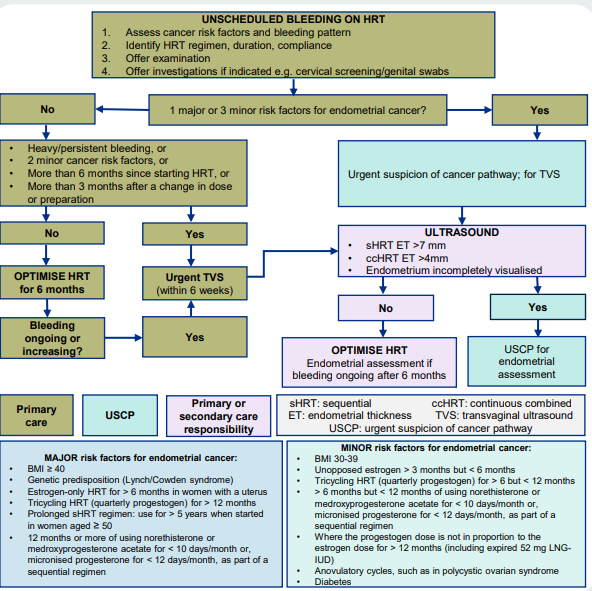
Click for full size