Warning

The Urogynaecology Department offers complete clinical and urodynamic assessment of female patients with pelvic floor dysfunction including lower urinary tract symptoms (LUTS) and incontinence, as well as surgical intervention for urinary incontinence and prolapse.


Who to refer, who not to refer, how to refer

Who to refer:

Women with symptoms as above and:

  • Failed Conservative Management
  • Significant (beyond introitus) and / or Symptomatic Prolapse
  • Previous Incontinence / Prolapse Surgery
  • Previous Pelvic Irradiation
  • Complicated symptoms (consider referral to urology):
    • Haematuria
    • Bladder pain
    • Recurrent UTIs
    • Difficulty with bladder emptying / Urinary Retention
    • Suspected fistula

Women with a suspected pelvic mass should be first referred for an Ultrasound Scan to establish a diagnosis and then referred according to the findings.

If symptoms are of sudden onset or atypical, especially in the elderly, bladder malignancy should be considered with early referral urology.

Who not to refer:

  • Women with uncomplicated symptoms who have not undergone initial primary care management
  • Women with urinary symptoms due to a pelvic mass – this needs urgent investigation first (Ultrasound Scan)

How to refer:

Via SCI Gateway:  Gynaecology

  • Referrals will be directed to one of the Physiotherapy Outpatient Clinics.
  • Referrals will be triaged appropriately to a Women’s Health Physiotherapist.
Primary care management

PRESCRIBING FOR THE TREATMENT OF OVERACTIVE BLADDER IN LOTHIAN

Symptoms of overactive bladder include:

Urinary frequency / urgency / nocturia with or without urge incontinence


PRIOR TO PRESCRIBING MEDICATION:

  1. Exclusion of the following:

Haematuria

Recurrent urinary tract infection

Difficulty with bladder emptying

Any of the above and previous surgery for incontinence warrant early referral


  1. Conservative management:

Advice regarding fluid intake

Bladder retraining


MEDICATION FOR THE OVERACTIVE BLADDER:

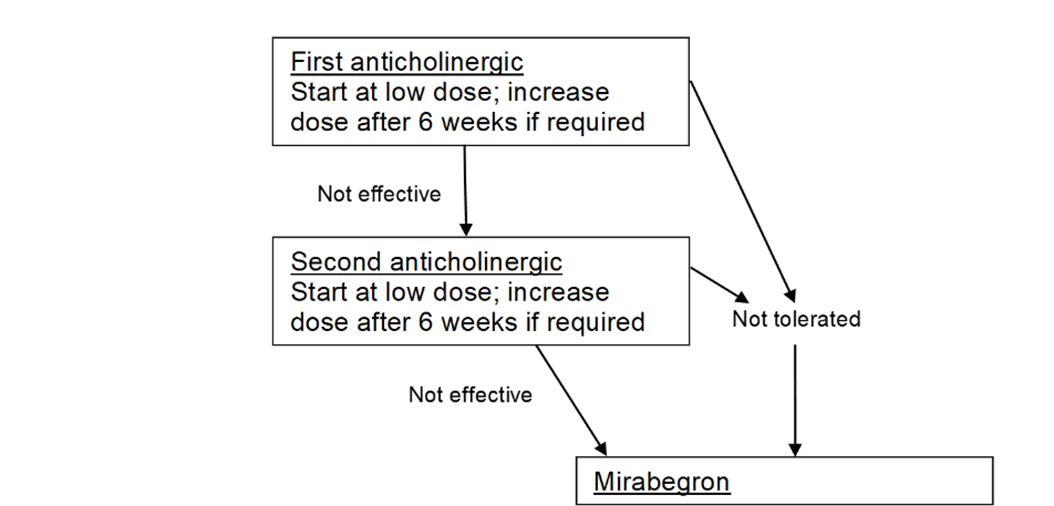
Medication should be commenced at the lowest dose and titrated up as required and tolerated.

If medication is not effective or not tolerated, the formulation should be changed.

The use of medication for overactive bladder may be limited by side effects. These may be reduced by adjusting the dose or changing the formulation / application.

Generic antimuscarinic formulations:

1st  - Tolterodine tartrate (Tablets 1mg, 2mg)

Dose:  2mg twice daily. Reduced if not tolerated to 1mg twice Daily Modified release tablets 4mg once daily

 or Solifenacin (Tablets 5mg, 10mg)

Dose:  5mg once daily. Increase to 10mg daily if required

Oxybutynin hydrochloride is no longer on the Formulary but is the only formulation available for transdermal application if oral application is not tolerated; it should not be used in patients aged over 65 due to increased risk of cognitive impairment

2nd - Fesoterodine  (Tablets 4mg, 8mg)

Dose:   4mg once daily. Increase to 8mg daily if required

OR

b3 Receptor agonist:

Mirabegron (Tablets 50mg)

Dose: 50mg once daily

If antimuscarinic formulations are contra-indicated, not effective in controlling symptoms or not tolerated, the b3-receptor agonist is an alternative option.

In patients who are already on medication with a high anticholinergic load, the b3-receptor agonist may be considered as a first line option.

The lower dose of Mirabegron 25mg is available for patients with renal or hepatic impairment.

Urogynaecology flowchart

Click for full size

Editorial Information

Last reviewed: 24/07/2025

Next review date: 24/07/2027

Author(s): Kate Darlow , Alison Hennessey.

Author email(s): obsandgynae.mailbox@borders.scot.nhs.uk.