Hypertriglyceridemia is a condition characterized by elevated levels of triglycerides in the blood, typically defined as fasting serum triglycerides >1.7 mmol/L. It can be classified as:
• Mild to moderate: 1.7–10 mmol/L
• Severe: >10 mmol/L, associated with increased risk of pancreatitis

Etiology
• Primary (genetic): Familial hypertriglyceridemia, familial combined hyperlipidemia
• Secondary causes: Obesity, poorly controlled diabetes, alcohol use, hypothyroidism, renal disease, and medications (e.g., corticosteroids, estrogens, antipsychotics)

Clinical Implications
• Increased risk of atherosclerotic cardiovascular disease (ASCVD), particularly when accompanied by other lipid abnormalities
• Severe cases increase risk for acute pancreatitis

Management
• Lifestyle: Weight loss, reduced intake of refined carbohydrates and alcohol, increased physical activity
• Pharmacologic: Statins (first-line if ASCVD risk), fibrates, and omega-3 fatty acids for severe elevations

Regular monitoring and addressing underlying causes are essential for long-term risk reduction.  

Clinics:

Lothian Hypertriglyceridaemia Guidelines (Confirmed May 2019).pdf

Who to refer, who not to refer, how to refer

Seek specialist advice:

  • If TG >10
  • TG 5–10 in a high cardiovascular risk patient not responding to statin treatment
  • Suspected familial hyperlipidaemia
  • Patients with significant hyperlipidaemia that is proving difficult to manage in primary care
  • Refer urgently to secondary care those with TG >20 not caused by alcohol or poor glycaemic control 

Who not to Refer:

Dyslipidaemia where secondary causes e.g. excess alcohol, uncontrolled diabetes, hypothyroidism, liver disease and nephrotic syndrome has not been excluded/managed

How to Refer:

Refer via diabetes inbox on SCI gateway
Primary care management

Triglycerides (TG) (mmol/L)

  • Routinely measured as part of a full lipid profile to enable LDL calculation.
  • TG testing in isolation is rarely indicated.
  • Can be elevated on a non-fasting sample due to the presence of dietary TG, consider fasting sample.
  • Very high TG levels e.g. >10mmol/L are associated with pancreatitis; increased morbidity and mortality independent of CVD risk.
  • High TGs are most commonly due to secondary causes e.g. poorly controlled diabetes mellitus, alcohol excess or medications.
  • The relationship between TG and cardiovascular risk is unclear. Overall, it is felt that raised TG still confer a small degree of additional risk.


Clinical assessment

  • Examine for any skin changes suggestive of a primary hyperlipidaemia
  • Check TFTs, fasting blood glucose, renal function, liver function, MCV and GGT
  • Consider any relevant secondary causes e.g. review medications
  • Further tests as appropriate e.g. pregnancy test, urinalysis to check for proteinuria


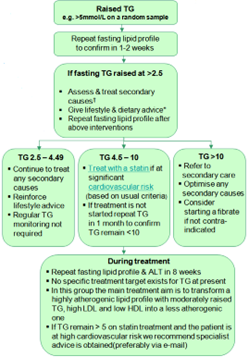
Hypertriglyceridemia flowchart

Please click for image

Flowchart Copyright NHS Lothian

  • Treat with a statin if  at significant (based on usual criteria) 


Secondary causes of raised TG

  • Alcohol excess
  • Hypothyroidism
  • Nephrotic syndrome/ renal disease
  • Immunoglobulin excessDrugs (including thiazides, non-cardioselective beta blockers, oestrogens, tamoxifen, corticosteroids)
  • Bulimia
  • Pregnancy
  • Obesity
  • Insulin resistance
  • Diabetes
  • Metabolic syndrome


Lifestyle advice

  • Weight loss, if appropriate
  • Reduce or abstain from alcohol
  • Dietary modification:
    reduce total calorie intake by minimizing intake of fats and carbohydrate
    increase intake of fish, especially oily fish
  • Smoking cessation (smoking independently increases TG levels)
  • Increase physical activity

Editorial Information

Author(s): Balakumar Muthukrishnan.

Author email(s): Balakumar.muthukrishnan2@nhs.scot.