Warning

What is it?

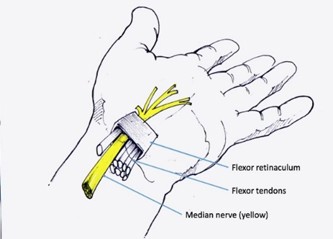
Carpal tunnel syndrome (CTS) is a condition where the median nerve is compressed where it passes through a short tunnel at the wrist. The tunnel contains the tendons that bend the fingers and thumb as well as the nerve (see diagram). CTS commonly affects women in middle age but can occur at any age in either sex. CTS can occur with pregnancy, diabetes, thyroid problems, rheumatoid arthritis and other less common conditions, but most sufferers have none of these. CTS may be associated with swelling in the tunnel which may be caused by inflammation of the tendons, a fracture of the wrist, wrist arthritis and other less common conditions. In most cases, the cause is not identifiable.

Carpal tunnel


What are the symptoms?

The main symptom is altered feeling in the hand, affecting the thumb index, middle and ring fingers; it is unusual for the little finger to be involved. Many people describe the altered feeling as tingling. Tingling is often worse at night or first thing in the morning. It may be provoked by activities that involve gripping an object, for example a mobile telephone or newspaper, especially if the hand is elevated. In the early stages the symptoms of tingling intermittent and sensation will return to normal. If the condition worsens, the altered feeling may become continuous, with numbness in the fingers and thumb together with weakness and wasting of the muscles at the base of the thumb. Sufferers often described a feeling of clumsiness and drop objects easily. CTS may be associated with pain in the wrist and forearm.

In some cases, nerve conduction tests are needed to confirm the diagnosis. Blood tests and x-rays are sometimes required.

What is the treatment?

Non-surgical treatments include the use of splints, especially at night, and steroid injection into the carpal tunnel. CTS occurring in pregnancy often resolves after the baby is born.

Surgery is frequently required. The operation involves opening the roof of the tunnel to reduce the pressure on the nerve (see diagram: the roof of the carpal tunnel is called the flexor retinaculum). The most common method involves an incision over the tunnel at the wrist, opening the roof under direct vision. In an alternative keyhole method (endoscopic release) the roof is opened with instruments inserted through one or two small incisions. The outcomes of the two techniques are similar and your surgeon can discuss the most appropriate method. The surgery may be performed under local anaesthesia, regional anaesthesia (injected at the shoulder to numb the entire arm) or general anaesthesia.

The outcome is usually a satisfactory resolution of the symptoms. Night pain and tingling usually disappear within a few days. In severe cases, improvement of constant numbness and muscle weakness may be slow or incomplete. It generally takes about three months to regain full strength and a fully comfortable scar.

Who to refer, who not to refer, how to refer

Who to Refer

  • Pins and needles in median nerve distribution (thumb/ index/middle and half of ring fingers) over 6 months  with no relief from primary care management.

Urgent Referral Criteria

  • Permanent numbness
  • Muscle wasting thenar eminence

Who Not to Refer

  • Those who have not tried primary care management.

Additional Info

  • Clinical examination of median nerve distribution + positive provocative tests:
  1. Phalen’s test – Flex wrist for 60 secs and note occurrence of in thumb/ index/ middle finger.

Note:  less sensitive than Durkan’s test.

  1. Durkan’s test - Press firmly with thumbs directly over the carpal tunnel for 30 secs and note occurrence of paraesthesia in thumb/ index/ middle finger
  2. Tinel’s test – Tap lightly over the median nerve at the wrist and look for  distal lancing paraesthesia in thumb/ index/ middle finger

Imaging

  • Nil Required.

How to refer

We accept referrals through SCI gateway for those who are based in Scotland.

We also accept e referrals through the below email address using the attached form for those who are based just on the other side of the border. 

E- Referral Email address - bor.orthoreferrals@borders.scot.nhs.uk

Referral form - E-Referral to Orthopaedics (Non Sci-Gateway)      

Primary care management

  • Patient Education – see patient information leaflet in next section
  • CTS score
  • Wrist (futuro) splints in neutral position at night time minimal 12/52

Resources and links

BSSH Patient information leaflet on Carpal Tunnel Syndrome-

https://www.bssh.ac.uk/patients/conditions/21/carpal_tunnel_syndrome

Editorial Information

Last reviewed: 31/07/2025

Next review date: 31/07/2027

Author(s): Mr Roshan Raghavan.

Author email(s): Roshan.Raghavan@nhs.scot.