Warning

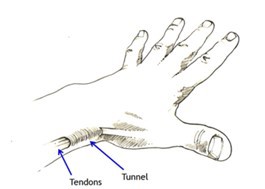
De Quervain's syndrome is a painful condition that affects tendons where they run through a tunnel on the thumb side of the wrist.

Dequervains syndrome

What is the cause?

It appears without obvious cause in many cases. Mothers of small babies seem particularly prone to it, but whether this is due to hormonal changes after pregnancy or due to lifting the baby repeatedly is not known. There is little evidence that it is caused by work activities, but the pain can certainly be aggravated by hand use at work, at home, in the garden or at sport.

What are the symptoms?

  1. Pain on the thumb side of the wrist, as shown in the diagram. Pain is aggravated especially by lifting the thumb, as in the hitchhiker position or when using scissors.
  2. Tenderness if you press on the site of pain.
  3. Swelling of the site of pain – compare it with same spot on the opposite wrist.
  4. Clicking or snapping of the tendons occurs occasionally.

What is the treatment?

De Quervain’s syndrome is not harmful, but it can be a really painful nuisance. Some mild cases recover over a few weeks without treatment.

Treatment options are:

  1. Avoiding activities that cause pain, if possible
  2. Using a wrist/thumb splint, which can often be obtained from a sports shop or a physiotherapist. It needs to immobilize the thumb as well as the wrist.
  3. Steroid injection relieves the pain in about 70% of cases. The risks of injection are small, but it very occasionally causes some thinning or colour change in the skin at the site of injection.
  4. Surgical decompression of the tendon tunnel.

The anaesthetic may be local (injected under the skin at the site of operation), regional (injected in the armpit to numb the entire arm) or a general anaesthetic. Through a transverse or longitudinal incision, and protecting the nerve branches just under the skin, the surgeon widens the tendon tunnel by slitting its roof. The tunnel roof forms again as the split heals, but it is wider and the tendons have sufficient room to move without pain.

Pain relief is usually rapid. The scar may be sore and unsightly for several weeks. Because the nerve branches were gently moved to see the tunnel, transient temporary numbness can occur on the back of the hand or thumb. Other risks are the risks of any surgery such as infection (less than one in 100 risk) or stiffness.

Who to refer, who not to refer, how to refer

Who to Refer

  • Diagnostic difficulties
  • Pain unresponsive to primary care management.

Urgent Referral Criteria

  • Nil

Who Not to Refer

  • Those who have not tried Primary care management.

Additional Info

  • Clinical tests –
  1. Pain on palpation of radial side of wrist
  2. Reduced ulnar deviation
  3. Positive Finklestein’s test

Imaging

  • Nil required

How to refer

We accept referrals through SCI gateway for those who are based in Scotland.

We also accept e referrals through the below email address using the attached form for those who are based just on the other side of the border. 

E- Referral Email address - bor.orthoreferrals@borders.scot.nhs.uk

Referral form - E-Referral to Orthopaedics (Non Sci-Gateway)      

Primary care management

  • Patient Education (see info leaflet in next section)
  • Oral +/- Topical NSAIDs (10% ibuprofen gel)
  • Thumb spica
  • Rest / Activity modification
  • CSI X 2 if person trained and possible

Resources and links

BSSH Patient Information leaflet on de Quervain’s Syndrome-

https://www.bssh.ac.uk/patients/conditions/19/de_quervains_syndrome#What_is_it_

Editorial Information

Last reviewed: 31/07/2025

Next review date: 31/07/2027

Author(s): Mr Roshan Raghavan.

Author email(s): Roshan.Raghavan@nhs.scot.