Management of the diabetic foot

Warning

Information

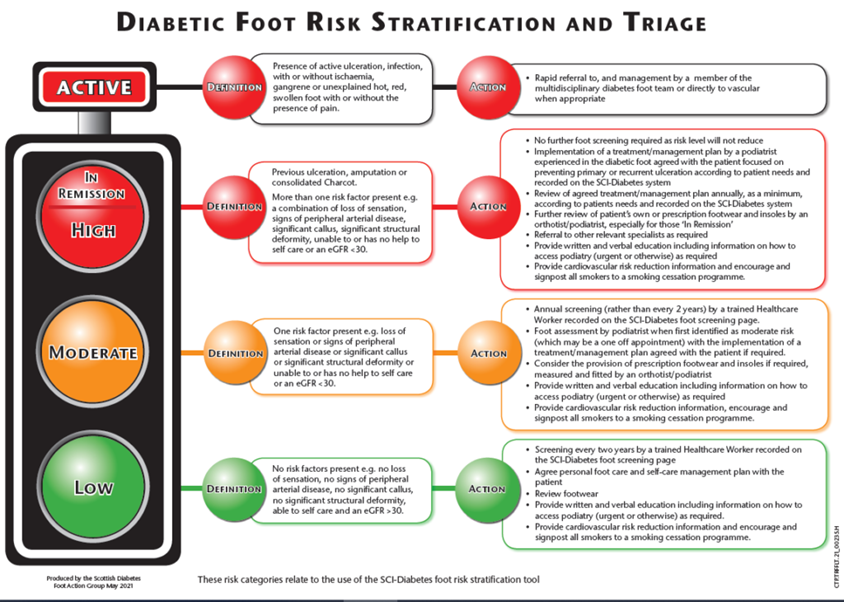
The Diabetic Foot Risk Stratification and Triage Guidelines, published by The Scottish Diabetes Foot Action Group, are used within NHS Borders to determine the most appropriate management plan. Those seen within the service are managed predominantly in the community podiatry clinics.

New referrals, and complex cases, of active ulceration are managed by our Advanced Practice Diabetes Podiatrist at our acute hospital site at Borders General Hospital.

Diabetic Foot pathway

Click for full size


Who to refer, who not to refer, how to refer

Who to Refer

Please only refer those who fall into the following categories:

  • Moderate Risk – has at least one risk factor, for example, loss of sensation, signs of peripheral arterial disease, unable to or has no help to self-care or an eGFR <30. (Refer to podiatry when first identified as moderate risk for an agreed treatment and management plan to be put in place - please note this may be a one-off appointment if assessment determines no current ongoing podiatric need).
  • High Risk – more than one risk factor present (if not already attending NHS podiatry)
  • In Remission – has had previous ulceration, amputation or a consolidated Charcot joint (if not already attending NHS podiatry).
  • Active foot disease – has current ulceration (urgent referral).

If a person has a limb-threatening or life-threatening diabetic foot problem, refer them immediately to acute services. Examples of limb-threatening and life-threatening diabetic foot problems include the following:

  • Ulceration with fever or any signs of sepsis.
  • Ulceration with limb ischaemia (see the NICE guideline on peripheral arterial disease).
  • Clinical concern that there is a deep-seated soft tissue or bone infection (with or without ulceration).
  • Gangrene (with or without ulceration)

For all other active diabetic foot problems, refer the person within one working day to the podiatry department for triage.

Who Not to Refer

  • Low risk or newly diagnosed individuals who do not have a podiatric need – any appropriately trained healthcare professional or clinical support worker can carry out foot screening.

How to Refer

Refer via SCI Gateway or ask patient to complete self-referral form here: podiatry-self-referral.docx (live.com)

Primary care management

If infection is suspected in an active foot ulcer at presentation to Primary Care service, please ensure a tissue/bone sample or swab is obtained prior to prescribing empiric antibiotics.

Any wound should be covered with an appropriate dressing and kept dry until attendance at the podiatry clinic.

See Foot Ulceration RefHelp page

Resources and links

Training, including an online module, for conducting diabetic foot assessments can be found at www.diabetesframe.org

Patient information leaflets for risk categories and other specific conditions can be found and downloaded from www.diabetesinscotland.org.uk

SIGN Guideline – Management of Diabetes: https://www.sign.ac.uk/assets/sign116.pdf

NICE Guideline – Diabetic Foot Ulcers: https://www.nice.org.uk/guidance/ng19/chapter/Recommendations#diabetic-foot-ulcer

NICE Guideline – Peripheral Arterial Disease: Overview | Peripheral arterial disease: diagnosis and management | Guidance | NICE

Information videos:

CPR For Feet – YouTube

SoleSafe Instructional Video (Scotland)

HeelSafe Instructional Video (Scotland)

FootSafe Instructional Video (Pre Inflated)

Local service details

Podiatryadmin@borders.scot.nhs.uk

Editorial Information

Last reviewed: 29/05/2024

Next review date: 29/05/2026

Author(s): Laura Bolan.

Author email(s): laura.bolan3@nhs.scot.