Warning

Examples of nail disorders include:

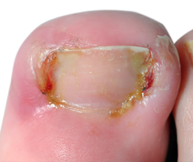
Onychocryptosis (Ingrowing Nail)

ingrowing nail

An ingrowing toenail is where a piece of nail pierces the flesh of the toe. It can be extremely painful and inflamed or infected.
Ingrowing toenails most commonly affect the big toenail but can affect the other toes too. A nail that is curling (involuted) into the flesh, but is not actually piercing the skin, is not an ingrowing toenail but can be very painful and can also appear red and inflamed.

Paronychia and Retronychia

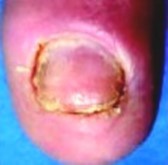
paronychia

Paronychia: Pain and tenderness to the toe at all sides of the toenail and on top of the toenail. Surrounding skin can be red and inflamed. In some cases, this can become infected.

Retronychia is linked with recurring paronychia. The nail will split close to the cuticle and ingrow into the nail fold. Usually a split is noted and/or redness at the cuticle and/or exudate.

Involution

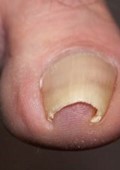
Involution

Pain and tenderness to the sides of the toenail as well as the tip of the toe. Nail curvature is exaggerated and can look C shaped when viewing from the apex. This can often be confused with an ingrowing nail. These nails can often be managed with good personal foot care. 

Subungual Exostosis

Exotosis

A subungual exostosis is an isolated slow‐growing benign osteochondral outgrowth from the distal phalanx, which arises from under the nail. The big toenail is affected in three-quarters of cases. A firm nodule develops from beneath the nail bed. The nodule usually grows slowly over weeks to months and develops a thick hyperkeratotic surface. As it enlarges the nodule causes the nail plate to separate from the bed.

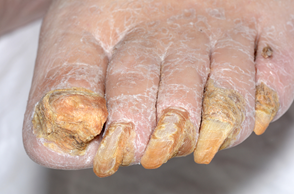
Thickened and overgrown nails

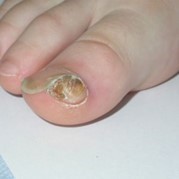
Thickened nails

Often characterised with thickening of the nail plate as well as discolouration. This is caused by a prolonged period where no personal foot care has been attempted. Often these are successfully self-managed once the length and thickness has been addressed on a one-off basis. Can often be prevented by good personal foot care. 

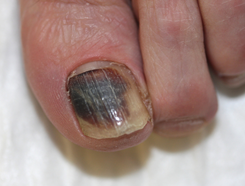
Subungal Haematoma

Haematoma

Deep red/black discoloration under the toenail plate often following a trauma. In acute phase can be very tender to touch with inflammation of the surrounding skin seen. Once the acute phase has passed then often there is no pain. There is a clear demarcation line where new healthy nail grows. It can take up to 1yr for a new healthy nail to regrow. No management required. 

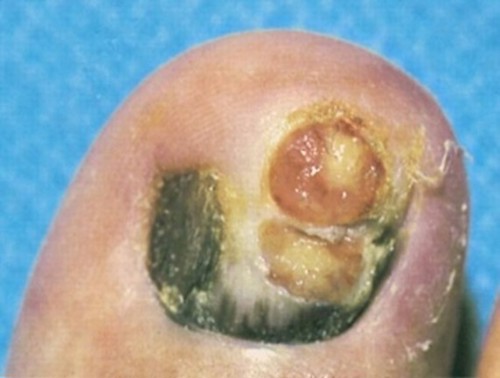
Subungal Ulceration

Ulceration

This can be painful however often they are asymptomatic particularly in those with altered protective sensation. A break in the skin occurs under the nail plate. Often a soft, spongy layer is noted, and discharge is evident. There may be some swelling of the surrounding skin particularly if the site is infected. 

Who to refer, who not to refer, how to refer

Who to Refer

·       In-growing nails (onychocryptosis)

·       Symptomatic or infected curved or pincer type nails (involution)

·       Paronychia/Retronychia

·       Rams horn nails (onychogryphosis)

·       Suspected subungal ulceration or subungal exostosis

·       Thickened and overgrown/neglected nails – note that this may be a one-off appointment to get nails to a point where they can be managed as personal care (patient may need family or carers to assist with maintaining as part of personal care).

Urgent Referral Criteria

Patients with any of the above nail conditions who have Diabetes (moderate or high risk on SCI-DC screening) and/or PVD should be referred urgently to the Podiatry Community Service.

Who Not to Refer

·       Basic personal foot care and nail cutting requests without medical need (age or being unable to reach feet are not examples of medical need.)

·       Asymptomatic nail pathology in healthy individuals

·       Fungal nail infections, including taking clippings for testing

·       Suspected subungual melanomas. These should be referred urgently to dermatology.

How to Refer

·       Refer via SCI Gateway or ask patient to complete self-referral form here: podiatry-self-referral.docx (live.com)

Additional Info

For some nail conditions the recommended treatment plan may be nail surgery with either partial or full removal of the nail.  Patients will always be brought in for assessment initially and would not be offered nail surgery as part of their first appointment.

Patients under the age of 12 years can be assessed for nail surgery by our department but whether they are suitable will be decided on an individual basis and they may need to be referred onto the hospital team for the procedure to be carried out.


Primary care management

Ingrowing nails, paronychia and infected involuted nails

Provide patient information leaflet for ingrown nails, if symptoms do not resolve within 7-14 days or worsen refer, or advise patient to self refer to podiatry.

If an ingrowing nail is infected, prescribe appropriate antibiotic and make an urgent referral.


Resources and links

National and local websites for further information

NHS Borders patient information links:

Personal Footcare Guidance – NHS GGC have created a detailed video on personal footcare that can be accessed through YouTube, it is a good resource for patients to use for learning about self-care of their feet.

Personal Footcare - YouTube link


Local service details

Editorial Information

Last reviewed: 29/05/2024

Next review date: 29/05/2026

Author(s): Laura Bolan.

Author email(s): laura.bolan3@nhs.scot.