


Warning

What to do if someone has a fall

Falls Risk bundle should be completed within 24 hours of admission for all patients and re-assessed if patient falls, their condition deteriorates or following transfer.

ABCDE assessment prior to movement including.

Don’t move patient until they have been checked for signs/symptoms of fracture or potential spinal injury.

Top to toe assessment for injury by nursing staff or doctor.

Make a plan to get patient safely off the floor.

All falls to be reported to medical team at time of fall.

Where head injury is suspected or has occurred, GCS must be recorded, frequency and duration to be based on medical guidance.

DATIX and Appendix A to be completed.
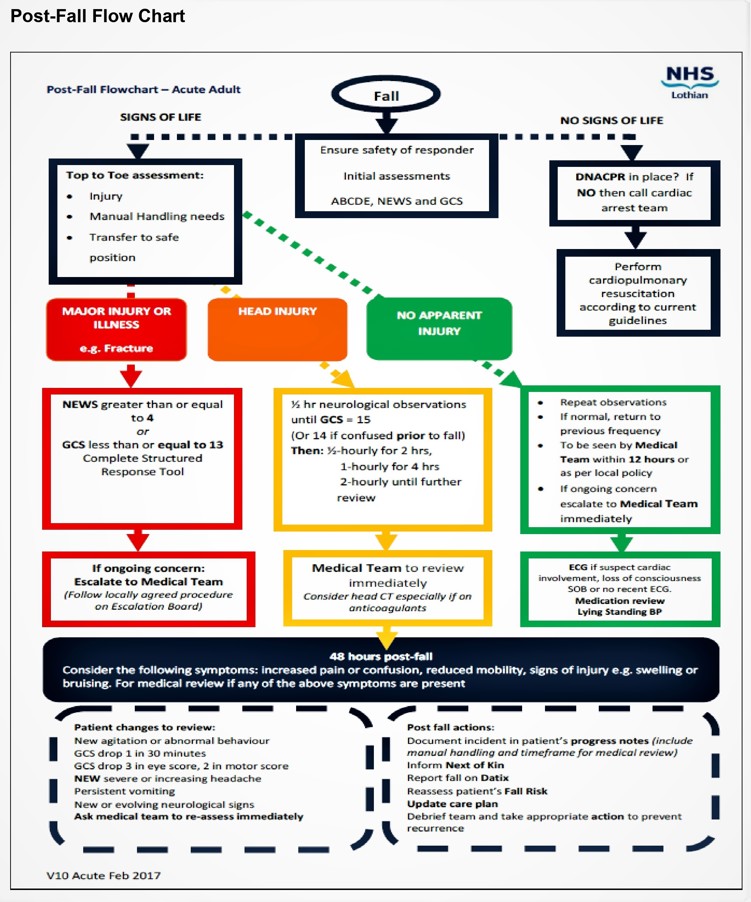
Post-fall flowchart, acute adult

The flow chart, below, can also be opened as a picture. Click here for the picture, it will open in a new tab.

Picture of the Post fall flow chart
Diagram: post-fall flow chart.

Top to toe survey

Please note that the table below may need to be scrolled horizontally or vertically in order to view all information, depending on your device.


What to look for

Skull

Scalp wound / haematoma

Depression / ridge in skull

Eyes Pupils - ? equal and react to light
Ears Discharge / bleeding
Nose Discharge / bleeding
Skin

Colour / laceration /graze

Bruising / bleeding

Mouth Bitten tongue / dislodged teeth or dentures
Neck and Spine

Tenderness/tingling or weakness in limbs

If concerns over neck or spinal injury don’t move

Chest and collarbones/ ribs Difficulties breathing
Abdomen Tenderness
Pelvis

Pain on pressing over hip / groin

Blood in urine / catheter

Arms and legs

Deformity

Joint movements – range and pain

Editorial Information

Last reviewed: 12/01/2026

Next review date: 12/01/2027

Author(s): Lizi Trafford.

Author email(s): Lizi.Trafford@nhs.scot.

Approved By: Jennifer Baxter

Reviewer name(s): Lizi Trafford.