



  1. Right Decisions
  2. Endoscopy
  3. Back
  4. Quantitative Faecal Immunochemical Testing (qFIT) for patients with new lower gastrointestinal symptoms
  5. Supporting information

Supporting information

Local implementations and pathways:

The implementation and pathways for qFIT testing needs to be agreed at a local Health Board level including for timing of referral (i.e. with result, pending result or secondary care arranging qFIT), initial and repeat qFIT testing or managing symptomatic patients where no qFIT is received. Local procedures and implementation of the recommendations are not within the scope of this document.


Suggested areas to discuss are as follows:

  • A qFIT may happen for another reason out with the remit of this guidance. In these cases, local arrangements should be made between primary and secondary care. Positive qFITs in these cases must be referred in as outlined above.
  • Circumstances where a referral may be regraded.
  • Timing of second qFIT test.
  • Responsibility for review and secondary testing if initial qFIT is under 20mgHb/g.
  • Management of non-returned/inadequate qFIT tests in qFIT pending referrals.
  • Strategy to adopt primary or secondary care testing as applicable.
  • There should be recognition of local endoscopy provision and capacity.


In patients with persistent abdominal pain (4 weeks) and weight loss (5%) cross sectional imaging should be considered as a first line investigation because of the likelihood of other abdominal and pelvic cancers. qFIT will guide the requirement for further luminal investigation, although, it is accepted there is limited data available to define this further.
Timing of the second qFIT

The current guidance recommends a repeat qFIT within 6 weeks of the first. There are no randomised control trials advising the timing of the second qFIT. NHS Lothian data reports a second FIT completed in 77% of patients where it was requested at a median of 13 days (17-45) following the first qFIT.7 NHS Greater Glasgow & Clyde data reports that a second qFIT still adds clinical value if performed within 12 months of the first, although the local advice recommends 6 weeks.8

The clinical consensus was a repeat in 6-8 weeks.

qFIT threshold for USC referral; impact of increasing USC qFIT threshold to 20µgHb/g faeces:

If cancer diagnosis delays are to be reduced, a further optimisation of the triage process requires consideration. It is understood that improving the pathway for many patients may delay the diagnosis of some within the current resource constraints.

Symptoms alone are unreliable predictors of those who may have a diagnosis of colorectal cancer.9 qFIT is therefore imperative in the triage process. In 2020, Scotland recommended qFIT as a support to clinical expertise to prioritise Lower GI. Subsequent publications report that qFIT at a threshold of ≥10µgHb/g faeces yields a sensitivity and Positive Predictive Value (PPV) of 84% and 5.5% respectively, for a colorectal cancer diagnosis.10 The addition of secondary care triage increases the sensitivity and PPV to 94.7% and 9.4% respectively.11

Similar data has been published for secondary care administered qFIT. A single qFIT at a threshold of ≥10 µgHb/g faeces yielding a sensitivity and PPV for colorectal cancer of 84% and 10.5%

The addition of a second qFIT (highest result used) increases the sensitivity and PPV to be 96.6% and 10.4%.7

At a threshold of ≥10mgHb/g faeces and single testing, 11 patients will undergo a colonoscopy to diagnose one colorectal cancer. Increasing the threshold to 20mgHb/g faeces reduces the number needed to scope to diagnose one colorectal cancer to 9. The biggest impact, however, is the reduction in USC colonoscopy demand by 20% with a reduction in waiting times for the majority of higher risk patients. The impact of raising the threshold of a single qFIT is a fall in sensitivity falls from 94.7% to 91.0%. This can be offset by double testing patients who remain symptomatic with a qFIT test below 20mgHb/g faeces.

As Scotland doesn’t currently include age in the colorectal cancer algorithm, it is anticipated that the impact of increasing the qFIT threshold may be less than anticipated.

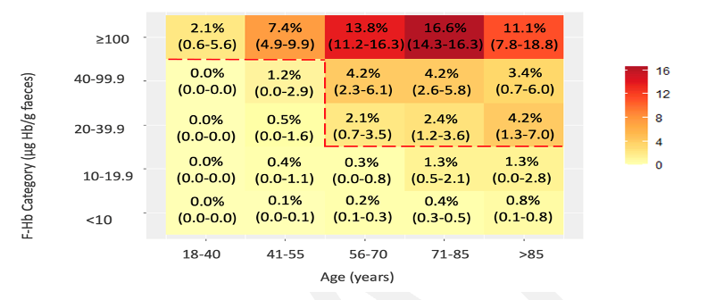
Preliminary data from NHS Tayside presented at the qFIT event reporting the colorectal cancer PPV by qFIT level for 34,353 patients, evidenced that except for those patients over 85 years, the PPV of colorectal cancer was below 3% at a single qFIT. This data has now been published in full.21

Heat map of 1-year cumulative colorectal cancer risk by FIT category. Tayside data

Heat map of colorectal cancer risk by FIT category

As further data is published double, qFIT may have an impact on reducing the potential missed colorectal cancers with a FIT threshold of 20µgHb/g faeces. One paper has reported a 2.3% reduction in missed colorectal cancer cases using a double qFIT protocol at a threshold of 20µgHb/g.7 However, the workforce and financial requirements to achieve this are substantial.

FIT threshold and Iron Deficiency Anaemia

A number of publications evidence an increase in colorectal cancer in the presence of iron deficiency anaemia (IDA).12-14 However, in keeping with earlier publications, NHS Fife presentation reported low colorectal cancers numbers at a threshold of 20µgHb/g faeces. The PPV of colorectal cancer with a FIT10-19µgHb/g faeces and IDA was 1.1%.20


Colorectal cancers and qFIT threshold of anaemia. Fife data (3 year follow up).

  All IDA (asymptomatic and symptomatic)

qFIT µgHb/g Total number of patients colorectal cancer              numbers PPV for colorectal          cancer %
 <10  1226  7  0.6
 10-19  177  2  1.1
 20-49  148  7  4.7
 50-100  92  9  9.8
 100-399  93  16  17.2
 >400  129  45  34.9


Although conflicting qFIT results are more likely in the presence of anaemia, data from NHS Lothian presented at the event, reported that the risk of a missing colorectal cancer was low if 2 qFIT results were ≤10µg/gHb. Data on the value of double FIT at a threshold of 20µgHb/g faeces was not presented. 


Double qFIT and anaemia. Lothian data

FIT result All Not anaemic Anaemic
N CRC CRC Prev NNI N CRC CRC Prev NNI
<10, <10 3327 2683 4 0.1% 671 447 1 0.2% 447
<10, >10 343 242 2 0.8% 121 75 1 1.3% 75
>10, <10 369 274 1 0.4% 274 80 2 2.5% 40
>10, >10 568 373 45 12.2% 8 165 30 18.2% 6
  4607 3572 52 1.5% 69 767 34 4.4% 23


Looking beyond Scotland, Nottingham NHS Trust, reported that as long as the abdominal and rectal examinations were normal, a qFIT ≥100mg/µgHb in the presence of iron deficiency anaemia was required to yield a PPV of 3% (NG1219) for colorectal cancer in those under 70 years.15

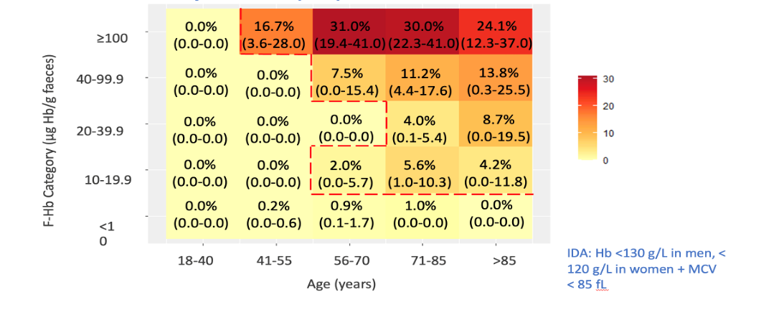
A PPV of 3% (NG1219) for colorectal cancer in those under 70 years.15 The data also supports no lower gastrointestinal investigations for patients with IDA and a FIT<10mgHb/g faeces as the risk of colorectal cancer as ≤1% across all ages.15 This data was reproduced in Tayside and presented at the Scottish 2024 qFIT event. The results are provided in the heat map of 1-year cumulative colorectal cancer risk by FIT category for patients with iron deficiency anaemia. 

Heat map of 1-year cumulative colorectal cancer risk by FIT category for patients with iron deficiency anaemia. Tayside

Heat map of 1-year cumulative colorectal cancer risk by FIT category for patients with iron deficiency anaemia. Tayside

In the absence of age stratification it was agreed that all patients with iron deficiency anaemia and a qFIT ≥10mg/gHb should be triaged separately from patients with other lower gastrointestinal symptoms.

The NICE qFIT guidance16 and NICE iron deficiency anaemia guidance17, published after the BSG guidance18, removed the recommendation for gastrointestinal investigation if the qFIT is <10mgHb/g faeces.

Our Scottish consensus recommends a second qFIT. A threshold was agreed of ≥20mgHb/g faeces for USC priority referral. Secondary care should provide the additional triage required for those with qFIT < 20mgHb/g faeces.