

 Gastroenterology
Dysphagia is defined as difficulty swallowing. It is a condition that can occur at any age but is more common in older adults. Dysphagia can be painful and, in some cases, swallowing may be impossible.

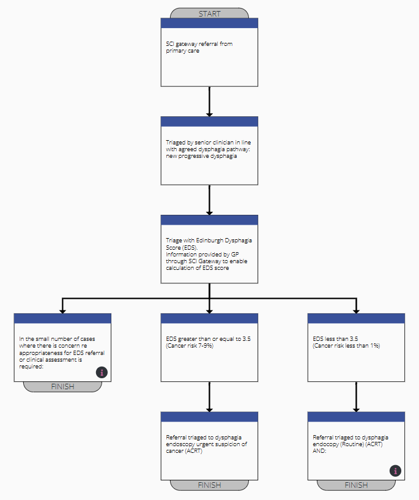
Click on the image below to open the pathway
Patient information leaflet (provided by your NHS Health Board)
NHS inform illnesses and conditions: Dysphagia (swallowing problems)
NICE guideline CG184: Gastro-oesophageal reflux disease and dyspepsia in adults: investigation and
management 2019 [Accessed 03/09/2025]
Beaton DR, Sharp L, Lu L, et al. Diagnostic yield from symptomatic gastroscopy in the UK: British Society of Gastroenterology analysis using data from the National Endoscopy Database. Gut. 2024 Aug 8;73(9):1421-1430. DOI: 10.1136/gutjnl-2024-332071
 @NHSScotCfSD
 Centre for Sustainable Delivery
 Scan the code to visit the CfSD website

