

  1. Right Decisions
  2. GGC - Clinical Guidelines
  3. Gynaecology
  4. Gynaecology guidelines
  5. Back
  6. Guidelines A-Z (all Gynaecology guidelines)
  7. Vulval Intraepithelial Neoplasia (VIN), management and follow-up (1230)

Vulval Intraepithelial Neoplasia (VIN), management and follow-up (1230)

Warning

Objectives

To provide a pathway for the diagnosis, management and follow up for women diagnosed with VIN (vulval intraepithelial neoplasia).

Audience

All Healthcare workers in primary and secondary care involved in the care of women with VIN

Vulval Intraepithelial Neoplasia (VIN) is a premalignant condition affecting the vulva.

The typical presentation can be with vulval itch or the persistence of a vulval lesion.  It can be unifocal or multifocal. 

Terminology and Classification

The current WHO guidance (2020) classifies VIN into HPV (Human Papilloma Virus) associated and HPV independent lesions.  When histopathology suggests VIN, immunohistochemistry testing for p16 (surrogate marker for HPV) and p53 are recommended to assist with classification [3]. 

A summary table outlining VIN terminology, classification and risk of progression to vulval squamous cell carcinoma (VSCC) is presented in Table 1.

LAST (Lower Anogenital Squamous Terminology) criteria [1] and WHO [2] recommend the terms low grade squamous intraepithelial lesion (LSIL) and high grade intraepithelial squamous lesion (HSIL).

However in the UK, VIN1, 2 and 3 are well understood by clinical teams and are therefore still acceptable terms [3]. 

HPV associated VIN

HPV associated VIN lesions may be multifocal and also seen in other areas such as the cervix (CIN), vagina (VaIN), perianal (PaIN) and anal areas (AIN).

  • LSIL corresponds with condyloma and viral change (previously VIN1). Low grade VIN is relatively uncommon in the vulva other than condyloma (genital warts).  There is neither evidence that the VIN 1-3 morphologic spectrum reflects a biologic continuum nor that VIN 1 is a cancer precursor [10].  Essentially, LSIL (VIN1) is associated with low-risk forms of HPV, rarely become cancerous and can resolve without treatment.  They should be managed as viral warts/condyloma.
  • HSIL corresponds with VIN2 & VIN3.

In those with HSIL, concurrent VSCC may be present in up to 20% [5].

HPV independent VIN

This describes the pre-malignant changes to the squamous cells which are not mediated by HPV. These usually occur on a background of dermatoses, most commonly vulval Lichen Sclerosus, and occasionally, Lichen Planus [7]. 

HPV independent VIN is more commonly seen in older women, and is not seen as frequently as HPV associated VIN, accounting for approximately 5% of all cases of VIN [11, 12].

In those with HPV independent VIN, there is a higher rate of progression to VSCC, with some estimations of 50% over 10 years [5].  Additionally, it is estimated that the incidence of concurrent VSCC at time of diagnosis may be as high as 50- 60% in those with HPV independent VIN.

HPV independent lesions are considered in two main categories.

  1. HPV independent, P53 mutant VIN (differentiated VIN (dVIN)) – characterised by abnormal maturation and basal atypia. The majority of cases are associated with an aberrant/mutational pattern of p53 on immunohistochemistry. These lesions are not graded as they are generally regarded as a ‘high grade’ precursor lesions by default and associated with a higher risk of progression to HPV independent SCC and risk of subsequent VIN recurrences than HPV associated disease.
  2. HPV independent, p53 wild type VIN. This is a rare lesion with a range of terminologies (lack of agreement internationally). Most recent suggested terminology is Verucciform Acanthotic VIN or vaVIN [4]. Pathological diagnosis is difficult as there is some overlap with other hypertrophic inflammatory conditions. It is however, recognised to be a precursor of HPV independent squamous cell carcinoma. 


HPV ASSOCIATED VIN (~95%)

HPV INDEPENDENT VIN (~5%)

Background disease/risk factors

High risk HPV types

Younger age of woman

Smoking, impaired immunological status, sexual partners

Can be multifocal/ multicentric (associated with other in situ neoplasia  e.g. cervix, anal, vaginal)

Association with LS and other inflammatory dermatoses

Older age of woman

Typically unifocal and unicentric

Grade/Terminology (UK accepted) 

HPV associated VIN 

Low grade – VIN1/condyloma

High grade – VIN2 or VIN3

LSIL and HSIL may be added as recommended in WHO but is not mandatory

LSIL = VIN1 or condyloma

HSIL = VIN 2 or 3


HPV independent, P53 mutant VIN (Differentiated VIN, dVIN)

All ‘high grade’

HPV independent, P53 wild type VIN (no agreed terminology -  suggested Veruciform acanthotic VIN or VaVIN)

Ancillary tests

P16 block positive (surrogate marker of HPV)

P53 mutant pattern

P16 negative

P53 wild type

P16 negative

Prevalence of occult VSCC at diagnosis

Approximately 3-4% [6]

Uncertain, some studies suggest up to 60%[6]

uncertain

Risk of progression

Approximately 10% of high grade VIN progress to VSCC within 10 years without treatment (5) Slower rate of progression than HPV independent lesions

Higher risk of progression and faster than HPV associated lesions (approximately 50% within 10 years)(5)

Probable Intermediate risk of progression but given rarity further studies required.

Table 1 Summary of VIN terminology, classification and risk of progression to VSCC

HSIL: High grade squamous intraepithelial lesion, LSIL: low grade squamous intraepithelial lesion, VIN: vulval intraepithelial neoplasia, VSCC vulval squamous cell carcinoma,  HPV: Human Papilloma Virus
Progression to Vulva Squamous Cell Carcinoma (VSCC)

The risk of progression to cancer is influenced by the type of lesion.  In all types of lesion, the risk of progression is greater in women who do not undergo treatment.

HPV associated VIN 2 or VIN 3 (HSIL)

In those with HPV associated high grade VIN 2 or VIN 3, it is estimated that up to 10% may develop VSCC at 10 years if untreated [5].

Additionally in those with HPV high grade VIN and a background of vulval Lichen Sclerosus (VLS), this risk may be higher at approximately 38% [5].

HPV independent VIN

In those with HPV independent VIN, there is most commonly a background of vulval Lichen Sclerosus.  It is estimated that there is an approximate 2-4% lifetime risk of developing VSCC on a background of VLS.  More recently it has been suggested, that in those where VLS is quiescent and controlled with maintenance steroid therapy, there may be a reduction in risk of progression to VSCC to around 1-2% lifetime risk [8].   Incidence of VSCC on background of vulvo-vaginal Lichen Planus is low, estimated at approximately 0.3% [6]

The number of women who develop non- HPV related VIN is small accounting for approximately 5% of all VIN cases [11, 12].  However, the risk of developing VSCC on a background on HPV independent VIN has been estimated at 50% over 10 years [5, 7], with approximately 50- 60% of women with HPV independent VIN having concurrent VSCC at time of diagnosis.

Diagnosis

If there is a suspicion of VIN or VSCC, diagnosis should be first established with a punch biopsy rather than excision biopsy.  For details please see vulval punch biopsy guideline. Indications and procedure for obtaining a vulval punch biopsy (1175) | Right Decisions

Treatment options

Low grade lesions

The Management of LSIL (VIN1, condyloma, viral changes) is different from HSIL (VIN 2/VIN3).  The management of genital warts within GG&C is outlined in the document Sandyford Guidelines: EXTERNAL ANOGENITAL WARTS

High grade lesions

Where a high grade lesion is found on punch biopsy, subsequent management should be via a clinician with a specialist interest in Vulval Disease.

Surgical removal

Surgical removal of VIN should be used first line where there is a clinical suspicion of underlying VSCC, even if it is not found on punch biopsy. 

HPV independent VIN is not Imiquimod sensitive and therefore treatment should only be by surgical removal. 

Localised excision or wide local excision (WLE) with a clear margin is an appropriate option for the management of VIN [9].  Previous guidelines suggested a margin of 2cm, however, this is now outdated as recurrence commonly occurs at another site from the original lesion [14].

Advantages of surgical excision include pathological examination of lesions excluding co-existing VSCC.  The aim to reduce disease burden and reduce symptoms for the patient.

Primary direct closure of the surgical excision site may be possible.  However, women should have access to reconstructive surgical input to maintain function including sexual function, help reduce tension and pain in scars, and reduce psychological impacts [9].

Laser

Laser vaporisation is a recognised alternative surgical technique.  It is however, not currently offered within GG&C.

Topical Imiquimod 5% cream

Where topical treatment for HSIL (VIN2 /VIN3) associated with HPV is preferred, the treatment of choice is Imiquimod 5% cream.  Emerging evidence suggests Imiquimod is a safe, effective, and well accepted alternative to surgery for women with vulval HSIL.  It does not appear to be inferior to surgery in terms of clinical response rates, and can be considered as first-line treatment [15, 16].

Imiquimod 5% cream is a Toll-like receptor 7 agonist (TLR-7), and acts as an immune response modulator.  Application of cream induces an inflammatory pathway and cellular immune response in the skin.  This type of treatment is only suitable for HPV associated VIN.

Due to the risk of unrecognised VSCC, it is suggested that adequate biopsy sampling is required prior to commencing treatment to reduce the risk of missing occult VSCC.

The use of topical immiquimod 5% cream can be limited by side effects of intense inflammatory response and erosion of the skin. 

Imiquimod 5% cream is currently used ‘off licence’ for HPV associated VIN.  This treatment should be commenced under the care of vulval specialist team only to allow support and adequate follow up.

A suggested regime is outlined below, however, modification of this regime is common due to side effects. 

  • Apply a thin layer to lesions overnight, initially once weekly for 2 weeks, twice weekly for 2 weeks, and then three times weekly if tolerated, until lesions are resolved for a maximum of 16 weeks.
  • The cream should be left on for 8-10 hours and is therefore best applied overnight.
  • It should be washed off with water and an emollient soap substitute.
  • It is useful to apply a simple barrier ointment to the surrounding normal skin to give some protection.

The role of repeated courses of Imiquimod cream application is unknown.

Topical 1% Cidofovir gel

Data suggests Cidofovir 1% topical gel may result in a clinical response similar to Imiquimod 5% cream.  However, it is still under investigation for the longterm outcomes and is not yet in routine use in GG&C for the treatment of HPV associated VIN 2 or 3.

The role of Smoking cessation

This is particularly important, as the immunosuppressant effect of smoking can affect the ability to clear the HPV virus and reverse the pre-malignant changes.

The role of screening for HIV

The British Gynaecological Cancer Society (BGCS) suggest that HIV testing should be offered to those with multicentric HPV related disease [6].

The role of HPV Vaccination

HPV mediated VIN and VSCC, is associated high risk HPV strains, with local data suggesting most commonly HPV 16 [11].  This will mean a cohort of younger population will be vaccinated against this virus.  However, as the time to development of HPV mediated VIN and VSCC is often decades from initial exposure, it is estimated the impact on vulval disease will take many more years to become apparent [6].

The HPV vaccine has been proposed in the treatment and reduction in recurrence of HPV associated VIN.  However, this is currently at research stages, and at the moment evidence is insufficient to support HPV vaccine in secondary prevention.[6]

Follow up regime

There is no standard evidence based follow up regime.  However, patients need to be seen at a face to face clinic appointment for examination.  Clinical photography can be helpful for monitoring.  Patient photographs without in person examination is not recommended. [6]

All patients should be taught self-examination and know to report and new lesions for reassessment.

The suggested follow up regime is outlined below.

HPV associated VIN.

These women should be seen 6 monthly for the initial 2 years, and annually thereafter for a total 5 years from date of completion of treatment. Patients can be discharged if there is no recurrence. 

Smokers are at higher risk of developing recurrence/new lesions and should be counselled appropriately.

Where, HPV associated VIN is found on a background of LS, progression to VSCC at 10 years is approximately 38%, therefore follow up should be extended in this population.

HPV independent VIN

Due to the increased risk of progression to VSCC, these women should be kept under review for at least 5 years following completion of treatment.  Suggested regime would be 6 monthly for the initial 2 years, then annually. 

However, discharge from follow up will be influenced by control of the underlying skin condition, as many may have difficult to manage Vulval Lichen Sclerosus, with the associated risk of recurrent VIN.  Therefore, this set of women will need long term follow up at least annually. 

Self-Examination    

All patients should be encouraged to undertake self-examination with the aid of a mirror and should be supported in clinic with demonstration of their own specific anatomy, which may be distorted following treatment. 

If new lesions are identified, they should be encouraged to attend for review, examination and consideration of repeat biopsy.

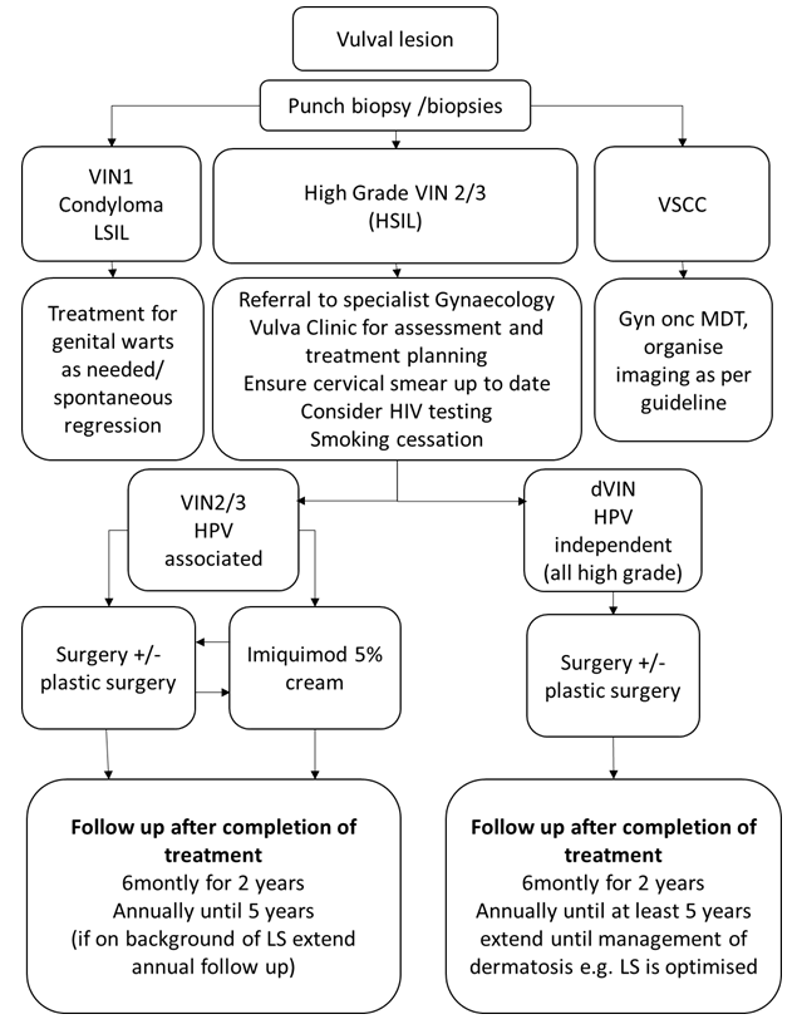
Summary Diagram for the diagnosis and management of VIN

Editorial Information

Last reviewed: 24/09/2025

Next review date: 30/09/2030

Author(s): Dr Claire Higgins, Consultant O&G, QEUH.

Version: 1

Co-Author(s): Dr Nadeem Siddiqui, Consultant Gynaecology Oncology, GRI, Dr Sarah Bell, Consultant Gynaecological Pathologist GG&C.

Approved By: Gynaecology Clinical Governance Group

Document Id: 1230

References
  1. Darragh TM, Colgan TJ, Cox JT, Heller DS, Henry MR, Luff RD, McCalmont T, Nayar R, Palefsky JM, Stoler MH, Wilkinson EJ, Zaino RJ, Wilbur DC; Members of LAST Project Work Groups. The Lower Anogenital Squamous Terminology Standardization Project for HPV-Associated Lesions: background and consensus recommendations from the College of American Pathologists and the American Society for Colposcopy and Cervical Pathology. Arch Pathol Lab Med. 2012 Oct;136(10):1266-97. doi: 10.5858/arpa.LGT200570. Epub 2012 Jun 28. Erratum in: Arch Pathol Lab Med. 2013 Jun;137(6):738. PMID: 22742517.
  2. International Agency for Research on Cancer. World Health Organization Classification of Tumours—Female Genital Tumours. 5th edition. IARC: Lyon, 2020.
  3. RCPath (2023) Dataset for histopathological reporting of vulval carcinomas 2023
  4. Parra-Herran, C., Nucci, M.R., Singh, N. et al. HPV-independent, p53-wild-type vulvar intraepithelial neoplasia: a review of nomenclature and the journey to characterize verruciform and acanthotic precursor lesions of the vulva. Mod Pathol 35, 1317–1326 (2022).
  5. Thuijs NB, van Beurden M, Bruggink AH, Steenbergen RDM, Berkhof J, Bleeker MCG. Vulvar intraepithelial neoplasia: Incidence and long-term risk of vulvar squamous cell carcinoma. Int J Cancer 2021; 148: 90–8
  6. British Gynaecological Cancer Society (BGCS) vulval cancer guidelines: An update on recommendations for practice 2023  Morrison, Jo et al.  European Journal of Obstetrics and Gynecology and Reproductive Biology, Volume 292, 210 - 238
  7. Voss FO, Thuijs NB, Vermeulen RFM, Wilthagen EA, van Beurden M, Bleeker MCG. The Vulvar Cancer Risk in Differentiated Vulvar Intraepithelial Neoplasia: A Systematic Review. Cancers (Basel). 2021 Dec 7;13(24):6170. doi: 10.3390/cancers13246170. PMID: 34944788; PMCID: PMC8699429.
  8. Lee A, Bradford J, Fischer G. Long-term Management of Adult Vulvar Lichen Sclerosus: A Prospective Cohort Study of 507 Women. JAMA Dermatol.2015;151(10):1061–1067. doi:10.1001/jamadermatol.2015.0643
  9. RCOG. Management of vulval skin disorders (Green Top Guideline No.58). 2011.
  10. Sideri M, Jones RW, Wilkinson EJ, Preti M, Heller DS, Scurry J, Haefner H, Neill S. Squamous vulvar intraepithelial neoplasia: 2004 modified terminology, ISSVD Vulvar Oncology Subcommittee. J Reprod Med. 2005 Nov;50(11):807-10. PMID: 16419625.
  11. Wakeham K, Kavanagh K, Cuschieri K, Millan D, Pollock KG, Bell S, Burton K, Reed NS, Graham SV. HPV status and favourable outcome in vulvar squamous cancer. Int J Cancer. 2017 Mar 1;140(5):1134-1146. doi: 10.1002/ijc.30523. PMID: 27864932.
  12. Thuijs NB, van Beurden M, Bruggink AH, Steenbergen RDM, Berkhof J, Bleeker MCG. Vulvar intraepithelial neoplasia: Incidence and long-term risk of vulvar squamous cell carcinoma. Int J Cancer. 2021 Jan 1;148(1):90-98. doi: 10.1002/ijc.33198. Epub 2020 Jul 22. PMID: 32638382; PMCID: PMC7689827.
  13. Henderson, I., Lewis, F., Williams, A., Yap, J. and Krishna, A. (2024), The diagnosis and management of vulval intraepithelial neoplasia. Obstet Gynecol, 26: 18-26. https://doi.org/10.1111/tog.12906
  14. Topical imiquimod versus surgery for vulvar intraepithelial neoplasia: a multicentre, randomised, phase 3, non-inferiority trial. Trutnovsky, Gerda et al. The Lancet, Volume 399, Issue 10337, 1790 – 1798
  15. The efficacy of imiquimod in the treatment of high-grade vulvar dysplasia: A meta-analysis (2178) Jhaveri, Vasanti et al. Gynecologic Oncology, Volume 176, S242 - S243.