  1. Right Decisions
  2. GGC - Clinical Guidelines
  3. Maternity
  4. Back
  5. Antenatal, general
  6. Antenatal Home Blood Pressure and Urinalysis Monitoring (931)

Antenatal Home Blood Pressure and Urinalysis Monitoring, Obstetrics (931)

Warning
Please report any inaccuracies or issues with this guideline using our online form

Introduction

Home BP monitoring was initially rolled out during covid however there have been identified benefits for both clinicians and women accessing this service which have extended post covid pandemic (Scottish perinatal pandemic (2020) 

Raised blood pressure (BP) hypertensive disorders in a pregnancy can affect around approximately 8 to 10 % of pregnancies worldwide and can be diagnosed as essential hypertension, chronic hypertension or gestational hypertension.

Early detection of raised BP and pre-eclampsia is paramount in pregnancy. 1-5 in 100 pregnancies will develop pre-eclampsia (RCOG) early detection is paramount.  RCOG have identified within that there are no issues around safety of home BP monitoring and it is an acceptable means of monitoring with benefits, it’s no less accurate than when carried out by a clinician. https://www.rcog.org.uk/globalassets/documents/guidelines/2020-03-30-self-monitoring-of-blood-pressure-in-pregnancy.pdf

Home BP monitoring can reduce the impact of hospital visits, admissions and it doesn’t compromise pregnancy outcomes https://pubmed.ncbi.nlm.nih.gov/29468771/ 
Which women are eligible for Home BP monitoring?

Self-monitoring of blood pressure by pregnant women at home will target women who are at high risk of hypertension and those who develop gestational hypertension.

  • Chronic hypertension
  • Current gestational hypertension- no more than 1+ protein, if > 1+ protein urine PCR to be sent if higher, no longer suitable for home BP, if less than 30 for discussion with medical staff
  • Raised BP with underlying medical conditions, to be discussed with medical staff
  • Increased risk of developing pre-eclampsia – BP needs to be stable at time of commencing home BP monitoring
  • Hypertension in previous pregnancy

Home blood pressure monitoring should NOT replace any appointment where a woman is receiving clinical review for her underlying medical condition (e.g. for respiratory review of cystic fibrosis or cardiac review of underlying cardiac condition) or where fetal assessment is required as part of the clinical review.

All requests for home BP monitoring in GGC must be discussed and approved by medical staff.  The named doctor must have recorded in BadgerNet that they agree to home monitoring and outline the follow-up plan

All women being considered for home blood pressure monitoring must fulfil the following clinical inclusion and exclusion criteria: 

Inclusion criteria

  • Systolic BP range ≤140 mmHg
  • Diastolic BP range ≤90 mmHg
  • Proteinuria ≤ 1+ on urine dipstick
  • Normal full blood count, liver and renal function blood tests as baseline and when new proteinuria present
  • Non symptomatic of pre-eclampsia

Exclusion criteria

  • Maternal age <16 years at booking.
  • Systolic BP >140 mmHg
  • Diastolic BP >90 mmHg
  • Proteinuria ≥ 2+ on urine dipstick
  • Symptoms of headaches, visual symptoms, epigastric pain
  • Significant mental health concerns
  • Women who are not capable of giving informed consent
  • Women who are not able to operate home blood pressure equipment
  • Fetal growth restriction
  • Women not wishing to take this responsibility

Eligibility should be considered on an individual basis for each woman, and in context of other pregnancy care guidance. Consideration should be given to ensuring that the woman has sufficient digital literacy, data/internet and devices to participate in remote consultations.

Clinical Pathway

Clinical Pathway – 2024-06-26-HomeMonitoringStaffGuidance-full.pdf (Perinatal Network)

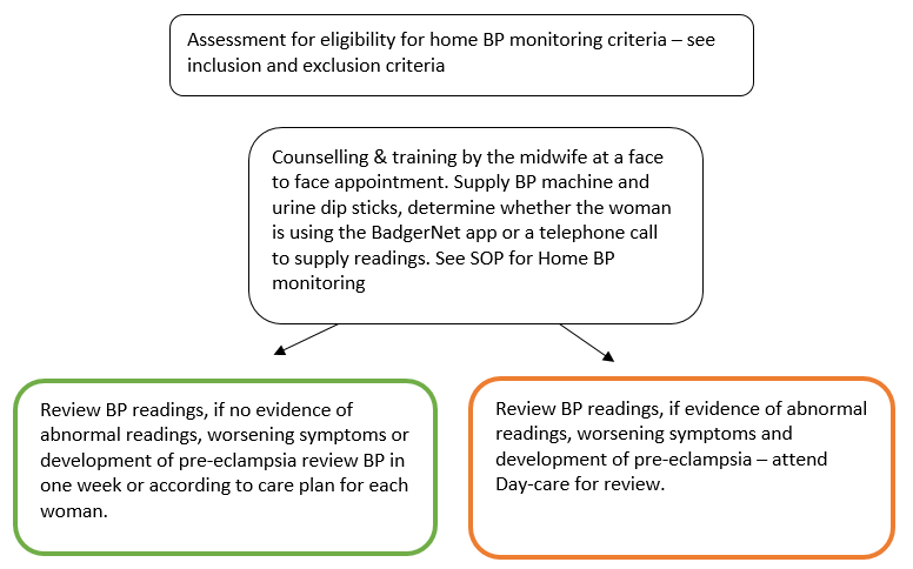
  1. Arrange for a woman to attend face to face appointment in Daycare Unit. Ask her to bring her mobile phone with her to the appointment. If a woman already has a blood pressure monitor at home to please bring to the appointment to ensure suitability for home BP monitoring, all NHS-issued monitors are validated.

  2. Provide antenatal check if required. Assess eligibility to participate in self-monitoring of blood pressure and urinalysis. Ensure contact details are up to date on BadgerNet (home, mobile phone, number, and email).
  3. Provide an NHS device, local agreement does not require a loan form just a verbal consent the machine is loan only and the expectation is that it’s returned.

  4. Verbally discuss the BP monitor is a loan only and requires return on discharge from home BP monitoring scheme or when postnatal, ensuring the asset is appropriately labelled and tracked on individual recording sheet.

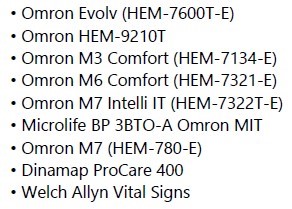
  5. If a woman has brought her own blood pressure monitor to the appointment, validate suitability for use in pregnancy ensure meets medical standards. The following are validated monitors:

  • Local procurement can confirm if machines meet the medical standards – sure sign machines are also being used within GG&C.
  • Upper arm cuffs should not be used to take forearm measurements
  • Velcro cuffs should be cleaned according to local decontamination process
  1. Give written instructions on how to take a blood pressure reading (patient information leaflet) and signpost the link to the short video: British Heart Foundation - How to take your own blood pressure. Use teach-back to show the woman how to take her own blood pressure, write down and interpret her results. Ask the woman to take her blood pressure by herself twice, at least one minute apart, to demonstrate understanding (patient information leaflet).

  2. Give written instructions on how to self-monitor for proteinuria only (patient information leaflet).  Use teach-back to ensure the woman understands how to use the test and where and how to record her results – within GG&C The results will be recorded by the patient into her BadgerNet app unless they opt for telephone call and midwife will input results into BadgerNet in the clinical area. Ensure this is all set up at initial face to face appointment and use teach back to ensure comprehensive understanding.

  3. Give written instructions on expected frequency of blood pressure monitoring and urinalysis, making clear whether this will be done in place of usual care or in addition to usual care ie usually checked once weekly and reviewed.

  4. Make clear home BP-readings will not be reviewed by a healthcare professional unless it is before a pre-organised clinic appointment or virtual contact. Women should be discouraged from recording readings at unspecified times. However, ensure she understands who to contact if she is concerned.

  5. If a woman requires additional investigations / appointments (e.g. growth scan, obstetric clinic follow-up etc), arrange as per local guidelines.

  6. Provide a paper blood pressure recording diary and show her how to use it.

  7. Please inform the woman that it is vital that they follow the written instructions and phone the hospital contact number if they develop raised blood pressure, new proteinuria, increasing proteinuria, or new symptoms.

  8. Book the next appointment with the woman and discuss whether this will be telephone or inputted into the BadgerNet app – if app is being used the woman should be informed that if home BP is normal there will not be a follow up call and a further app appointment will be generated.
    Suggested follow up will vary on a case to case basis.  A robust plan must be documented in BadgerNet.

  9. Explain the arrangements to the woman for the return of the blood pressure monitor (local arrangements).

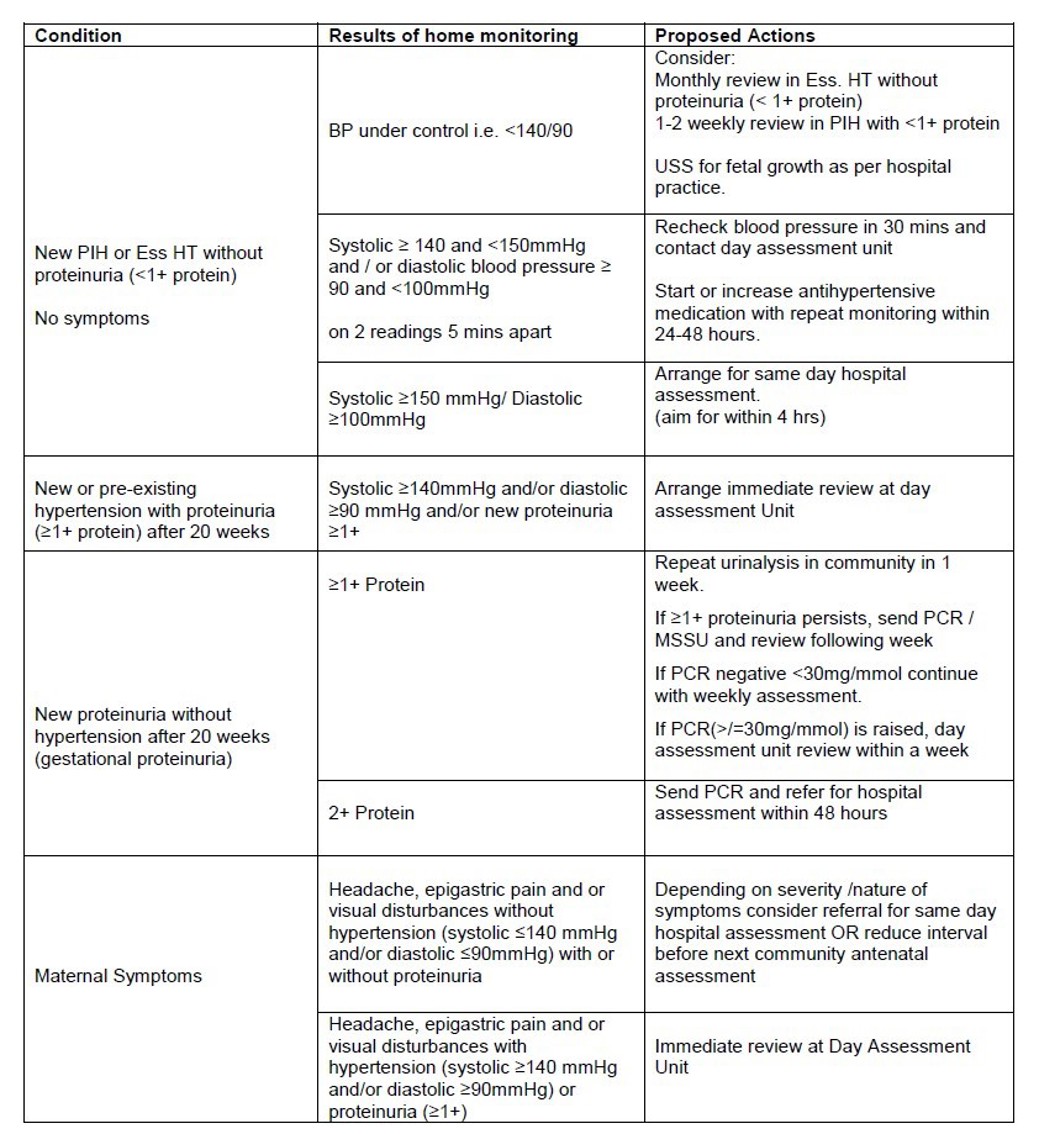
How to interpret home monitoring

An overview of home blood pressure monitoring