


  1. Right Decisions
  2. GGC - Clinical Guidelines
  3. Maternity
  4. Back
  5. Common obstetric problems, intrapartum labour ward
  6. Large for Gestational Age fetus in singleton, non-diabetic pregnancies, investigation and management (1242)

Large for Gestational Age fetus in singleton, non-diabetic pregnancies, investigation and management (1242)

Warning
  • The identification of a large for gestational age fetus during pregnancy should initiate consideration of the following maternal complications; gestational diabetes mellitus (GDM), perineal trauma and risk of caesarean birth and neonatal complications; risk of shoulder dystocia, brachial plexus injury and perinatal death.  
  • Risk of shoulder dystocia is related to birth weight  
    • 4000-4250g risk of shoulder dystocia 5.2% (around 5 babies in every 100 may have a shoulder dystocia) 
    • 4250-4500g risk of shoulder dystocia 9.1% (around 9 in every 100)
    • 4500-4750g risk of shoulder dystocia 14.3%  (around 14 in every 100)
    • 4750-5000g risk of shoulder dystocia 21% (around one in every five)  
  • For the purposes of this guideline, ‘Large for Gestational Age’ (LGA) is defined as an estimated fetal weight (EFW) >97th centile for gestation. 
  • EFW is plotted from 22 weeks on the Intergrowth chart, prior to this AC is used.  
  • Pregnancies with an LGA fetus may require investigation for GDM as below. Refer to the separate guidelines for management of diabetes in pregnancy if GDM is diagnosed.
  • Ultrasound scanning is the best tool we have to identify an LGA fetus however estimations of fetal weight in the third trimester have limited accuracy, with an approximately 15% margin of error and tendency to overestimate. A 15% margin of error means a fetus with an EFW of 4kg could be within 3.4kg-4.6kg. 
  • The Big Baby Trial confirmed the poor predictive value of scan estimated fetal weight for LGA at birth. They recruited individuals whose EFW was higher than the 90th percentile at 35+0 to 38+0 weeks gestation, but at birth only 40% (4 in 10) of participants in the standard care group and 42% in the induction group had a birthweight higher than the 90th percentile. 

Management of women with an LGA fetus

1. 18+0 - 21+6 weeks

At this gestation, AC/EFW is unlikely to be related to maternal glycaemic status 

Recommendation: 

If the AC/EFW is >97th centile at the routine anomaly scan, an oral glucose tolerance test (OGTT) is NOT indicated unless there are any other risk factors for GDM. A follow up antenatal clinic appointment with repeat ultrasound scan for biometry should be scheduled at 36 weeks. 

2. 22+0 – 34+6 weeks 

Recommendations: 

If the symphysial-fundal height (SFH) is >97th centile on routine measurement an ultrasound scan for fetal biometry should be arranged within the next 5 working days. SFH can be measured from 24 weeks but usually commences at the 28 week appointment.

  • If the symphysial-fundal height (SFH) is >97thcentile on routine measurement an ultrasound scan for fetal biometry should be arranged within the next 5 working days 
  • If EFW ≤ 97th centile, return to original care pathway. If the SFH remains above the 97th centile on subsequent SFH measurements a repeat scan is not indicated unless there is a significant upward trend in the percentiles. 
  • If EFW >97th centile an OGTT should be arranged as soon as possible 
  • If an OGTT has already been performed at an earlier gestation with a negative result, a repeat test should be undertaken if the following develop 
    • Glycosuria- 2+ or above on one occasion, 1+ on 2 or more occasions or polyhydramnios 
  • An antenatal clinic appointment should be arranged to plan follow-up scans and discuss birth.  

3. After 35+0 weeks 

Recommendations: 

  • If the SFH is >97thcentile, an ultrasound scan for fetal biometry should be arranged within the next 5 working days 
  • If EFW ≤97th centile, return to original care pathway 
  • If EFW >97th centile:  
  • An OGTT is not recommended at  ≥35+0  
  • HbA1C and random blood glucose should be taken and antenatal clinic appointment arranged to discuss birth options. 
  • If the scan was done at <36+0 weeks consider repeat scan prior to birth planning.  
Planning and discussing birth of a fetus with EFW/AC ≥97th centile at 36-42 weeks

The uncertainty of benefits and risks of induction of labour versus expectant management should be discussed with a woman and documented in Badgernet. Following this discussion, induction of labour can be offered from 38+0 weeks. 

  • Women may wish to request a caesarean birth after discussion of the risks and benefits.  Planned caesarean birth is recommended from 39+0 weeks onwards unless there are other indications. It should always be discussed for EFW of over 5kg. 
  • Documentation of any discussions and completion of the PPH risk assessment checklist should be completed on Badgernet. 

Induction of labour versus expectant management: Big Baby Trial

A significant limitation of the Big Baby Trial was the poor predictive value of scan estimated fetal weight. At birth, only 40% (4 in 10) of babies identified as LGA on scan had a birthweight >90% centile. So, 6 in 10 babies identified as LGA were not LGA.  

Main findings 

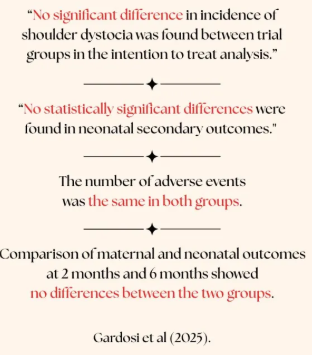
There was a non-significant reduction in shoulder dystocia in the induction of labour group versus the standard care group in the intention to treat analysis, however in the per protocol analysis there was a reduction in shoulder dystocia with IOL between 38+0 and 38+4 weeks. This was felt to be due to the higher proportion of earlier than expected births in the standard care group (25%, 1 in 4, of pregnancies in the standard care group were delivered early) reducing the intended between group differences in gestational age and birth.

As the incidence of harm secondary to shoulder dystocia is small, three composite harm outcomes were prespecified; 

Intrapartum birth injury (fractures, brachial plexus injury or both) 

There were no significant differences between the induction of labour group versus expectant management group. 

Maternal intrapartum complications (3rd/4th degree perineal tears, cervical injury or primary PPH) 

Women in the induction group had fewer primary post-partum haemorrhages and there were no significant differences in the incidence of third and 4th degree tears between the two groups. This is in contrast to the findings of the NICE evidence review (Nov 2021) which found an increase in 3rd and 4th degree tears in the induction of labour group.

Prematurity associated problems (use of phototherapy, respiratory support or both) 

There were no significant differences in prematurity associated problems between the two groups. 

The authors also concluded that although associated with an extra half day in hospital pre-birth, induction of labour can lead to a reduction in operative birth. 


Discussion aid

Editorial Information

Last reviewed: 05/01/2026

Next review date: 31/12/2028

Author(s): Dawn Kernaghan.

Version: 1

Approved By: Maternity Clinical Governance Group

Document Id: 1242

Related resources

Boulvain M, Irion O, Dowswell T, Thornton JG. Induction of labour at or near term for suspected fetal macrosomia. Cochrane Database of Systematic Reviews 2016, Issue 5. Art. No.: CD000938. DOI: 10.1002/14651858.CD000938.pub2 

NICE Evidence review for large-for-gestational age baby.2019.

Shoulder Dystocia: RCOG Green-top Guideline No. 42. 2012.

Inducing Labour (A) Induction of Labour for suspected fetal macrosomia NICE guideline NG207. November 2021 

Kramer MS, Yang H et al. Why are babies getting bigger? Temporal trends in fetal growth and its determinants. J Pediatr. 2002.141(4):538-42 

Liao P, Park AL et al. Using estimated fetal weight from ultrasonography at 18-22 weeks to predict gestational diabetes mellitus and newborn macrosomia. J Obstet Gynecol Can 2014; 36(8):688-91 

Gardosi, Jason et al. 2025. Induction of labour versus standard care to prevent shoulder dystocia in fetuses suspected to be large for gestational age in the UK (the Big Baby trial): a multicentre, open-label, randomised controlled trial.  The Lancet, Volume 405, Issue 10491, 1743-1756.

Wickham, Sara. 2025. Explaining the Big Baby Trial.