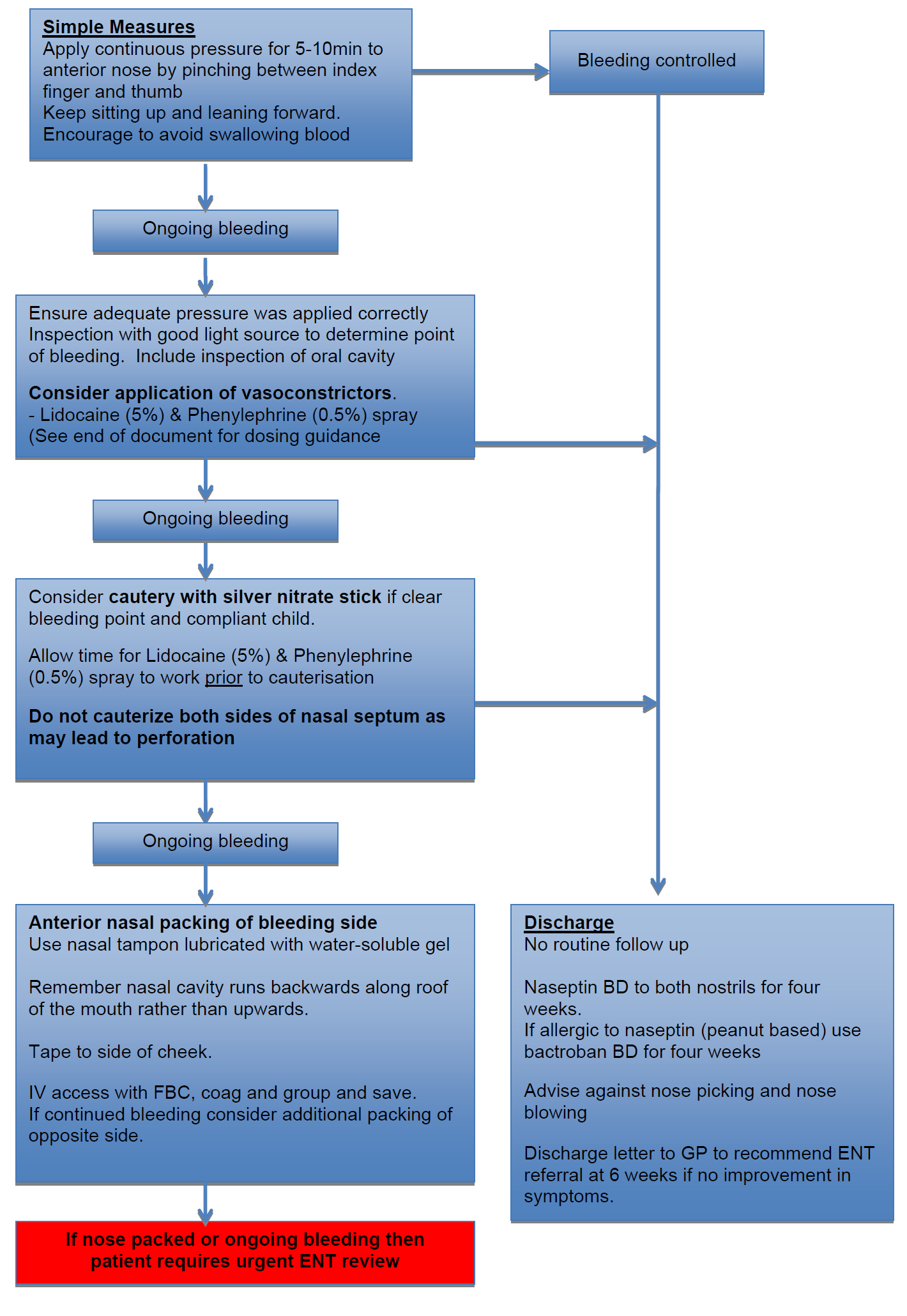
Epistaxis is a common childhood complaint and is normally benign and self-limiting. Epistaxis in children is most commonly caused by minor trauma such as nose picking. Alternative diagnosis to consider include recent URTI, allergic rhinitis, nasal foreign body and more rarely bleeding disorders. Epistaxis is unusual in children under the age of two and alternative diagnosis should be considered. Most bleeding occurs anteriorly from Little’s area.
Epistaxis management in children, paediatrics (490)

Warning
Objectives
Guidance for the assessment and management of children presenting with epistaxis.
Scope
A guideline is intended to assist healthcare professionals in the choice of disease-specific treatments.
Clinical judgement should be exercised on the applicability of any guideline, influenced by individual patient characteristics. Clinicians should be mindful of the potential for harmful polypharmacy and increased susceptibility to adverse drug reactions in patients with multiple morbidities or frailty.
If, after discussion with the patient or carer, there are good reasons for not following a guideline, it is good practice to record these and communicate them to others involved in the care of the patient.
Audience
Emergency department medical and nursing staff.
ABC approach with resuscitation as appropriate.
See flow diagram below for specific management options.