Warning

Information on Mental Health for Early Years can be found here

Introduction/ Information

The Scottish Government’s Mental Health and Wellbeing Strategy (2023) aims for a Scotland free from stigma and inequality. It focuses on early intervention and prevention from pre-birth to adulthood. Health and wellbeing are key parts of the Curriculum for Excellence, supported by a whole-school approach and Getting It Right For Every Child (GIRFEC). 

Mental health spans a broad spectrum, from everyday emotional well-being to serious mental illnesses that require professional support. The World Health Organization says mental health helps people manage stress, work well, and take part in their community. 

In 2023 - 2024,  430,000 children in the UK were referred to mental health services, but many faced barriers to getting help. Mental health issues often start early, with half beginning by age 14. Outcomes are worse in deprived areas, where suicide rates are four times higher. Risk factors include adverse childhood experiences, minority backgrounds, domestic abuse, chronic illness, disabilities, parental mental health issues, and refugee status. 

Schools provide stability, routine, and support for mental health through GIRFEC wellbeing indicators and a whole-school approach. Issues like bullying, transitions, and exams can affect wellbeing, but schools can take positive actions to help build resilience. Teachers and staff play a key role in promoting mental health, and there are a range of resources and training opportunities available to help them. 


Health and Wellbeing Census Scotland 2021- 2022 

The data shows that positive mental health and wellbeing decreases with stage, and there are differences by sex and deprivation. For pupils up to S4 positive perceptions of life satisfaction, confidence and loneliness decrease but there are small improvements (or no further decreases) for those in S5 and S6. The percentage of pupils who say their body and the way they look affects how they feel about themselves increases as children and young people get older. The survey also asked pupils about time spent online.

  • Pupils in P5 – P7 are more likely to spend three or more hours on electronic devices on weekdays and at weekends 
  • Pupils in S1 – S6 are more likely to spend 6 hours or more on electronic devices on weekdays and at weekends.  
  • Pupils in the most deprived areas in S2 – S6 were more likely to have problematic social media.  
  • Girls were also more likely to have problematic social media use than boys.  
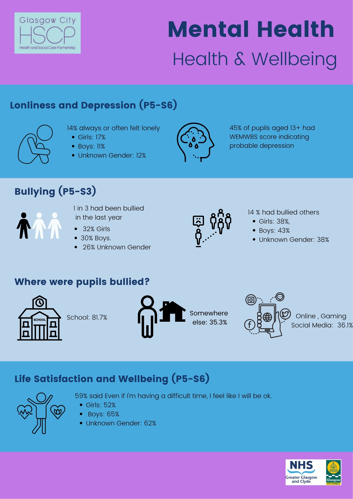
 

View the full School Health and Wellbeing Census 2021/22 here.

Resources and Planning tools

Children and Young People's Mental Health Support Guide (Glasgow City) (NEW)

This is a guide to support statutory and third sector professionals to refer children and young people to mental health and wellbeing supports and services that are appropriate to their needs and that can be accessed relatively quickly and easily.

Click here to access the guide.

Mental Health and Wellbeing School Practice Guidelines

There are Mental Health and Wellbeing School Practice Guidelines available to all schools in Glasgow and accessible via Go Glasgow.  These practice guidelines provide information for establishments to support understanding around MHWB for children and young people and recognising the crucial role of education staff.

Click here  to access the guidelines.

Schools can apply for up to £300 funding from Health Improvement to support the implementation of these guidelines with involvement of children and young people. Alongside this, Health Improvement staff can offer support and guidance on developing your schools action plan and completing your self-evaluation. 

Contact: ggc.educationhwb@nhs.scot 

Please note if you are a community organisation supporting young people. Health Improvement can offer support to help you develop, review or implement a Mental Health and Wellbeing Policy. Organisations can apply for the funding mentioned above to support this. For more information or to apply for the fund please contact: ggc.educationhwb@nhs.scot 


Suicide Prevention: Guidance for organisations supporting young people in Glasgow City (NEW)

This resource has been developed to support anyone working with young people in Glasgow. It’s a practical resource designed to create hope and guide in responding effectively to distress. Please note this resource is part of a wider suite of Suicide Prevention resources, which can be viewed here .

Click here to access the guidance.


The following curricular resources have been developed and/or quality assured by the Glasgow City HSCP Health Improvement Team and can be used in both a school and community setting:

On Edge: Self Harm Awareness Resource Pack

Stage: Upper Primary onwards

Description: The On Edge: Self Harm Awareness Resource Pack is for teachers and professionals working with young people. This has been developed in partnership with mental health and education professionals and funded by NHS Greater Glasgow and Clyde. It includes teaching support materials and further information in the form of sign-posting to external resources and advice services, references, and linked where relevant to the Curriculum for Excellence and other national guidance.

Link to resource : On Edge: Self Harm Resource Pack

Be Screen Smart

Stage: Early Years to Secondary

Description: The Be Screen Smart resource aims to raise awareness of the benefits of reduced screen time. 

Link to resource: Be Screen Smart Resource 

The Compassionate and Connected Classroom

Stage: Mid to Upper Primary

Description: The Compassionate and Connected Classroom is a classroom resource that aims to raise awareness of the potential impact of adversity and trauma in shaping outcomes for children and young people and provide support that can help mitigate the impact of these experiences.

Link to resource: The Compassionate and Connected Classroom 


A Whole School Approach to Loss and Bereavement

Stage: Early Years to Secondary

Description: This document is intended for anyone who requires advice on issues relating to loss, grief, and bereavement. Sections include how children understand death at different ages, supporting children and young people with Additional Support Needs through loss and bereavement and the impact of peer help and social media.

Link to resource: A-Whole-School-Approach-to-Loss-and-Bereavement-December-2021.pdf

The Glasgow City Health Improvement Team have collated a range of additional mental health and wellbeing resources that will support you when working with children and young people. These include capacity building opportunities, resources to use with young people and groups, useful tips, guidance and planning tools. You can view the resources here

Information for Parents/ Carers

SAMH Information for Parents/ Carers

A range of resources which are designed to help parents/ carers start a conversation around mental health and know where to turn to if help is needed. Access the resource here

Papyrus Supporting your child resource 

This guide has been created following discussions with parents who have experience of supporting a young person struggling with their mental health. The aim of this guide is to provide information and guidance and to help parents cope with a young person who is struggling with thoughts of suicide. It aims to reassure them that they are not alone. Access the resource here

Scottish Government Parent Club Wellbeing Newsletter 

Newsletter including helpful resources, links, and tips to support and help parents with their mental health and wellbeing, offering ideas on things to do at home to look after themselves, tips for keeping active and managing stress and anxiety as well as help with money worries and how to eat healthy, comforting and affordable food. Access the newsletter here

YoungMinds: Self-Harm Mental Health - Guide For Parents

Guide that covers what self-harm is, what the signs of self-harm are in a young person, and where to get support. Access the resource here

Self-Harm Network Scotland (Penumbra)

Website sharing information and resources on self-harm, which can be used to support the person you’re worried about. Access the website here

Glasgow City Youth Health Service

Support Service for young people/family health and wellbeing, including mental health support. Further information can be found here

Mental Health Strategy / Policy Links

The Glasgow City HSCP Health Improvement Team have pulled together a list of key strategy and policy links regarding children and young people. These documents should be used to inform planning and delivery within your classroom and school community.

These documents are a useful resource to build a knowledge base around current priorities and work around mental health and wellbeing in Glasgow and across Scotland. Please note that clicking on these documents will take you to external websites.

Children and Young People’s Mental Health Task Force Recommendations  

Mental health and wellbeing strategy: delivery plan 2023-2025  

Community Mental Health and Wellbeing Supports and Services Framework

Creating Hope Together: Suicide Prevention Strategy (2022 - 2032) 

Children and Young People – Mental Health Improvement Policy Landscape

Scotland's Self Harm Strategy and Action Plan (2023 - 2027)

Scottish Government Mental Health and Wellbeing Strategy

The Scottish Governments Mental Health Strategy (2017-2027) - a 10 year vision 

Editorial Information

Last reviewed: 17/09/2025

Next review date: 31/03/2026

Reviewer name(s): Glasgow City Health Improvement Team.