

Acute sore throat, Paediatrics (336)

Warning
Objectives
Guidance for the assessment and management of children with acute sore throat
Scope
Children presenting to the Royal Hospital for Children, Glasgow (RHCG), with a likely diagnosis of acute sore throat
Audience
Medical and nursing staff assessing children presenting to RHCG with a likely diagnosis of acute sore throat
Sore throat occurs with an acute respiratory tract infection that affects the mucosa of the throat.
Clinical descriptions of acute score throat (1,2)
- Acute pharyngitis: Inflammation of the oropharynx(part of the throat behind the soft palate)
- Tonsillitis: Inflammation of the tonsils
Acute tonsillitis is more common in children aged 5-15 years.(2)
History (1)
- Fever
- Non-specific symptoms:
- Headache
- Nausea
- Vomiting
- Reduced oral intake
- Abdominal pain
- Rhinorrhea, nasal congestion and cough usually present in viral pharyngitis and not bacterial pharyngitis
Examination (1)
Tonsilitis: Enlargement and erythema of tonsils, tonsillar exudate. Anterior cervical lymphadenopathy
Pharyngitis: Pharyngeal exudate, cervical lymphadenopathy
Common infectious causes:
- Rhinovirus, Coronavirus, Parainfluenza virus, Influenza types A and B, Adenovirus, Herpes Simplex Virus type 1
- Streptococcal infection
- Group A beta-haemolytic streptococcus (GABHS) or Streptococcus pyogenes is the commonest bacterial cause of sore throat. It is reported to account for less than a third of all cases of acute pharyngitis (Shulman et al 2012 in (4)) and tonsillitis in children (Wessels 2011, Miller et al. 2018 in (2)). GABHS colonization reaches peak prevalence, up to 20% in school-aged children during the winter months.(1)
- Epstein-Barr virus leading to infectious mononucleosis
- Fusobacterium necrophorum
- Rarely leads to Lemierre syndrome (septic phlebitis) of the internal jugular vein
Rarer infectious causes:
- Enteroviruses - can cause herpangina and hand-foot-and-mouth disease(HFMD)
- Haemophilus influenza type b - can cause epiglottitis
- Candida albicans
- Corynebacterium diphteria, Corynebacterium ulcerans - Cause diphtheria
Non-infectious causes (uncommon)
- Physical irritation(eg: from nasogastric tube, smoke)
- Gastro-oesophageal reflux disease(GORD)
- Kawasaki disease (usually presents with fever and diagnosis is established on the presence of clinical criteria)
- Oral mucositis secondary to radiotherapy or chemotherapy
- Haematological disorders such as leukaemia and aplastic anaemia
- Drugs:
- Cytotoxic drugs
- Carbimazole
- Clozapine
- Sulfasalazine
Complications from streptococcal pharyngitis/tonsillitis are rare
- Scarlet fever: Infection with streptococci that produce erythogenic toxins which produce a characteristic ‘scarlatina’ rash.
- Suppurative complications:
- Otitis media (Commonest)
- Acute Sinusitis (Occurs in 0.4% of untreated cases within 2 weeks of acute tonsillitis)
- Peri-tonsillar abscess (quinsy) which occurs in approximately 2% of cases within 2 months of acute tonsillitis
- Non-suppurative complications (rare in developed countries):
- Acute rheumatic fever
- Acute glomerulonephritis
- Reactive arthritis
FeverPAIN criteria
FeverPAIN (5) is an acronym that stands for:
- Fever during the last 24 hours
- Purulent tonsils
- Attend rapidly (short duration in development of symptoms ≤3 days)
- severely ‘Inflamed tonsils’
- ‘No cough or coryza’ (purely pharyngeal illness)
Each of the FeverPAIN criteria score 1 point (maximum score of 5).
The PRImary Care Streptococcal Management Study (PRISM) group developed the FeverPAIN score from two cohorts of patients aged 5 years and above presenting with acute pharyngitis. A logistic regression model was used to identify the 5 clinical variables that were significantly associated in predicting Lancefield groups A, C and G streptococcal infection.(5) A FeverPAIN score of 4 or 5 has been thought to be associated with a 62-65% likelihood of having a bacterial infection.(3)
The FeverPAIN score was tested in a randomised controlled trial(6) on people aged 3 years and over. 631 patients were randomised into three prescribing strategies: empirical delayed prescribing (control group); use of the FeverPAIN score to direct prescribing; or a combination of the FeverPAIN score and Rapid Streptococcal Antigen Detection Tests (RADTs). Compared to the control group, the two intervention groups showed a significant improvement in several outcomes:
- Improvement in symptom severity reported by patients (by about one-third for both)
- Shorter duration of symptoms reported by patients by about one day (when only FeverPAIN score is used)
- Relative reduction in the use of antibiotics (29% when only FeverPAIN score is used and 27% when FeverPAIN score was combined with RADTs)
*No clear advantage was demonstrated with the additional use of RADTs
A local retrospective study looking at the diagnostic accuracy of the FeverPAIN score in predicting GABHS infection was carried out during a period of high prevalence of GABHS infections from 3rd-16th December 2022. 335 throat swab results taken at RHC ED were included for analysis. ROC analysis showed that there was reasonable accuracy in children aged 5 years and over. If applied in this population, it could have improved judicious antibiotic prescribing for acute sore throat. However, application of FeverPAIN showed no significant benefit in children under 5 years of age.
Centor score / McIsaac Score
The Centor score was initially developed in 1981 to predict the diagnosis of GAS for adults who presented to the emergency department.(7) A Centor score of 3 or 4 is associated with a 32-56% probability of bacterial infection.(3)
A modified Centor score known as the McIsaac score adjusted the Centor score for age in view of the increased likelihood of GAS infections in younger patients. The McIsaac score has been validated for use in patients aged 3 years and over. (8–10)
|
History of fever |
+1 point |
|
Tonsillar exudate |
+1 point |
|
Tender enlarged cervical lymph nodes |
+1 point |
|
Absence of cough |
+1 point |
|
Aged 3-14 years |
+1 point |
|
Aged 15-44 years |
0 points |
*Patients who score 5 are assigned score of 4 for the purpose of assigning probable bacterial infection (11)
On external prospective validation, the McIsaac score showed insufficient diagnostic accuracy of infection with GAS without the use of microbiological testing. (12)
Throat culture
Throat culture is the standard test for a definitive diagnosis of bacterial tonsillitis. Its usefulness as a first test is limited by the delay in results (usually more than 48 hours).
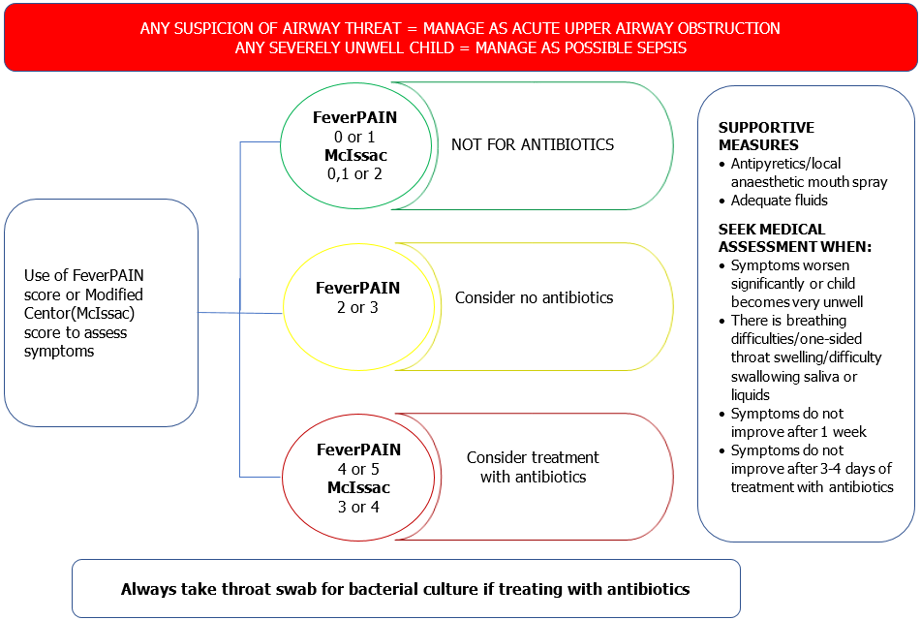
**Our departmental policy advises to collect a throat swab for culture if the child is being treated for likely GABHS with an antibiotic in case of failure to respond to antibiotics**
Rapid Streptococcal Antigen Test - Not routinely available in RHCG ED
Blood tests
Not routinely recommended. They can be useful when there is suspicion of infectious mononucleosis, in immunocompromised patients and in patients with signs or symptoms of sepsis/severe infection.(2)
A raised WCC with neutrophilia is indicative of bacterial infection. A raised WCC count with lymphocytosis and atypical lymphocytes would be suggestive of infectious mononucleosis.(2)
See EBV guideline for details on EBV investigation and management.
**ANY EVIDENCE OF AIRWAY THREAT OR CHILD APPEARS SEVERELY UNWELL** = Manage as acute upper airway obstruction and consider sepsis management concurrently.
Supportive measures (1,2)
- Adequate fluids
- Avoid hot drinks which can exacerbate pain
- Gargling with warm salt water
Analgesics/antipyretics (1)
- Paracetamol/Ibuprofen as antipyretic and/or analgesic
- Local anaesthetic: Benzydamine spray (Difflam)
- Use FeverPAIN score or McIsaac score (Modified Centor score) to assess symptoms
- For people with FeverPAIN score of 4 or 5, McIsaac score 3 or 4: consider immediate antibiotic prescription
- For people with FeverPAIN score of 2 or 3: consider no antibiotic prescription.
- For people with FeverPAIN score of 0 or 1, McIsaac score 0, 1 or 2: do not offer an antibiotic prescription
- See BNFc for correct antibiotic dosing for age and weight.
If antibiotic required:
Phenoxymethypenicillin for 5 days.
If Symptoms remain at 5 days of treatment then a further 5 days of antibiotic should be taken.
Penicillin allergy:
Clarithromycin for 5 days.
Course length 10 days for relapse/recurrence of tonsillitis within 2 weeks, or where there are
signs/symptoms of Scarlet Fever.
Discharge Advice (1)
- Symptoms may last for about 1 week
- Children may return to school day care once the fever has resolved and they are feeling well, and/or after 24 hours of taking antibiotics when indicated
- Seek follow-up if symptoms are not improving after 3-4 days of treatment with antibiotics(for consideration of alternative diagnoses)
- Seek urgent advice if there is:
- Difficulty swallowing saliva/liquids
- Difficulty breathing
- One-sided throat swelling
- Consider referral to Ear, Nose and Throat(ENT) specialist for people with severe recurrent tonsillitis:
- 7 episodes per year for one year
- 5 episodes per year for 2 years
- 3 episodes per year for 3 years
|
Cause |
Symptoms |
Investigations |
Treatment |
|
Peritonsillar abscess (Quinsy) |
-severe sore throat often unilateral -hot potato voice -drooling -trismus -neck swelling -referred ear pain |
|
Discuss with ENT regarding clinical review +/- IV antibiotics and drainage |
|
Epiglottitis or bacterial tracheitis
(more likely if not immunised against HIB)
|
-abrupt onset respiratory distress -absent cough with low pitched stridor -muffled/hoarse voice -tripod/sniffing positioning -drooling -fever |
-do not examine throat, do venepuncture or lateral neck x-ray in patients with severe respiratory distress due to risk of precipitating respiratory arrest
|
-early PICU review -maintain position of comfort with parents present -discuss with ENT regarding clinical review +/- IV antibiotics choice. |
|
Retropharyngeal abscess/lateral pharyngeal abscess |
Retropharyngeal -respiratory distress -stridor -dysphagia -odynophagia -drooling -torticollis -muffled voice -neck mass -trismus -chest pain Lateral pharyngeal -as above with swelling below mandible |
-lateral neck x-ray (normal does not exclude diagnosis) -CT with IV contrast with access to advanced airway management
|
-Early ENT +/- PICU review - Discuss with ENT regarding clinical review +/- IV antibiotics
|
|
Infectious mononucleosis (glandular fever/EBV) |
-suspect if sore throat fails to improve/worsens -enlarged tonsils with thick white exudate -palatal petechiae -fever -generalised lymphadenopathy -fatigue/malaise -variable hepatosplenomegaly -amoxicillin induced rash -symptoms usually resolve in 1-2 weeks but lethargy can last months to years Complications -meningitis/encephalitis -hepatitis -myocarditis -orchitis -cytopenias -lymphoproliferation -splenic rupture |