Warning

Click on the image to view a larger version


GGC Medicines: Drugs for genito-urinary disorders

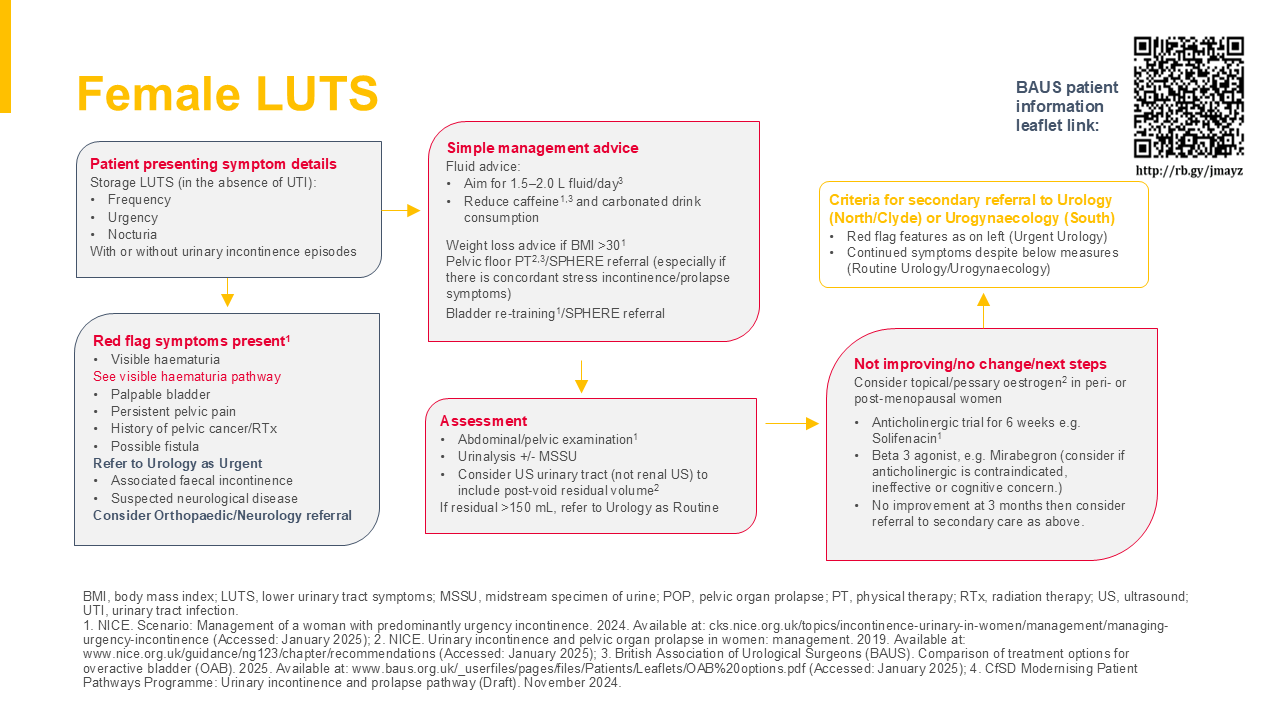
Patient presenting symptom details

Storage LUTS (in the absence of UTI):

  • Frequency
  • Urgency
  • Nocturia

With or without urinary incontinence episodes

Red flag symptoms present

  • Visible haematuria
  • Palpable bladder
  • Persistent pelvic pain
  • History of pelvic cancer/RTx
  • Possible fistula1

Refer to Urology as Urgent

  • Associated faecal incontinence
  • Suspected neurological disease

Consider Orthopaedic/Neurology referral

Simple management advice

Fluid advice:

  • Aim for 1.5–2.0 L fluid/day3
  • Reduce caffeine1,3 and carbonated drink consumption

Weight loss advice if BMI >301

Pelvic floor PT2,3/SPHERE referral (especially if there is concordant stress incontinence/prolapse symptoms)
Bladder re-training1/SPHERE referral

Assessment

  • Abdominal/pelvic examination1
  • Urinalysis +/- MSSU
  • Consider US urinary tract (not renal US) to include post-void residual volume2

If residual >150 mL, refer to Urology as Routine

Not improving/no change/next steps

Consider topical/pessary oestrogen2 in peri- or post-menopausal women

Criteria for secondary referral to Urology (North/Clyde) or Urogynaecology (South)

  • Red flag features as above (Urgent Urology)
  • Continued symptoms despite above measures (Routine Urology/Urogynaecology)

Abbreviations

  • BMI, body mass index
  • LUTS, lower urinary tract symptoms
  • MSSU, midstream specimen of urine
  • POP, pelvic organ prolapse
  • PT, physical therapy
  • RTx, radiation therapy
  • US, ultrasound
  • UTI, urinary tract infection.

References

  1. NICE. Scenario: Management of a woman with predominantly urgency incontinence. 2024. Available at: cks.nice.org.uk/topics/incontinence-urinary-in-women/management/managing-urgency-incontinence (Accessed: January 2025)
  2. NICE. Urinary incontinence and pelvic organ prolapse in women: management. 2019. Available at: www.nice.org.uk/guidance/ng123/chapter/recommendations (Accessed: January 2025)
  3. British Association of Urological Surgeons (BAUS). Comparison of treatment options for overactive bladder (OAB). 2025. Available at: www.baus.org.uk/_userfiles/pages/files/Patients/Leaflets/OAB%20options.pdf (Accessed: January 2025)
  4. CfSD Modernising Patient Pathways Programme: Urinary incontinence and prolapse pathway (Draft). November 2024.

Editorial Information

Last reviewed: 12/08/2025

Next review date: 30/06/2026

Author(s): Consultant Urologist.

Version: 1

Approved By: Urology South and North Sector