Warning

Click on the image to view a larger version


GGC Medicines: Drugs for genito-urinary disorders

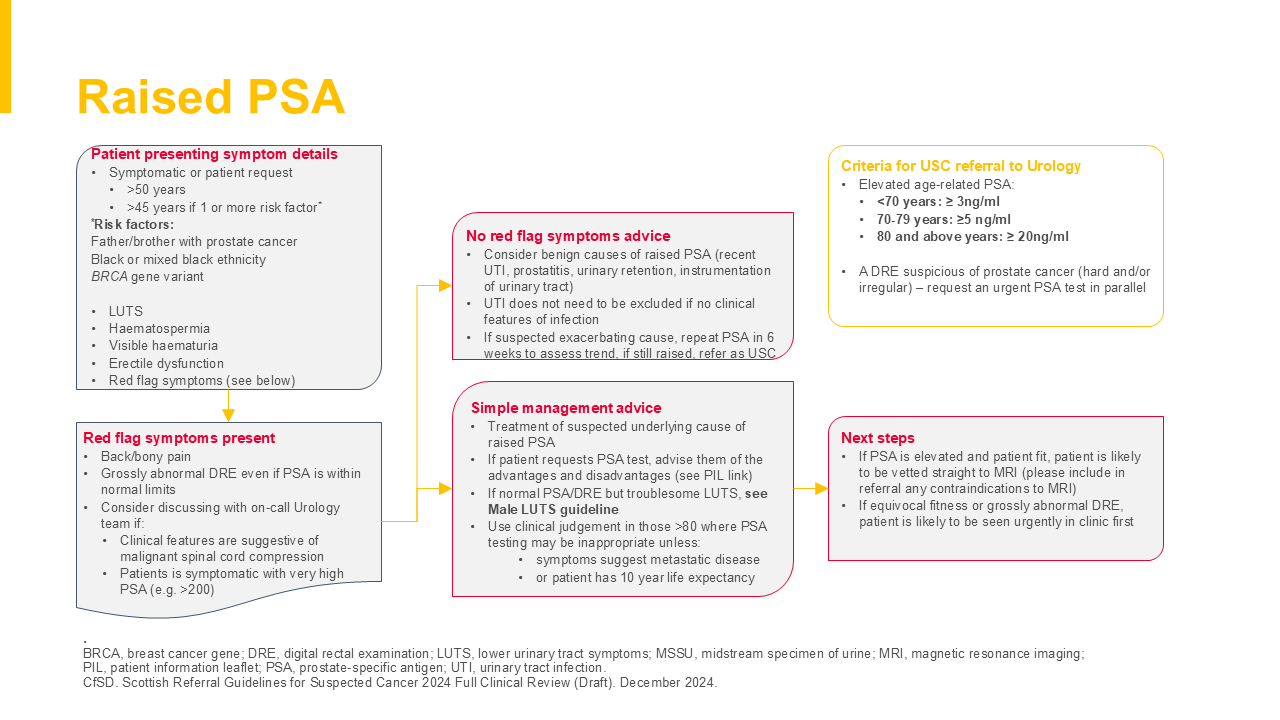
Patient presenting symptom details

  • Symptomatic or patient request
    • >50 years
    • >45 years if 1 or more risk factor*

*Risk factors:

  • Father/brother with prostate cancer
  • Black or mixed black ethnicity
  • BRCA gene variant


  • LUTS
  • Haematospermia
  • Visible haematuria
  • Erectile dysfunction
  • Red flag symptoms (see below)

Red flag symptoms present

  • Back/bony pain
  • Grossly abnormal DRE even if PSA is within normal limits
  • Consider discussing with on-call Urology team if:
    • Clinical features are suggestive of malignant spinal cord compression
    • Patients is symptomatic with very high PSA (e.g. >200)

No red flag symptoms advice

  • Consider benign causes of raised PSA (recent UTI, prostatitis, urinary retention, instrumentation of urinary tract)
  • UTI does not need to be excluded if no clinical features of infection
  • If suspected exacerbating cause, repeat PSA in 6 weeks to assess trend, if still raised, refer as USOC

Simple management advice

  • Treatment of suspected underlying cause of raised PSA
  • If patient requests PSA test, advise them of the advantages and disadvantages (see PSA advice)
  • If normal PSA/DRE but troublesome LUTS, see Male LUTS
  • Use clinical judgement in those >80 where PSA testing may be inappropriate unless:
    • symptoms suggest metastatic disease
    • or patient has 10 year life expectancy

Next steps

  • If PSA is elevated and patient fit, patient is likely to be vetted straight to MRI (please include in referral any contraindications to MRI)
  • If equivocal fitness or grossly abnormal DRE, patient is likely to be seen urgently in clinic first

Criteria for USC referral to Urology

  • Elevated age-related PSA:
    • <70 years: ≥ 3ng/ml
    • 70-79 years: ≥5 ng/ml
    • 80 and above years: ≥ 20ng/ml
  • A DRE suspicious of prostate cancer (hard and/or irregular) – request an urgent PSA test in parallel

Abbreviations

  • BRCA, breast cancer gene
  • DRE, digital rectal examination
  • LUTS, lower urinary tract symptoms
  • MSSU, midstream specimen of urine
  • MRI, magnetic resonance imaging
  • PIL, patient information leaflet
  • PSA, prostate-specific antigen
  • UTI, urinary tract infection


References

CfSD. Scottish Referral Guidelines for Suspected Cancer 2024 Full Clinical Review (Draft). December 2024.

Editorial Information

Last reviewed: 12/08/2025

Next review date: 30/06/2026

Author(s): Consultant Urologist.

Version: 1

Approved By: Urology South and North Sector