Warning

Click on the image to view a larger version.
 

GGC Medicines: Some other antibacterials

GGC Medicines: Preparations for vaginal and vulval changes

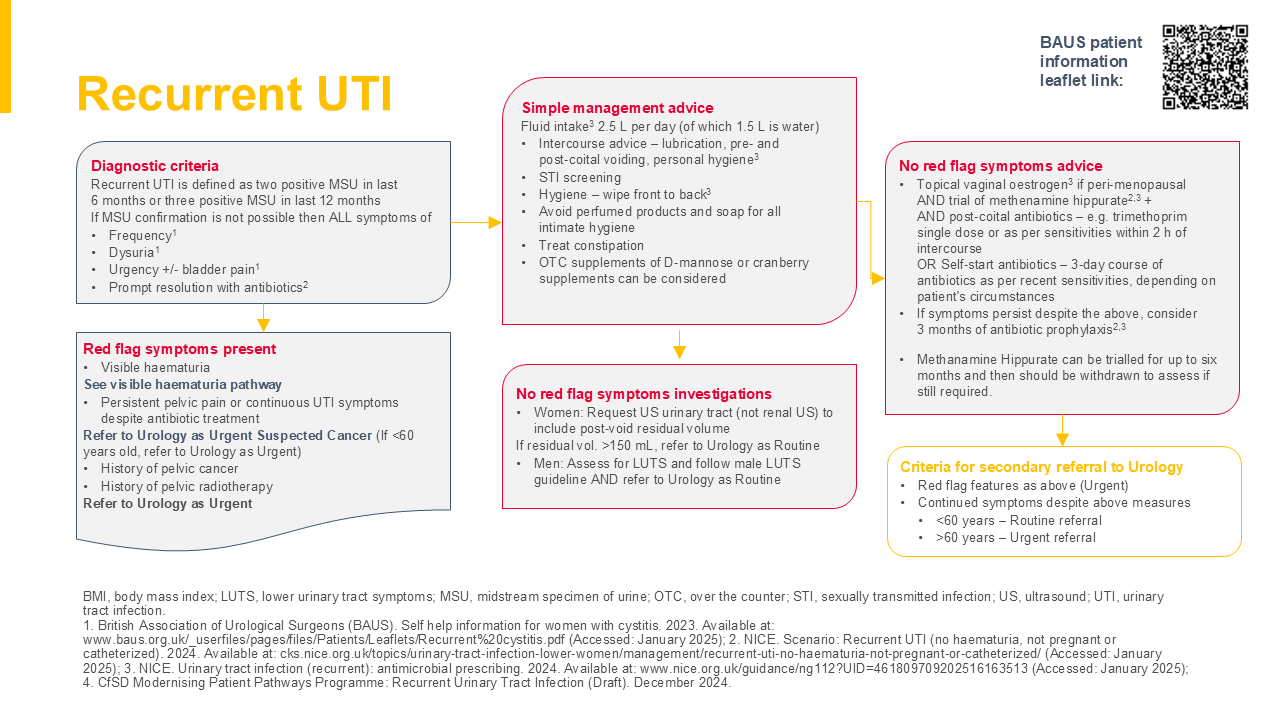
Diagnostic criteria

Recurrent UTI is defined as two positive MSU in last 6 months or three positive MSU in last 12 months

If MSU confirmation is not possible then ALL symptoms of

  • Frequency1
  • Dysuria1
  • Urgency +/- bladder pain1
  • Prompt resolution with antibiotics2

Red flag symptoms present

  • Visible haematuria

See visible haematuria pathway 


  • Persistent pelvic pain or continuous UTI symptoms despite antibiotic treatment

Refer to Urology as Urgent Suspected Cancer (If <60 years old, refer to Urology as Urgent)


  • History of pelvic cancer
  • History of pelvic radiotherapy

Refer to Urology as Urgent

Simple management advice

Fluid intake3 2.5 L per day (of which 1.5 L is water)

  • Intercourse advice – lubrication, pre- and post-coital voiding, personal hygiene3
  • STI screening
  • Hygiene – wipe front to back3
  • Avoid perfumed products and soap for all intimate hygiene
  • Treat constipation
  • OTC supplements of D-mannose or cranberry supplements can be considered

No red flag symptoms investigations

  • Women: Request US urinary tract (not renal US) to include post-void residual volume
    If residual vol. >150 mL, refer to Urology as Routine
  • Men: Assess for LUTS and follow male LUTS guidance AND refer to Urology as Routine 

No red flag symptoms advice

  • Topical vaginal oestrogen3 if peri-menopausal
    AND trial of methenamine hippurate2,3 +
    AND post-coital antibiotics – e.g. trimethoprim single dose or as per sensitivities within 2 h of intercourse
    OR Self-start antibiotics – 3-day course of antibiotics as per recent sensitivities, depending on patient's circumstances
    GGC Medicines: Preparations for vaginal and vulval changes

  • If symptoms persist despite the above, consider 3 months of antibiotic prophylaxis2,3


Criteria for secondary referral to Urology

  • Red flag features as above (Urgent)
  • Continued symptoms despite above measures
    • <60 years – Routine referral
    • >60 years – Urgent referral

Abbreviations

  • BMI, body mass index
  • LUTS, lower urinary tract symptoms
  • MSU, midstream specimen of urine
  • OTC, over the counter
  • STI, sexually transmitted infection
  • US, ultrasound
  • UTI, urinary tract infection

References

  1. British Association of Urological Surgeons (BAUS). Self help information for women with cystitis. 2023. Available at: www.baus.org.uk/_userfiles/pages/files/Patients/Leaflets/Recurrent%20cystitis.pdf (Accessed: January 2025)
  2. NICE. Scenario: Recurrent UTI (no haematuria, not pregnant or catheterized). 2024. Available at: cks.nice.org.uk/topics/urinary-tract-infection-lower-women/management/recurrent-uti-no-haematuria-not-pregnant-or-catheterized/ (Accessed: January 2025)
  3. NICE. Urinary tract infection (recurrent): antimicrobial prescribing. 2024. Available at: www.nice.org.uk/guidance/ng112?UID=461809709202516163513 (Accessed: January 2025)
  4. CfSD Modernising Patient Pathways Programme: Recurrent Urinary Tract Infection (Draft). December 2024.

Editorial Information

Last reviewed: 12/08/2025

Next review date: 30/06/2026

Author(s): Consultant Urologist.

Version: 1

Approved By: Urology South and North Sector