Oral PrEP medication 

Tenofovir disoproxil and emtricitabine (Truvada) 

  • Fixed dose co-formulation tablet 
  • Licensed for treatment of HIV as one part of combination therapy 
  • Widely used off-licence in PEPSE* in combination with Raltegravir​​  

Tenofovir alafenamide and emtricitabine(Descovy) 

  • Second line option 
  • Use if renal or bone contraindications including initiation under 18 years 

*PEPSE- Post exposure prophylaxis following sexual exposure 

New formulations

Cabotegravir (Apretude) 

  • IM injections, administered every 2 months​
  • Approved by the SMC in February 20259
  • Eligibility criteria and implementation under discussion ​
  • Requirement for National MDT discussion prior to starting ​
  • Patient/practitioners to contact local sexual health services for further information 

Oral HIV PrEP: side effects​

Majority of people do not report side effects​

​Potential side effects

  • Nausea, diarrhoea, bloating and headache can happen in about 1 in 10 people in the first months but usually resolve after four weeks ​
  • PrEP can affect kidney function and bone density, renal monitoring is important
  • ‘Event-based’ PrEP will help reduce the risk of renal and bone side effects as less drug exposure

Kidney function

  • A small proportion of people taking PrEP have developed reduced kidney function​
  • Changes to kidney function reversed on stopping PrEP​
  • Risk is higher in older adults and/or risk factors for renal disease such as nephrotoxic drugs or family history​
  • Increased frequency of renal monitoring (eGFR calculated using CKD-EPI equation) to every 3 – 6 months is recommended for those with increased risk of renal toxicity.

Bone density​

  • PrEP may reduce bone density by 1-5%​
  • In studies, this was partially reversible; however, there may be a particular risk in young adults/adolescents who have not attained peak bone mass*​
  • Risk is also higher in those who already have low bone density related to other factors​
  • To date, there have been no reports of bone fractures relating to PrEP use.​

​*Peak bone mass is typically achieved by the mid-20s and predicts bone fractures in later life, with the period of maximal bone accrual occurring before the age of 18 years.  For further information: BASHH/BHIVA guidelines on the use of HIV pre-exposure prophylaxis (PrEP) 2025
How is PrEP taken? ​

Clinical trials and other studies have shown that PrEP can be taken in the following ways:​​ 

  1. Daily Dosing  
  2. Event-based dosing (EBD)(2:1:1, 2:7)
  3. Intermittent dosing (4 days a week – known as TTSS or T’s & S’s)​​ 
  4. New formulations – IM injections  

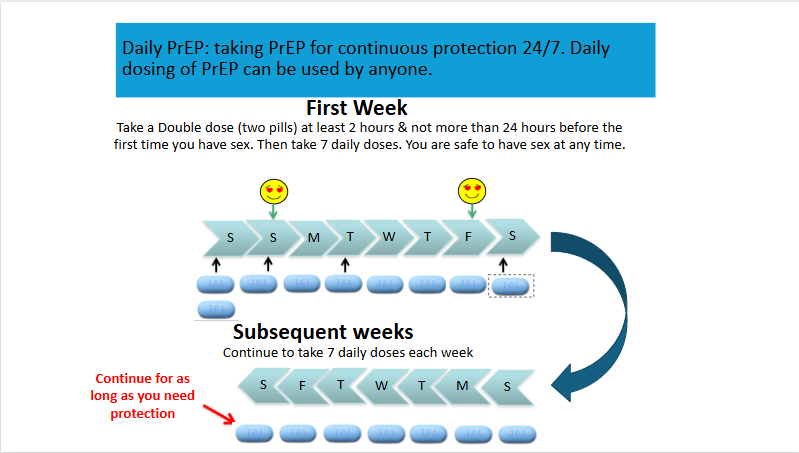
Daily PrEP: protection 24/7​

Most PrEP studies have used daily PrEP – taking one tablet around the same time every day​. 

Daily PrEP is suitable for anyone, having any kind of sex. 

Taking PrEP every day helps ensure there are protective drug levels 24 hours a day, 7 days a week​. 

For people who routinely have sex more than once a week daily PrEP is likely to be a better dosing option​.

Daily Dosing infographic
click to enlarge

Daily dosing

For daily dosing PrEP can either be started with​:

  • One tablet a day for 7 days OR
  • A double dose 2-24 hours prior to sexual intercourse/exposure and a single dose each day thereafter.

When stopping PrEP it should be continued for following number of days after last exposure​:

  • 2 days if receptive anal sex or insertive anal, vaginal or neovaginal sex
  • 7 days if receptive vaginal or neovaginal sex
  • 7 days if injecting drug use

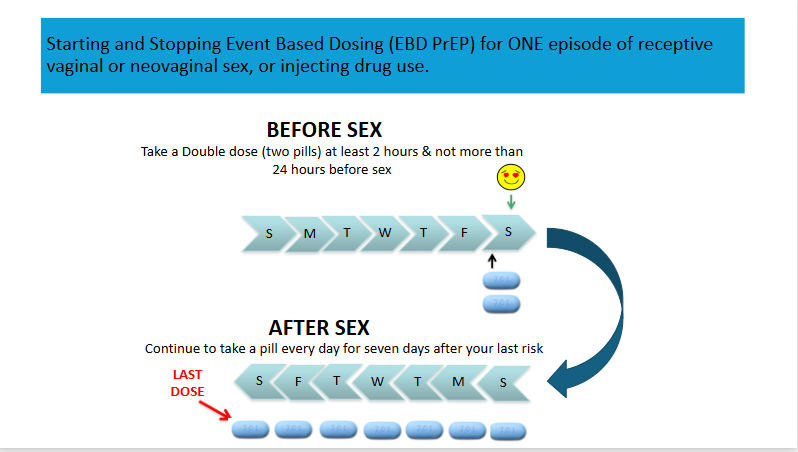
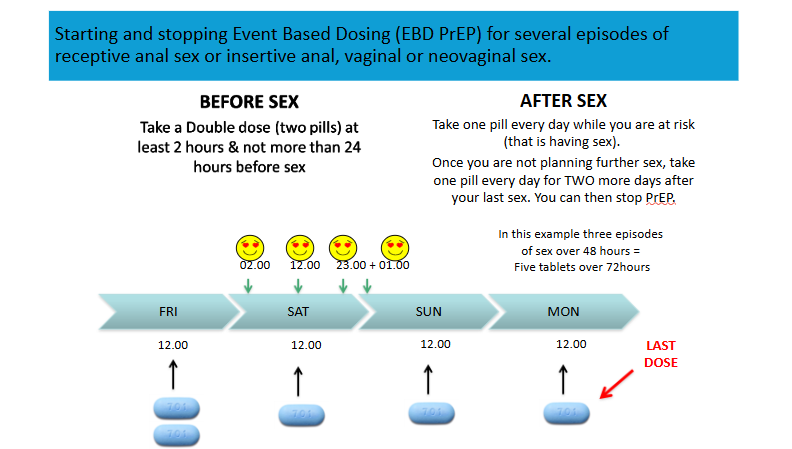
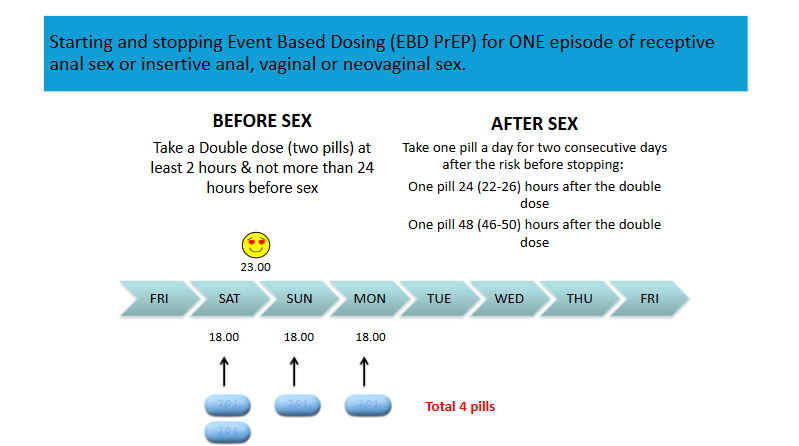
Event-based dosing (EBD)​

Event-based dosing involves:

  • Taking a double dose of PrEP (two pills) between 2 and 24 hours before sex

After initial double dose, PrEP should be continued for following number of days after last exposure

  • 2 days if receptive anal sex or insertive anal, vaginal or neovaginal sex
  • 7 days if receptive vaginal or neovaginal sex
  • 7 days if injecting drug use​​


Start stop infographic1
click to enlarge
Start stop infographic 2
click to enlarge
Start stop infographic 3
click to enlarge

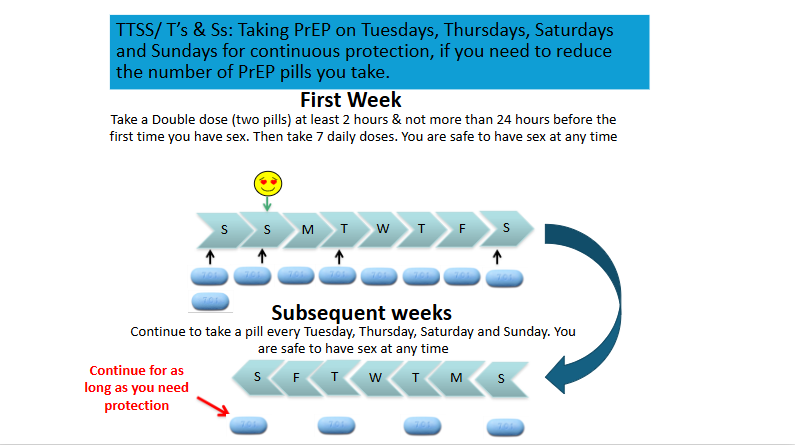
Intermittent dosing – TTSS/T’s & S’s​

Some people may choose to use intermittent dosing – 4 daily tablets spread over a week providing 24/7 protection.

Most commonly these are taken on Tuesday, Thursday, Saturday and Sunday (and therefore names TTSS or T's & S's)

This may be helpful if patients need to reduce exposure to PrEP due to renal toxicity or other side effects but require continuous protection.

This requires optimal adherence to be effective (i.e. no less than 4 doses in total each week). Discussion with a specialist PrEP clinician is advised to ensure that this doing option is appropriate for the individual user.

TTSS infographic
click to enlarge


PrEP and drug resistance

Since implementation of the PrEP programme in Scotland in July 2017, 14 HIV seroconversions have been recorded among individuals ever prescribed NHS-funded PrEP13 (although it is not known if all individuals were taking PrEP at the time of HIV acquisition). ​

If a person tests positive for HIV while taking PrEP, there is a small risk of developing drug resistance. This means that the drug regimen used for PrEP may not work as well to treat HIV.​

In PrEP studies, there were very few HIV acquisitions whilst taking PrEP and, of these, one in 20 developed drug resistance which is lower than the overall rate of HIV resistance in the UK (7.5% in 2015).​

Highest risk of drug resistance is if individuals start PrEP when they are already living with HIV or if they stop PrEP and their HIV status is not checked prior to restarting.​


PrEP and other STIs

  • PrEP will not protect against other STIs and condoms are still advised for prevention of these infections.​
  • Generally, STIs are manageable but can cause unpleasant symptoms, some of which can be serious.​
  • Bacterial infections can be treated successfully with antibiotics but there is a risk of developing antibiotic resistance.​
  • Regular checks for STIs when taking PrEP is important, as is the use of condoms.​
  • Symptoms or a diagnosis of an STI in Primary Care is an important trigger to consider when discussing PrEP.  ​

Does PrEP interact with other medications?​

Tenofovir disoproxil and emtricitabine do not interact with many other medicines but should be used with caution with other drugs that have renal toxicity

Tenofovir disoproxil and non steroidal anti-inflammatory drugs

  • One important interaction is between tenofovir disoproxil and non-steroidal anti-inflammatory drugs, especially diclofenac. Together they can cause kidney problems
  • Other medicines from this class include ibuprofen and naproxen
  • Advise patients to avoid using these medicines while taking PrEP
  • Further information can be found at the HIV Drug Interaction Checker

Recreational drugs

  • PrEP does not react with other recreational drugs but if these affect kidney function they should not be taken at the same time as PrEP

Before starting PrEP​

  • Ensure an individual has a HIV test before starting PrEP​. It is NOT necessary to wait for an HIV test result before staring PrEP.​ 
  • PrEP must not be used if someone is already living with HIV​.
  • PrEP should not be started if a person has flu-like symptoms and a recent HIV risk to rule out recent seroconversion​. However it is not necessary to defer PrEP start if someone is asymptomatic but in the window period for HIV due to recent risk exposure/s. 
  • A 4th generation* HIV blood test should be used as it indicates HIV status 45 days ago​.
  • Some near patient tests are 3rd generation** and indicate HIV status up to 3 months ago. This should be repeated out with the window period or a 4th generation test be used prior to PrEP if there have been interim risks ​.
  • Risk assessment and patient discussion should be used to decide whether a patient who is still in the window period for HIV testing should start PrEP .

*4th generation HIV test- detects p24 HIV antigen present on the outer shell of the HIV virus which is present in early infection  ​​ 

**3rd generation HIV test- detects HIV-specific antibodies and whilst extremely accurate, they are unable to detect the early period of HIV infection due to the low concentrations of anti-HIV antibodies in early infection 

The following tests should be done at baseline: ​

  • sexually transmitted infections​
  • hepatitis B (recommend vaccination, or boost a previous vaccine as appropriate)*​
  • hepatitis C​
  • kidney function (this should be checked via blood test for creatinine prior to starting PrEP)​

*Hepatitis B positive individuals can still use PrEP but daily dosing is preferred. Those with newly diagnosed hepatitis B should be referred for hepatology assessment.​


Routine monitoring​

Registered practitioners should advise clients of the importance of regular review:

  • Patients will require regular (usually 3-6 monthly) 4th generation HIV test and STI screen (usually chlamydia, gonorrhoea and syphilis)
  • Frequency of testing for renal function, hepatitis B and C depends on patient factors and should be done as per local protocol

Other considerations​

Practitioners should discuss any concerns individuals may have in relation to taking PrEP including:​

  • Adherence ​
  • Any new health issues including symptoms of seroconversion such as: sore throat; myalgia; flu like symptoms; and rash​
  • New medications and interactions​
  • Recreational drugs​
  • Relationship issues including pressures from others to take PrEP ​