Warning

For many, the sense of rehabilitation starting is when they begin to regularly get out of bed and attend the gym. For some, this process will begin while they are still in Edenhall, while for others, they will have already have moved the short distance through to the Philipshill ward.

People can feel a little anxious moving from Edenhall to Philipshill. The quality of care is the same level but how the two wards feel is different. It is important to remember that Edenhall is a high dependency unit for acutely injured and unwell individuals. Philipshill is a rehabilitation ward charged with getting people to their maximum level of recovery. As such, you will be expected to do more and play an active role in recovery when you move into rehabilitation. The nursing team should intuitively know your needs, but if this is not the case, they are open to learning and being directed in how best to care and support you.

At this stage in your journey, you will be spending less time with the medical team. Rehabilitation may only last a week while for others it may last several months.

You will be spending less time with the medical team and more time with the rehabilitation nurses, physiotherapists, occupational therapists, psychologists and discharge coordinators. You will be introduced to peer support volunteers and the services offered by various support organisations. 

The team will help you to set goals for your rehabilitation and identify what you can do for yourself, within the limitations of your injury. You will be offered group and individual education sessions to help you understand your options and you will be encouraged to put the skills learned in physiotherapy and occupational therapy sessions into practice on the ward.  You will also be supported to start to spending time off the ward and out of the hospital.

Nursing

Across your stay, one of the most important aspects of your rehabilitation will be the skills you learn from the nursing team. The nurses will work with you to help you to learn to manage your bowel and bladder, understand the care your skin now requires, and how to apply the skills learned in the gym to the ward environment.


Prognosis Meeting

In the early days after your injury it can be difficult to predict how you may recover. The picture for the doctors and the rehabilitation team often becomes clearer as they get to know you.

Once any acute medical issues have settled and once they have enough evidence at their disposal, the consultant will arrange a meeting with you. A family member often attends this meeting. Here, the objective is to explain the nature of the spinal injury, how it may affect your body in the longer term, and to discuss the timescales required for rehabilitation.

The prognosis meeting is an opportunity to learn and to understand what has happened, what has changed, and often marks the beginning of the recovery process. For some, it can confirm fears while for others it can nurture hope of future recovery. The process of developing an understanding of the spinal injury can be stressful and the team as a whole will always be around to answer any questions or to listen to any concerns.

The psychological reaction of an individual and their family to difficult news can vary from person to person. Some may feel the prognosis is negative or quashed their hope, while others will appreciate knowing what the issues are and what one can expect going forward. There is no right or wrong way to react to feedback from the consultant about how they think you will progress. What is important is that the individual, family, and rehabilitation team are all working with a shared knowledge and all are working to the same goal. Even if you do not agree with the team's prediction as to how much recovery can be made, it is important that you know their opinion.

The psychological processes involved when we hear bad news means that the information is not always processed or remembered efficiently. It is common for the consultants to tell an individual or a family the prognosis for the person's spinal injury and for that information to be forgotten. If this is the case, the consultant or other members of the team can re-cover information.

Goal Planning

Goal planning has long served as a core principal of rehabilitation across the last few decades. The scientific literature suggests that by setting difficult but specific short-term and long-term goals, outcomes in rehabilitation can be maximised.

Goal planning meetings typically occur within 3 weeks of you getting out of bed and beginning to mobilise. The key members of your rehabilitation team come to the meeting - usually nursing, physiotherapy, occupational therapy, and your discharge coordinator. Medical doctors, psychologists, or speech and language therapists tend to attend when there are concerns or goals in their area of practice. Individuals usually attend with a family member, but this is not essential and it is also possible to attend remotely via computer link.

The core purpose of the goal planning meeting is to set the agenda for the coming 4 weeks of rehabilitation. Essentially, what is going to be different in 4 weeks time? What are we trying to achieve?

Examples of goals would include:

  • “In 4 weeks time, I will be transferring from my wheelchair in and out of a car”
  • “By the 30th June, I will be walking the length of the gym with the aid of two crutches”
  • “By the point of discharge, I will feel confident enough to go out in my power chair and order food at the
    hospital canteen”

Typically, you will have two to four goal planning meetings prior to your discharge. The number of meetings depends on the level of recovery and the timescales required to achieve your goals.

While an individual may have the goal “to get back to normal”, the goals of rehabilitation are often more specific, measured, and achievable. The aim of rehabilitation is to maximise recovery and independence given the injuries sustained. The nature of spinal injury is such that "recovering to 100%" or "getting back to normal" is often outside of what is possible.

Occupational Therapy

Your occupational therapist (OT) will come to meet you on the ward and find out about what is important to you. They will then review various areas of your daily life and support you with the following:

Housing, adaptations and equipment

  • Your spinal unit OT will work with you and your local community OT to assess your property to see if this is suitable for going home and for the long-term. If you need equipment and/or adaptations, these will be discussed with you and arranged where possible.
  • If your home is not suitable for you with equipment and adaptations, support with rehousing will be provided.

Upper limbs

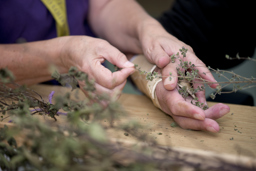
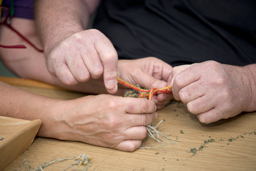
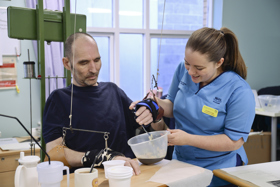
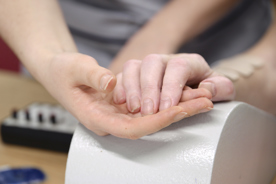
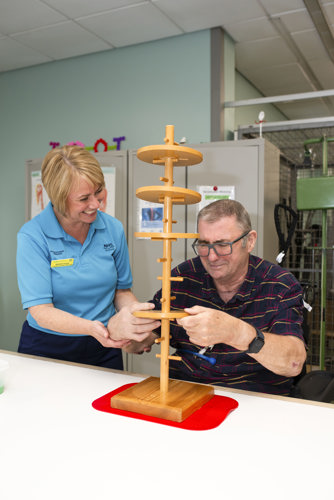
  • Depending on your injury level, you may attend hand therapy to learn techniques and use equipment to work on daily tasks like using your phone or tablet, eating and drinking, grooming tasks, and writing.

hand therapy                          Hand therapy tying knots


Patient and therapist hand therapy                   Hand therapy - flexing fingers


Upper limb dexterity

Seating, posture and pressure care

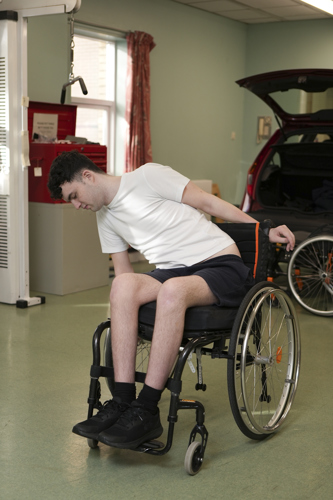
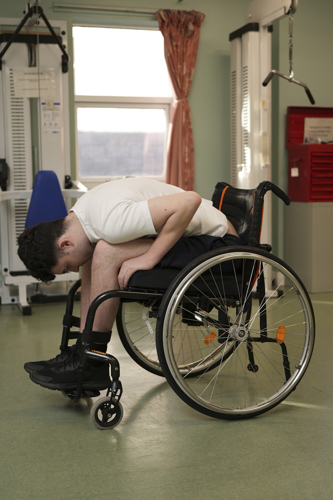
  • When you are up in your wheelchair, a cushion is required to protect your skin from being damaged. While in the Unit, the OT department will loan you a suitable cushion and if required, your own cushion will be ordered for you during your stay.
  • You may need support to sit well in your wheelchair. Your OT and physiotherapist will work together to help with this.

Pressure relief leaning sideways  Pressure relief leaning forward


Pressure relief lifting

Personal activities of daily living

  • You will work with your OT to progress your independence with eating, drinking, grooming tasks, washing and dressing. This may involve learning new ways of doing the task or using equipment. Some people will require carer support with these tasks and your OT will discuss this with you. If required, your OT will link with the team to arrange this.

Domestic activities of daily living

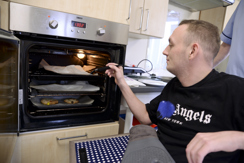
  • You will work with your OT to learn how to use new techniques or equipment to complete domestic tasks such as cooking, cleaning, ironing, laundry. Some people require carer support with these tasks and your OT will discuss this with you.

Cooking             Using an oven

Work, education, leisure and driving

  • Your OT will discuss work, education, leisure activities, holidays and driving with you and offer advice and support with these areas.
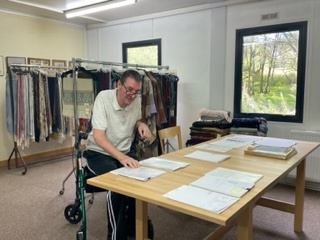
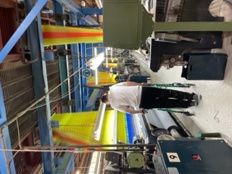
  • Returning to work after a spinal cord injury can boost your confidence, provide many benefits, as well as financial, to you after your injury.  It can boost your confidence, provide social interactions, support you to structure your week and gives you regular meaningful activity.  Your OT will provide advice and guidance to you with returning to work or retraining during your rehabilitation. 


Returning to work 1  Worksite visit


  • Access to Work is a government scheme that assists with travel to and from work, equipment for use at work and liaising with your employer to support your return.  You can self-refer for this and further information is available on their website:

  • Many people can return to driving after their spinal cord injury, if they want to.  If you didn’t drive before, you can often learn to.  To get more information on the legal obligations for driving after your injury, please speak to your OT.  Some people require a driving assessment to determine adaptations that may be needed to their vehicle. Remember, the legal responsibility lies with you to inform the DVLA if you know of any medical condition that would affect your ability to drive. 

  • The Motability Scheme can be used to support you to lease a vehicle, if you are entitled to this.  For more information on this, see their website:

  • If you do not drive after your injury, it should be possible to use public transport.  Most buses are now wheelchair accessible and you can get support to get on/off trains. Scotrail have further information on this on their website.  Your local bus service should also have information online. Many taxi’s are also accessible

    by wheelchair.

Physiotherapy

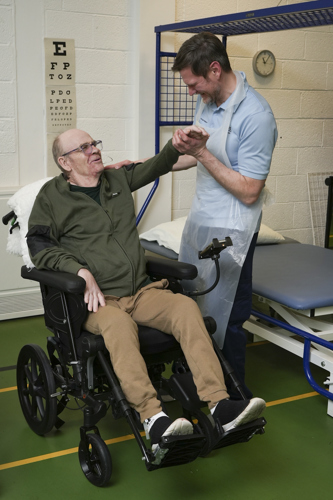
The physiotherapy team consists of physiotherapists and physiotherapy support workers. We will often have student physiotherapists in the department as well. Upon admission to spinal injuries unit, you will be allocated a physiotherapist who will work with you for the duration of your stay in rehabilitation.

Acute Phase

Physiotherapy starts as soon as possible, normally within 24 hours of admission. A physiotherapist assesses the movement and sensation you have as well as evaluating your chest and respiratory function.

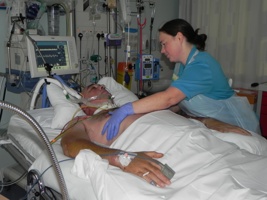
In the acute phase, normally while you are in Edenhall ward, daily exercises are carried out to maintain your range of movement or work with whatever strength you have. Chest care will be provided if required.

When medical staff have requested for you to get out of bed (normally after a period of bedrest or an operation), the physiotherapist will do this with a member of nursing staff. In most cases, the first time you get out of bed it will be into a wheelchair. 

Ventilated patient  Passive movements

Rehabilitation

Once you have started getting up, you will attend the gym to see your physiotherapist, and will normally build up to have at 4/5 sessions of physiotherapy per week (weekdays only). This process normally starts while you are in Edenhall ward , and continues when you move to Philipshill ward. The content of physiotherapy sessions is tailored to each individual and the type of injury you have and may contain:

Strengthening

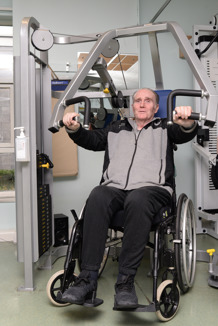
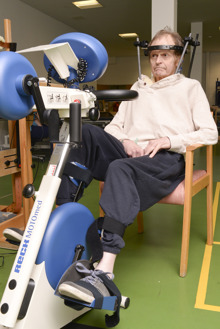
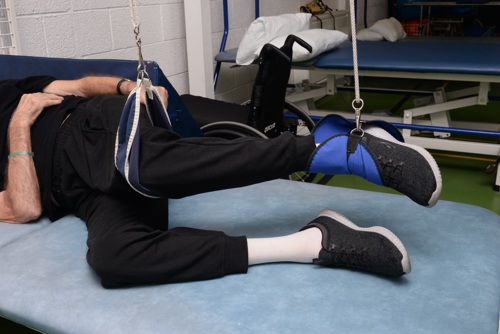
The physio team will support you to increase the strength in the muscles that still have signals getting to them after spinal cord injury. This may involve use of weights machines, leg bikes, active exercises, electrical stimulation and other forms of resistance exercises.

strengthening exercise     Strengthening exercise 2


Strengthening exercise 3

Stretching

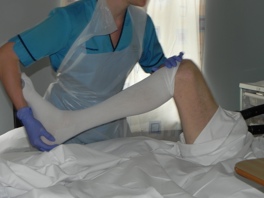
Within physiotherapy sessions you may undertake stretching of tight muscles. This may be carried out either by staff, or you may be shown how to do this independently. Sometimes ward staff may support patients to stretch in bed prior to getting up, or apply splints for a longer duration stretch outwith gym times.

Stretching

Bed mobility

Where appropriate, you may undergo practice of bed mobility as part of your rehabilitation. You will practice rolling side-to-side, getting from lying down to siting up and vice versa, and how to lift your legs on and off the bed.

Sitting balance

Due to spinal cord injury many patients have weak or ineffective core muscles. Part of physiotherapy intervention may include helping you improve your sitting balance and stability, particularly before undertaking any transfer work.

Transfers

For many patients a key part of physiotherapy is to learning how to transfer into their wheelchair. If the level of your injury permits learning this skill, you will initially learn how to do it in the gym before applying this skill in the ward, on and off your bed and showerchair, into a car, a sofa and possibly even on and off the floor.

Wheelchair skills

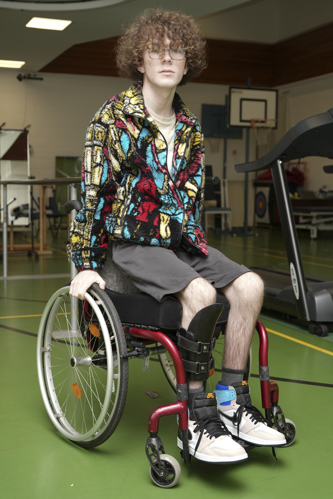
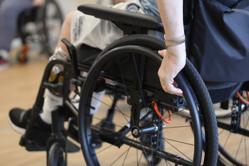
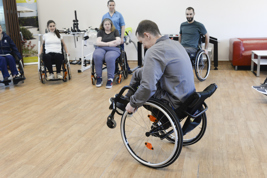
During you rehabilitation, you will learn how to use a wheelchair efficiently. This may include being able to move around indoors, to more advanced skills like back-wheel-balance, negotiating kerbs, uneven surfaces and slopes. Where appropriate the physiotherapy team, often in conjunction with a wheelchair skills trainer from Back-Up , will organise supported trips out the unit perhaps to a local supermarket or restaurant as part of rehabilitation.

If you require a manual wheelchair after discharge, this will be measured up by the physiotherapy team and an appropriate wheelchair will be provided. For those who require a powered wheelchair we endeavour to carry out a trial within the unit if we have an appropriate powerchair and a referral will be sent to your local wheelchair service for assessment and provision. 

Wheelchair skills (both manual and powerchairs) are also covered within the patient education programme.

Manual wheelchair                       Manual wheelchair wheelies

Standing frames/ Tilt table

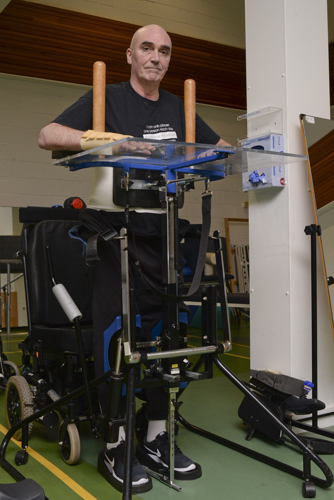
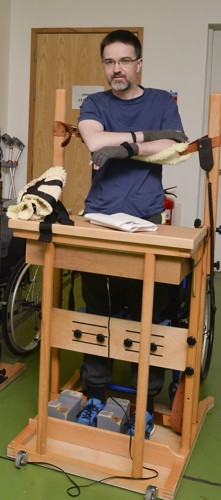
Many patients suffer from low blood pressure after their injury. In the initial stages of rehabilitation the physiotherapy team may use a tilt table to get you used to being in an upright position.  Even those with a complete injury can benefit from standing. If appropriate, you may progress onto using a standing frame regularly within gym sessions and a standing frame may be ordered for use at home after discharge if  your accommodation is suitable and there is somebody who can be trained to assist if required.

In the longer term there are many benefits to standing including maintenance of range of movement, reduction in spasm and to minimise loss of bone density.

      Tilt table Standing frame

Standing/ Walking

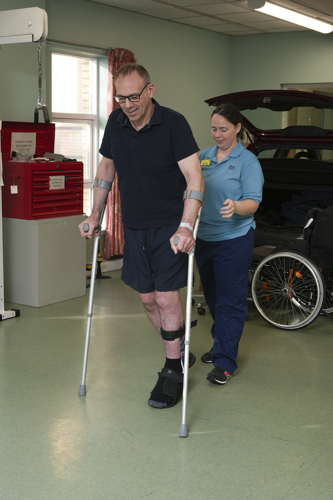
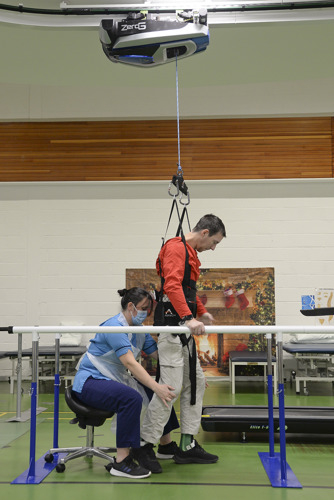
For those who are able, physiotherapy may focus on standing and walking. This may involve strengthening muscles, gait (walking) practice with or without walking aids, balance re-education and use of technology such as the ZeroG system to assist the process.

Standing with crutches   Spinal balance

Sport and Recreation

Sport has always been an integral part of rehabilitation after Spinal Cord Injury. On Wednesday afternoons patients are given the opportunity to participate in sports sessions with support organisation WheelPower. We encourage everyone, regardless of your level of injury to attend these session as they are not solely about sport, but also help with wheelchair mobility, balance, mood and confidence. For may sports we are able to adapt the session to allow even those with limited upper limb function to participate.


Clinical Psychology

Spinal cord injury has far-reaching consequences. There are many adjustments which need to be made to adapt to your new situation, both physically and psychologically.

Following admission to Edenhall, it can be difficult to take in the reality of the situation. There may still be uncertainty regarding prognosis and thinking may be clouded by medication, stress, or injury.

Once you are medically fit and able to process information, your medical consultant will discuss your case with you and your family. They will share their thoughts regarding your long term outcome.

Some people find it is helpful to understand their injury in detail and learn how it will impact on their future. For others, this can seem overwhelming and they may only want to know the basics. The staff will be guided by you as to how much information to provide to you and your family.

People can experience a wide range of emotions after learning about their injury. Some may be distressed if it should confirm their fears, while others may be relieved that their recovery is expected to be significant.

It can often be helpful to talk with your consultant, other staff, or family about how you are feeling. Some may also find that reflecting on their emotions with the Unit’s clinical psychologist may also be helpful.

Early Stages

In the early stages after admission, people often report that they are in less control of their emotions. You may experience significant ups and downs in how you are feeling, you may be more tearful, or you may feel numb or find it difficult to describe your emotions. Other people may seem ‘fine’. These differing reactions are all considered normal and there is no right or wrong way to process the loss that comes with spinal injury.

Our initial emotional reaction is often influenced by:

  • What we were like prior to the injury (personality, coping style, beliefs)
  • Poor sleep
  • Medication
  • Cognitive difficulties
  • Withdrawal from alcohol or drugs
  • Being on bed rest

One of the factors that often complicates early psychological processing is being on bed rest. This may be needed while awaiting surgery to mend fractured bones, to allow any pressure marks on skin to heal, or because the doctors think the bones in your body will heal best naturally by remaining in bed.

After spending time on bed rest, people tend to look forward to "getting up". This often means a slow transition period from being flat in bed, to sitting up in bed, to brief periods in a wheelchair. People often notice a lift in their sprits at this point as their thinking begins to focus on rehabilitation and increasing independence. For others, it can bring greater insight into the challenges that lie ahead.

In the early stages, people can draw comparisons with the grief that can follow from the loss of a close relative or friend. With the passage of time, people begin to understand their situation, acute distress tends to settle, and they begin to plan a way forward.

Rehabilitation

It is likely that you and your relatives will get used to the staff and procedures in Edenhall during the few weeks that you are there. Once medically stabilised, you will progress on to rehabilitation on the Philipshill Ward. While this is a positive step, it will be something new and some people may find this change stressful. Staff from both wards should meet with you to discuss this transition and how you are feeling about it.

During rehabilitation, people tend to focus on physical improvement. Some may ignore the psychological stresses that they are under, or reason that if they “fix the physical changes, they would not have anything to worry about”. In the short term, this is not necessarily an unhelpful approach and managing from day to day can allow people to cope. In the medium to longer term, people typically benefit from recognising and reflecting upon the psychological impact of their injury. This does not have to be with the Unit’s clinical psychologist and many will get benefit from discussions with family and friends, others going through rehabilitation, or the representatives from the various charitable organisations which are present in the Unit. Family also provide a wealth of valuable support.

For some, it may be that spending time receiving formal professional support is of benefit.

Psychological Input

In the context of the spinal unit, the clinical psychologist will often see those who are finding that the stresses and worries that an injury to the spinal cord brings are outstripping their normal coping mechanisms.

The clinical psychologist will most likely meet you for a brief discussion while you are in Edenhall. This is mainly to find out how you functioned prior to your injury, you understanding of what has happened to you, and how you are coping. They will help establish your main concerns, identify which difficulties may have answers to them, and help to cope and adapt to those which do not.

The clinical psychologist will also try and spend time with your next of kin and ask how they are managing. It can be difficult sometimes to coordinate a meeting with relatives but if they say to the nursing staff that they wish to meet, the clinical psychologist will then prioritise this.

As your rehabilitation progresses, many find it is helpful to reflect on their emotions. Typically this is a mixture of the frustrations of rehabilitation and the losses that they have encountered as a result of their spinal injury. Others may need more specific treatment for anxiety or depression that has arisen or worsened since their spinal injury. Discussions with the clinical psychologist are confidential.

While some people may experience mild changes in their emotions, others can experience more significant difficulties. The type and frequency of psychology input will vary according to what is jointly seen as being helpful.

The Unit also has access to the hospital's liaison psychiatry service. Liaison Psychiatrists are medical doctors who specialise in mental health in those with physical or health issues in a hospital setting. They can often be asked to see someone when medication may play a useful role in helping them cope effectively, or when they have more severe mental health difficulties. 

Long Term Outcome

How someone copes in the longer term tends not to depend on the injury that they had. Some people assume that a more debilitating injury is somehow worse but this is not necessarily the case. The most influential factors tend to be:

  • How someone perceives their situation
  • Belief that they can cope and influence their situation
  • Social support
  • Meaningful activity

People continue to adapt to their new situation over the course of their rehabilitation and in the years that follow. Some will adjust with ease while for others it may be tougher and they may benefit from additional support. Research does note that quality of life can be affected in the longer term. If quality of life should be affected, people often cite factors such as physical and mental health or social/environmental factors such as housing. In general terms, it is often the case that people report quality of life increases as the time from injury lengthens.

Relatives

While the spinal injury has happened to you, relatives tend to experience a very similar emotional reaction. They will have many of the same worries and fears that you have. There is a lot to be gained by discussing these worries. More often than not, you will be reassured and feel more secure after such a discussion.

Your relatives are able to discuss any worries that they may have with the clinical psychologist. This can be done on a one to one basis or jointly with you. They can also come along to monthly meetings within the Unit for relatives. These meetings set out the stages of recovery and allow your relative to discuss any worries they may have.

Relatives can also receive support from The Back-up Trust, Spinal Injuries Scotland, or access emotional support via their own GP.

Additional Information

There are additional psychological resources available in the Education section.

Contact Details

Dr Campbell Culley, Clinical Neuropsychologist

 0141 201 2547

 campbell.culley@ggc.scot.nhs.uk

The Clinical Psychology office is opposite the swimming pool. You and your relatives should feel free to knock on the door if you have any concerns at any stage in your rehabilitation.


Length of Stay

The length of stay in the Unit is largely dictated by recovery potential and the progress you are able to make over time. On average, people stay in the unit for three to four months. This can vary significantly from person to person for varying reasons. Length of stay is also influenced by factors such as:

• The level and severity of the spinal injury
• Age
• Other injuries or health conditions
• Psychological well-being (mental health/cognition)
• Illness or issues such as urine infection
• Pressure sores

Prolonged Bed Rest

There may be periods during your rehabilitation when you will be required to stay in bed to allow a fractured bone or broken skin to heal. 

During this time, your rehabilitation will focus on activities that can still be carried out from your bed such as assessment, education and completing any relevant forms e.g. a benefits review.  You will also be encouraged to do what you still can for yourself as far as is practically possible to prevent you from deskilling, becoming weaker or stiffening up. 

The physiotherapy and occupational therapy team may carry out some stretching, strengthening or task practise at your bed side on the ward or provide you with exercises to carry out yourself.  You may also be able to attend the gym in your bed.  Your therapy provision while on bed rest will depend on your level of spinal cord injury and the reasons why you are on bed rest.   

Some types of beds and/or infections may prevent you from leaving your room and may limit your ability to engage in rehabilitation while on bed rest. 

Editorial Information

Last reviewed: 30/09/2024

Next review date: 30/09/2028

Author(s): Editorial Group QENSIU .

Version: V1

Co-Author(s): louise.cownie@nhs.scot , campbell.culley2@nhs.scot , mary.hannah@nhs.scot , susan.gilhespie2@nhs.scot , claire.lincoln2@nhs.scot .

Reviewer name(s): Mary Hannah.