Uses of Entonox
- Pain relief in labour. For a period not exceeding 24 hours.
- Short term relief during painful clinical procedure, such as suturing
Adverse side effects
- Dry mouth
- Events such as euphoria, disorientation, sedation, nausea, vomiting, dizziness and generalised tingling are commonly described. These events are generally minor and rapidly reversible.
- Myloneuropathy and sub acute combined degeneration have also been reported following prolonged or frequent use. However in patients with undiagnosed subclinical deficiency of vitamin B12, neurological toxicity has occurred after a single exposure to nitrous oxide for anaesthesia.
Entonox should not be used with any condition where air is entrapped within the body and where its expansion might be dangerous such as:
- Artificial, traumatic or spontaneous pneumothorax
- Head injuries with impairment of consciousness
- Air embolism
- Decompression sickness
- Gross abdominal distension
Special warnings and precautions for use
- In patients taking other centrally acting depressant medicinal products, such as such as morphine derivatives and/or benzodiazepines, concomitant administration of ENTONOX may result in increased sedation, and consequently have effects on respiration, circulation and protective reflexes. If ENTONOX is to be used in such patients, this should be under the supervision of appropriately trained personnel.
- Thorough ventilation or scavenging of waste gases should reduce operating theatre and equivalent treatment room levels of ambient nitrous oxide to a level below 100ppm
- ENTONOX is non flammable but strongly supports combustion and should not be used near sources of ignition. Because ENTONOX strongly supports combustion and will cause substances to burn vigorously, including some materials that do not normally burn in air due to the high concentration of oxygen within the mixture. It is highly dangerous in the presence of oils, greases, tarry substances and many plastics due to the risk of spontaneous combustion in the presence of oxygen in relatively high concentrations.
- Under no circumstances should oils or grease be used to lubricate any part of the ENTONOX cylinder or the associated equipment used to deliver the gas to the patient.
- Where moisturising preparations are required for use with a facemask or in nasal passages, oil based creams should not be used.
- Wash hands prior to use.
- Check that hands are clean and free from any oils or grease.
- Where alcohol gels are used to control microbiological cross-contamination ensure that all alcohol has evaporated before handling ENTONOX cylinders or equipment.
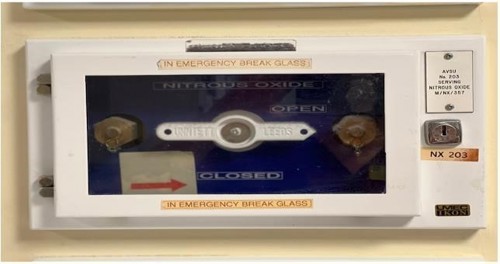
- Staff should be aware of location of shut off valves.
- In the event of a fire the supply of Entonox should be stopped by breaking glass and turning valve to closed. (see picture below)
Administration of Entonox
Entonox must be administered in conjunction with the terms and conditions of the following documents:
- NMC Standards for medicines management
- NMC Midwives Rules and Standards
Midwifery formulary
- BOC Gases Medical data sheet for use of Entonox
- BOC Educational online material
Entonox may be administered by qualified Midwives registered with the NMC, who have received appropriate training. A patient should be continuously monitored whilst using Entonox to ensure there are no adverse effects.
N.B. During administration the midwife should try not to position herself between the ventilation outlet and the women.
Method of Administration
- ENTONOX is administered through a facemask or mouthpiece. The face mask or mouthpiece is connected to an ENTONOX supply through a demand valve system which allows the Entonox to be self-regulated by the patient. The demand valve is operated by the act of inhalation of the patient and closes down when the patient ceases to inhale.
- Cylinder – check if there is gas in the cylinder, by turning on, and examining the gauge.
- Piped Entonox – check the flow of Entonox by pressing the purge button.
- Check there are no contra-indications prior to administration.
- Ascertain how much the woman knows about Entonox. Explain the use of the inhalational gas and how to use the apparatus effectively.
- Encourage the patient to start using the Entonox at the beginning of a contraction and throughout the duration of the pain.
- Observe the effects (both desired and adverse) on the patient and ensure she is using the equipment correctly.
- Entonox can be used in conjunction with other forms of pain relief.
- The filter and mouthpiece are single use only and should be disposed of when finished.
Overdose
When used appropriately, there is no risk of overdose with ENTONOX Inappropriate, unwitting or deliberate inhalation of ENTONOX will ultimately result in unconsciousness, passing through stages of increasing light-headedness and intoxication. The treatment is removal to fresh air, mouth-to-mouth resuscitation and, if necessary, the use of an oxygen resuscitator.
Special precautions for storage
ENTONOX cylinders should be:
- stored under cover, preferably inside, kept dry and clean
- not stored near stocks of combustible materials
- Storage away from heat source
- not subjected to extremes of heat or cold
- stored separately from industrial and other non-medical cylinders
- stored to maintain separation between full and empty cylinders
- used in strict rotation so that cylinders with the earliest filling date are used first
- stored separately from other medical cylinders within the store
- F size cylinders and larger should be stored vertically. D size cylinders and smaller may be stored horizontally
- Storage at home (see assessment)


 Maternity & Gynaecology Guidelines