1. Right Decisions
  2. Maternity & Gynaecology Guidelines
  3. Maternity
  4. Back
  5. Antenatal, general
  6. Latent phase labour (409)

Latent phase labour (409)

Warning

Objectives

This guideline aims to support staff on how to assist women to manage the latent phase of labour. Women should be given support and coping strategies to remain at home until active labour is established. This guideline will refer to women between the gestations of 37-42 weeks, planning a vaginal birth.

Audience

Midwives and Obstetricians

Please report any inaccuracies or issues with this guideline using our online form

Introduction

According to NICE Intrapartum Care Guideline (NG235), the latent phase of the first stage of labour is defined as the period when the cervix typically softens and begins to efface, up to 4cm. Contractions may be irregular and vary in intensity. Women may also present with backache, loss of the mucous plug (show), nausea or loose stools. This stage of labour can often last 2-3 days before active labour commences, especially in primiparous women. Women who are multiparous may have a shorter latent phase of labour.

The quality of care provided during the latent phase of labour can significantly shape a woman’s overall childbirth experience. This early phase is particularly sensitive to external influences, including the environment and interactions with healthcare providers, which can affect the duration and progression of labour. According to the World Health Organization, respectful, woman-centred care during this time should prioritise emotional support, reassurance, clear communication, and the provision of information to reduce anxiety and promote a positive labour experience.

Roles/Responsibilities

Assessment, management and care of the woman should be undertaken by a midwife if the woman is low risk. Midwives must identify women who are high risk, especially those who deviate from their original care pathway and seek support from an appropriate grade doctor if needed. All members of staff responsible for care should be up to date on all mandatory training including midwives working in telephone triage.

Antenatal Period

Women should be signposted to appropriate evidence based antenatal information and education to enable them to understand the normal processes of labour and what to expect. This will include directing women towards information including ‘Ready Steady Baby’ and spending time during antenatal appointments discussing birth plans.

Early Labour Support via Telephone Triage

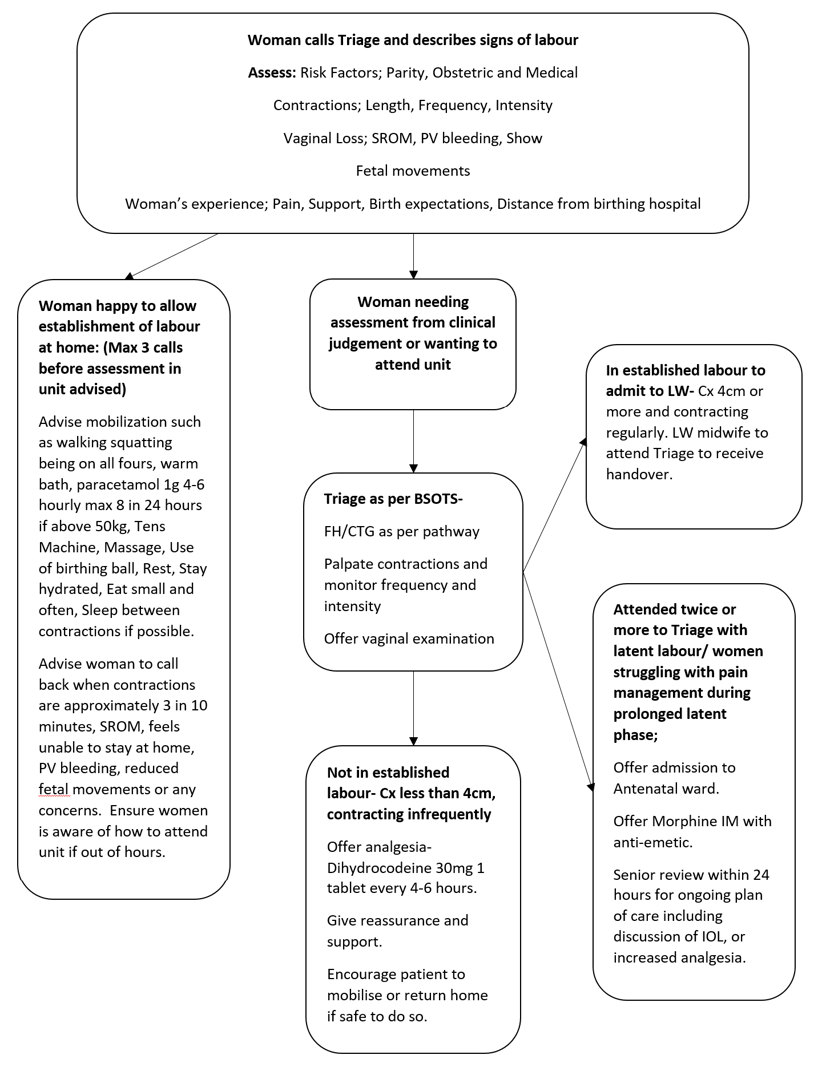
NICE (2023) recommends that if a woman contacts maternity triage for labour advice, the midwife should carry out an assessment on the telephone to determine if a face-to-face assessment is required.

The telephone triage midwife should ensure they have looked at all previous communications to allow for full oversight of the clinical situation. This will allow the midwife to identify women who have phoned multiple times that may need a face-to-face review.

The midwife should ensure appropriate professional telephone interpretation is in place to enable a full discussion with a woman who does not have English as a first language.

The midwife should ensure the call duration allows a full assessment of the woman’s uterine activity and allows time for the midwife to fully obtain the woman’s account of her pregnancy up until now considering any risk factors or concerns the woman may have.

Women who call twice within 24 hours may be offered a face-to-face assessment if the midwife taking the call has any concerns that the symptoms being described are out with what is expected of the latent phase of labour. Women who have experienced a prolonged latent phase of labour and have contacted triage multiple times should be considered for a face-to-face assessment by their third call.

Any woman who is not coping at home, regardless of how many phone calls they have made, or has any concerns with their health or the wellbeing of their baby should be offered immediate face to face review.

The following information should be included in a triage assessment of labour:

  • ask the woman how she is, and about her wishes, expectations and any concerns she has
  • ask the woman about the baby's movements, including any changes
  • give information about what the woman can expect in the latent first stage of labour and how to work with any pain she experiences
  • give information about what to expect when she accesses care
  • agree a plan of care with the woman, including guidance about who she should contact next and when
  • Provide guidance and support to the woman's birth companion(s).

The midwife should be able to confidently give advice on latent phase of labour coping strategies over the phone, for example:

  • Performing activities as normal
  • To go for a walk
  • The use of water (warm shower/baths)
  • Distractions through listening to music, watching television
  • Using a TENS machine when the contractions become uncomfortable
  • Using breathing and relaxation techniques such as hypnobirthing
  • To try different positions and the use of a birthing ball
  • To try massage. Women with babies in the occipito posterior position often experience increased back pain; massage and back rubbing may help this.
  • To try to sleep/rest/nap when able too
  • To keep well hydrated and eat light snacks to maintain energy levels
  • To continue to monitor fetal movements

In addition, midwives must establish that they have appropriate social support and give advice on when to call back.

When inviting a woman in for a hospital review, the midwife should identify if the woman has access to appropriate transport to attend.  Where a woman states that she does not have means to pay for taxi or public transport, the midwife should assess whether an ambulance is required or whether a hospital taxi could be arranged.


In Person Assessments in Triage

When carrying out an early labour assessment, midwives should be mindful of the environment in which the woman will be assessed and try to make it welcoming and relaxing environment, using dimmed lights and reducing noise levels.

It is important that midwives use encouraging, affirming and enabling language to help support and reassure women in early labour (BJM, 2019).

Studies suggest maternal satisfaction and probability of vaginal birth is likely to increase if the environment is free from medical equipment and facilitates self-comforting behaviour.

The midwife assessing a low-risk woman in early labour should carry out:

  • Full set of observations
  • Urinalysis
  • Symphysis fundal height measurement if not carried out within the last 2 weeks
  • Fetal heart auscultation- identify the fetal heart with a pinnard and then auscultate for 1 minute with a doppler following a contraction
  • Assessment of frequency, duration, and strength of contractions as well as resting tone in between
  • Vaginal loss/liquor observation (if any)
  • Discuss fetal movements

NICE (2023) state that vaginal examinations should not be routinely carried out unless the woman requests one, particularly if it is evident labour has not yet started. If the woman requests a vaginal examination, risks and benefits such as increased risk of infection should be discussed.

Pain Relief Within the Latent Phase

Health care professionals should consider that every woman's experience of pain is unique and may be expressed in different ways, both verbally and non-verbally (NICE). This may vary because of:

  • their cultural background and beliefs
  • their socioeconomic status
  • any neurodiverse conditions they may have.

Women who come to the hospital for a labour check may be offered oral analgesia before returning home.  These analgesics include:

  • Paracetamol 1g – (2x 500mg tablets every 4-6 hours). Maximum of 8 tablets in 24 hours not to be taken with any other Paracetamol containing products.  N.B. If weight <50kg dose of 500mg.
  • Dihydrocodeine 30mg (1 tablet every 4-6 hours), maximum dose of 240mg within 24 hours.

It is the responsibility of the midwife to ensure the woman has a weight measurement documented within the third trimester. The midwife must identify any known drug allergies before giving women any analgesics and ensure all drugs given are charted on the woman’s drug kardex as well as documented on Badgernet.

Women should be advised to return if:

  • SROM
  • PV bleeding
  • Reduced fetal movements
  • Unable to pass urine
  • Abdominal pain/no space between contractions
  • Not coping at home
  • Change in colour of liquor if SROM

A prolonged latent phase of labour can be a discouraging and exhausting experience for women.  An individualised plan of care incorporating the woman’s preferences is vital when the distinction between the latent and the active phase of labour is difficult. (MBRRACE- UK, 2017)

Admission to the Antenatal Ward

Admission can be offered to women who are experiencing a prolonged latent phase and unable to manage at home. This is to offer stronger analgesia such as morphine. Women admitted to the Antenatal ward should be reviewed within 24 hours to create an ongoing plan of care such as Induction of labour, Augmentation of labour or further analgesia input.

If admitted to the antenatal ward 6 hourly CTGs should be carried out following an admission CTG in triage.

Indications for Review by the Obstetric Team in Triage

Women who have attended triage twice or more with the same presenting complaint require review by middle grade at a minimum as per ‘Frequent Attendance for Unscheduled Maternity care in Triage and DCU (1202)’ guideline.

Women in early labour who have concerns regarding any of the following: abdominal pain, RFM, SROM or feeling unwell. 

Appendix: Flow Chart

Editorial Information

Last reviewed: 22/12/2025

Next review date: 31/12/2028

Author(s): Rachael Brennan.

Version: 3

Approved By: Maternity Clinical Governance Group

Document Id: 409

References

British Journal of Midwifery (2019). The importance of language in maternity services. Available at: British Journal of Midwifery - The importance of language in maternity services

Frequent Attendance for Unscheduled Maternity care in Triage and DCU (1202) Available at: Frequent Attendance for Unscheduled Maternity care in Triage and DCU (1202) | Right Decisions

National Institute of Health and Clinical Excellence (NICE) (2023) Intrapartum Care.  Clinical Guideline NG35.  Updated 2025. Available at: Recommendations | Intrapartum care | Guidance | NICE

National Institute for Health and Care Excellence (NICE.,2022). Intrapartum Care for Healthy Women and Babies. Clinical Guidance [CG190] Available at: Intrapartum care for healthy women and babies | Guidance | NICE

MBRACE-UK (2025) Saving Live’s, Improving Mothers’ Care. Available at: MBRRACE-UK Maternal Report 2025 - Main ONLINE v1.0.pdf

World Health Organization (WHO) (2018) WHO recommendations: intrapartum care for a positive childbirth experience. Available at: WHO recommendations: intrapartum care for a positive childbirth experience