

Monitoring fetal growth, Maternity SOP
 Maternity & Gynaecology Guidelines

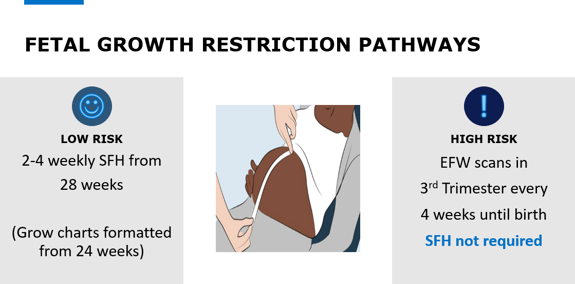
Pregnancies at lower risk of fetal growth restriction (FGR) can be monitored using symphyseal fundal height (SFH) measurements, after 24 weeks gestation.
If the first measurement is below the 10th centile, a scan should be arranged within 3 days. If first measurement is above the 97th centile then refer for scan within 5 days.
If accelerated growth (which may not be over the 97th centile) at any point, then refer for scan within 5 days, for measurement of estimated fetal weight, liquor volume and end diastolic flow. If the SFH remains above the 97th centile on subsequent SFH measurements a repeat scan is not indicated unless there is a significant upward trend in the percentiles.
Always check the growth chart before commencing an antenatal check to decide if the SFH is required. SFH should be measured with a minimum gap of two weeks between measurements, and a maximum gap of four weeks between measurements. If there has been any assessment of growth, by SFH or Scan then you should wait at least 2 weeks before assessing growth again.
If attending for reduced fetal movements the Maternity Triage midwife should always check the growth chart to see if a measurement has been performed recently. Do not perform SFH measurement if it has already been done in the last fortnight or if gestation is below 24 weeks.
Pregnancies at higher risk of growth restriction should have ultrasound assessment of estimated fetal weight (EFW) four weekly from the third trimester until birth. If a patient is due to commence growth scans from 32wks then SFH should be measured at 28wks and patient referred for scan if <10th or >97th. Further SFH measurements will then not be required.
Best practice is continuity of carer when measuring growth, to reduce the human error by changing clinicians.
Late onset growth restriction can be initially detected by measurements below the expected growth trajectory or by static measurements. Clinical judgement must be used to interpret the plotted measurements in relation to the printed growth curves as there is no evidence to suggest that a particular drop is significant. Clinicians should perform a risk assessment to consider the wider picture and arrange an ultrasound scan within 3 days.
Following an ultrasound scan a plan of care should be made based on the findings of EFW, Liquor Volume and end diastolic flow, by the woman’s lead professional, which will depend on her care pathway.
SFH measurement is an evidence-based tool for monitoring fetal growth. It does not completely replace the role of professional clinical judgement in assessing fetal growth and in some circumstances professional clinical concern alone may indicate the need for obstetric review.