Risk of uterine rupture after one previous caesarean is quoted as 1 in 200 (0.5%) in spontaneous labour, 1 in 90 (1.1%) following labour induction or augmentation and 1 in 20 (5%) following previous uterine rupture2. UK based studies quote rate of 1 in 4000 deliveries1.
Uterine Rupture (565)

Warning
Please report any inaccuracies or issues with this guideline using our online form
Uterine rupture is a catastrophic event that is associated with significant maternal and fetal morbidity and mortality1. Uterine rupture is disruption of the uterine muscle, extending or involving the uterine serosa, bladder or broad ligament. When there is partial or complete disruption of uterine muscle with intact serosa, it is called uterine dehiscence. Although most reported cases of uterine rupture occur in women with previous caesarean birth or uterine surgery, there are cases of uterine rupture in unscarred uterus. Prompt diagnosis and management is associated with better maternal and fetal outcome.
|
During pregnancy |
|
|
Rare causes described in primigravida women |
|
|
During labour |
|
|
Rare causes |
|
|
Post delivery |
|
Silent rupture can occur when amniotic sac slowly herniates through an avascular scar with retraction of surrounding uterine wall.
Rupture in a scarred uterus:
- Fetal heart rate changes with persistent bradycardia is the commonest sign (55-87%)3
- Constant pain may occur in 7.6% and vaginal bleeding in 3.4%
- Scar tenderness is tenderness elicited over caesarean scar area or above pubic symphysis. It is associated with pain between the contractions or increasing analgesic requirement.
- Abnormal CTG, constant pain and bleeding may be nonspecific signs but when present as a combination should be treated as uterine rupture unless proven otherwise.
- Unexplained maternal tachycardia, hypotension and syncope can be associated with internal haemorrhage.
- Cessation of contractions, loss of station of the presenting part or fetal parts easily palpable on abdominal examination suggests fetus outside the uterine cavity and within the peritoneum. Staircase sign is gradual reduction in the amplitude followed by cessation of contractions.
- Haematuria or blood-stained liquor
Rupture of unscarred uterus:
- Reported in connective tissue disorder like Ehler-Danlos syndrome, chronic steroid use, cocaine use, grand multiparity, oxytocin in multiparity
- Rupture may be preceded by Bandl’s ring formation in obstructed labour
- Mechanical methods for induction of labour - avoid prostaglandins
- Cautious use of oxytocin
- Obstetric unit - ability for immediate recourse to caesarean if required
- One to one care - hourly observations and four hourly vaginal examinations
- Continuous electronic fetal monitoring in labour when regular contractions commence
- Intravenous access in labour
- Up to date full blood count and group and save
- Senior medical review for delay in first or second stage of labour4
Early recognition and treatment is the key for optimal outcome!
Suspected rupture:
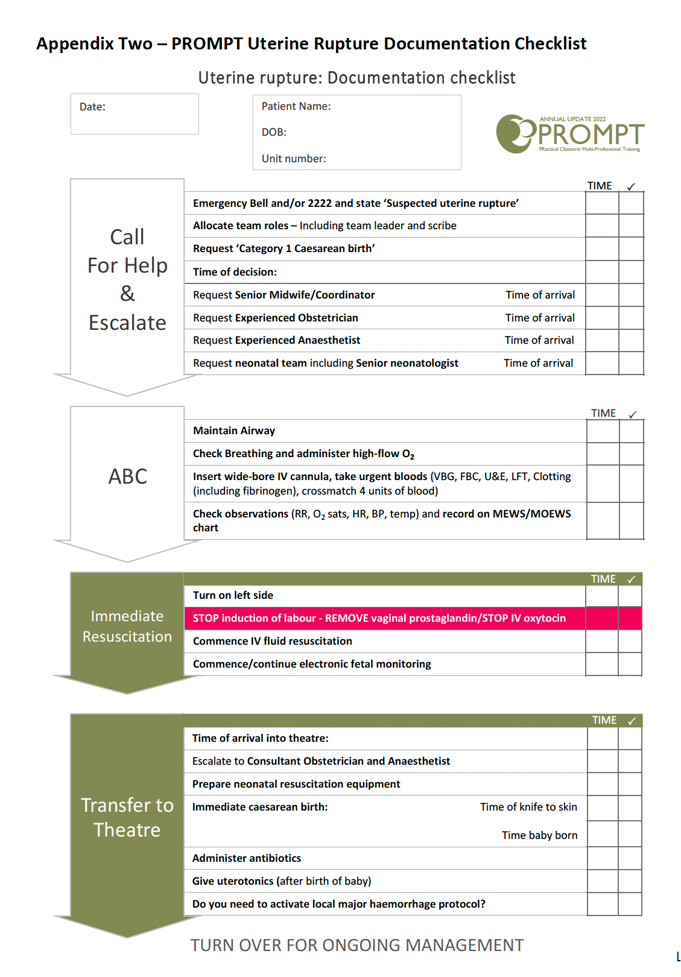
- Emergency buzzer/ Call for help
- Stop the oxytocin infusion
- Inform the senior obstetrician and anaesthetist
Uterine rupture:
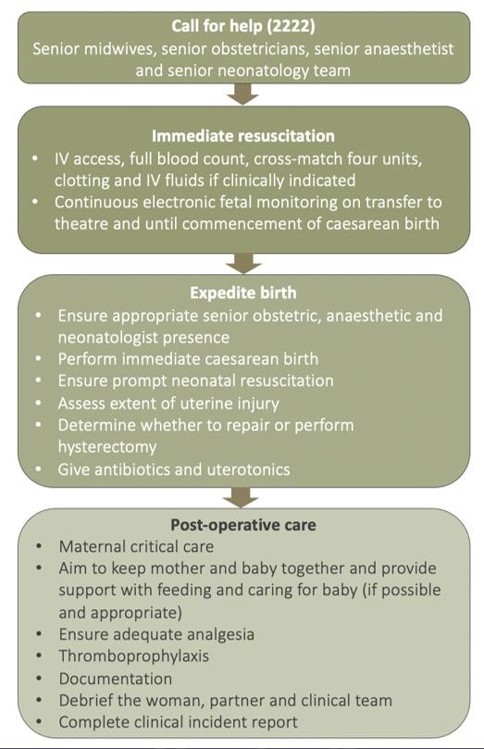
- Follow PROMPT uterine rupture algorithm5
- Airway – assess, maintain
- Breathing – assess, attach pulse oximeter, apply oxygen
- Circulation – assess pulse and blood pressure – continuously record pulse, BP, SpO2, ECG, CTG
- Secure two grey IV access and initiate fluid resuscitation
- Send urgent FBC, coagulation screen and cross match 4 units
- Prepare for category 1 birth – caesarean or forceps as indicated, neonatal compromise may be expected if birth is delayed beyond 18 minutes from rupture
- Anaesthetist to decide on the suitability for regional or general anaesthesia
- Laparotomy – midline may be suitable if fetus is lying in the abdominal cavity.
- Explore the uterus and neighbouring structures – bladder, broad ligament, vessels, posterior wall to assess extent of injury
- Repair of the rupture can be performed unless the severity of rupture or haemorrhage warrants a hysterectomy. In complex situation, consultant obstetrician presence in the theatre is required. Second consultant or gynaecologist presence may be needed and should be planned early. Manual pressure can be used to control bleeding until help arrives.
- If Hysterectomy is required, attempts should be made to preserve ovaries
- Major obstetric haemorrhage is managed with oxytocics and antibiotics as per protocol
- Incidental rupture following vaginal birth should be discussed with consultant and managed in accordance with the risk of bleeding and laparotomy
Postoperative plan:
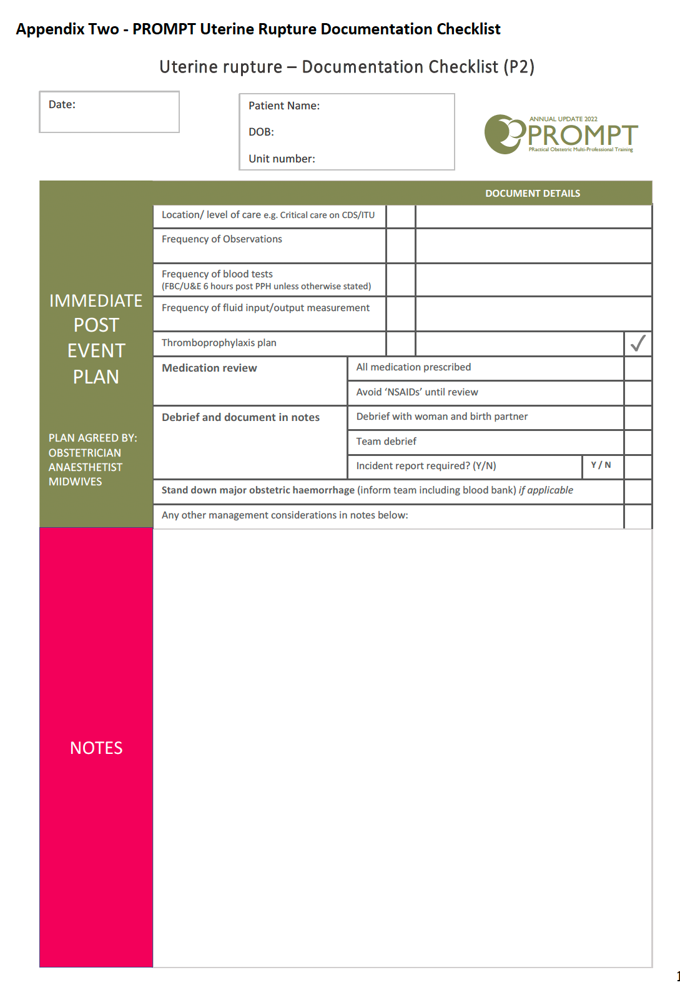
- Detailed postnatal plan should be documented immediately to include place of care – obstetric HDU/ ITU, fluids, analgesia, antibiotics, VTE prophylaxis and catheter care
- Datix should be completed
- Woman and family should be debriefed before discharge and offered postnatal consultation in a few weeks.
- Plan should be discussed about future fertility, smears and menopause depending on the procedure. Contraception should be offered when uterus is preserved.