

 MyPsych App
- Gear, coke, charlie, chico, ching and snow refer to powder cocaine
- Gram, “eggs and ham” and a ‘G’ all refer to the most commonly sold weight of powder cocaine which is 1 gram
- Line, patsy and patsy cline refer to a line of cocaine which is commonly snorted
- Bump or key refer to a small mound of powder cocaine which will be snorted without a straw
- Rock, base, freebase and nugget refer to crack or freebase cocaine
- Pipe and crack pipe refer to the utensil needed for smoking
- Snowball refers to mixing heroin and cocaine together for injecting
Overview of cocaine

Warning
Cocaine hydrochloride is the most common form of cocaine used in the UK. It is isolated from the leaves of the Andean coca shrub using a range of chemicals and refining processes. This plant can only be found in very specific regions of South America, meaning all the cocaine found in the UK has been trafficked here. Of course, this also means there are multiple opportunities for it to be cut, adulterated or “bashed” throughout its journey. Common agents used to cut cocaine include glucose, creatine, caffeine and benzocaine. Analysis has also shown that on occasion cocaine has been cut with painkillers such as phenacetin. Cocaine powder may be snorted or injected. Its form can also be changed to facilitate smoking.
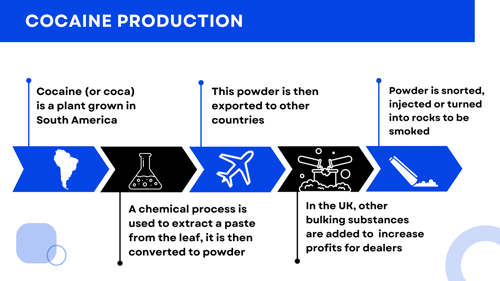
Regardless of how cocaine is administered, it significantly impacts neurotransmitter systems in the limbic (reward) part of the brain. It primarily affects dopamine, norepinephrine and serotonin.
Cocaine inhibits the reuptake of these neurotransmitters by binding to their transporters:
Dopamine Transporter - Binding to this transporter blocks dopamine reuptake and so increases its concentration in the synapse.
Result - Euphoria, increased energy and heightened alertness.
Norepinephrine Transporter - Binding to this transporter blocks norepinephrine reuptake and so prolongs its activity.
Result - Increased heart rate, blood pressure and alertness.
Serotonin Transporter - Binding to this transporter blocks serotonin reuptake, although this effect is less pronounced than with dopamine and norepinephrine.
Result - May contribute to initial mood elevation but plays a lesser role when compared to dopamine.
It is primarily the excess of dopamine that produces feelings of euphoria, well-being, enhanced alertness and a desire for social bonding. This is likely the main driver for compulsion to take more.
This mechanism of dopamine transporter blockade, and increased dopamine release caused by cocaine, followed by a period of dopamine depletion, creates two clear stages. Initially, a high caused by increased dopamine, followed by a state of dopamine depletion after use. Many of the negative psychological effects people experience relate to this dopamine depleted state after using.
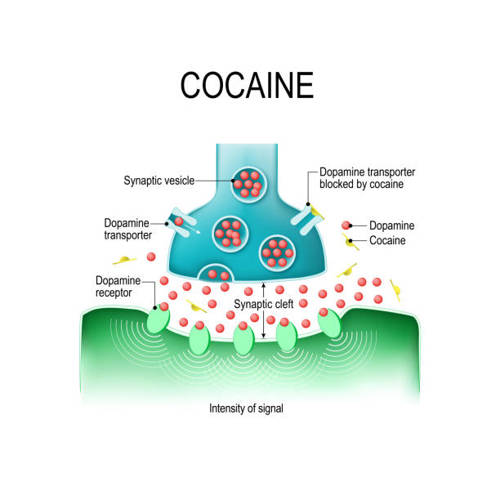
There are 3 main forms of cocaine used in the UK: powder, crack and freebase. Each form lends themselves to different methods of administration.
Powder Cocaine (cocaine hydrochloride) is the most common form of cocaine to be sold. It is often snorted in lines through a straw or banknote, however it is also water soluble so easy to prepare for injection. This type of cocaine does not lend itself well to smoking due to the high melting point.
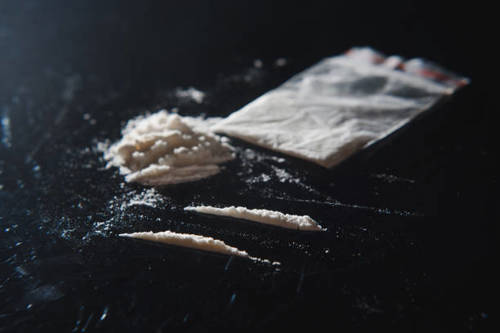
The local powder cocaine market
Over the years the powder cocaine market has developed into a tiered model with ranges of purities linked to price. In Glasgow this is particularly well established with all purity levels indicated by name.
- Small bags which are aimed at those injecting are £10-£15
- Poor quality - this is often called “council” is approximately £30 per gram
- Medium quality/purity - this is often called 50-50 and costs approximately £50 per gram
- High quality/purity – this is often called “proper” or “prop” and costs approximately £80 per gram
This business model is reflective of a well-established, flexible and resilient cocaine market
Crack Cocaine is a base form of cocaine that can be produced by mixing powder cocaine with water and sodium bicarbonate (baking soda). This is then be heated to form a solid rock like state for smoking. Although produced for smoking, these rocks can also be injected, however an acidifier such as vitamin C needs to be added to return it to a water-soluble state first. It is not uncommon for suppliers to add bulking agents during preparation to increase profit which will result in a poor-quality product – not all crack cocaine is high purity.
Cost - £10 - £20 per rock depending on weight and purity.
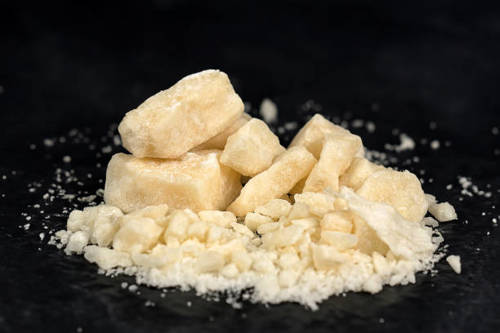
Freebase Cocaine is a base form of cocaine. The process of freeing the cocaine base comes from the adding of ammonia. The result is a form of cocaine that is very pure. This form has a low melting point which makes it easy to smoke. Freebase cocaine is not soluble in water and so an acidifier, such as vitamin C, needs to be added to return it to a water-soluble state - all freebase cocaine is high purity.
Cost - Not commonly sold at street level but when it is cost will always be related to weight e.g. 0.2 grams.
Cocaine and alcohol
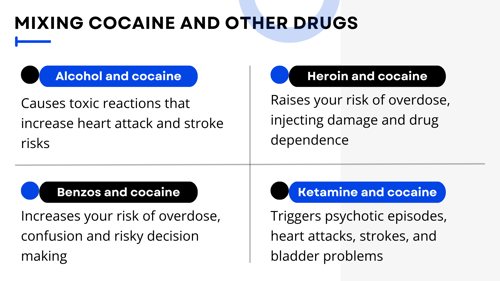
The interaction between cocaine and alcohol is complex. One of the reported benefits of taking cocaine and alcohol together is the ability to consume far more alcohol without passing out or appearing very drunk. Of course, the damage caused by consuming large amounts of alcohol in a binge fashion does not disappear. This level of alcohol consumption will make people’s “come down” far worse than using cocaine on its own. When both drugs are consumed together the body produces a third chemical called cocaethylene. This is known to enhance the euphoric effect of cocaine and increase the duration of effect. This may explain why so many people have such a strong urge to use both together. As well as the risks associated with increased alcohol consumption, cocaethylene creates other risks because it is toxic to the cardiovascular system. Cocaethylene elevates heart rate and blood pressure more than cocaine would alone.
Cocaine and heroin
The most common way to take heroin and cocaine together is through an injection called a “snowball”. There are however several other ways the drugs can be taken together such as; injecting heroin and smoking crack/freebase, or smoking heroin and injecting cocaine. It is a commonly held false belief that when taking both heroin and cocaine at the same time they will cancel out the effects of each other. In actual fact, a synergy occurs where the effects of both drugs are significantly amplified. Overdose risk can be increased due to a false sense of relative sobriety, which is driven by cocaine and may lead to frequent re-dosing of heroin, thus increasing the risk of overdose.
Cocaine and benzodiazepines.
Cocaine can be taken with benzodiazepines in an attempt to counteract some of the more sedative effects of benzodiazepines. People may also take cocaine and benzodiazepines in order to enhance, or prolong, a cocaine driven euphoric high. It is also common for people to take benzodiazepines after a cocaine binge to help ease the comedown or help sleep. There is a risk of overdose with either drug used alone, which may be increased when taken in combination. Taking these drugs together may also cause the person to feel that they can consume more which increases the likelihood of overdose.
Cocaine and ketamine
When cocaine and ketamine are taken together they can create a dreamy euphoric state. People can also feel that they have increased energy. These drugs used in combination can cause a series of life-threatening conditions. Some of the adverse effects of this combination include; unpredictable behaviour, bad trips, psychotic reactions, heart problems, high blood pressure, stroke and other neurological complications. As this market has developed, there is now evidence that these drugs are being sold ‘premixed’ for ease of use. In this scenario the buyer will not be aware of purity or concentrations of either drug. The street name for this combination is CK.
The compulsive nature of cocaine is related to the powerful effect it has on the brain’s reward system. People can feel an overwhelming, and sometime unexpected urge to use, even after a significant period of abstinence. Cravings are often triggered by sights, sounds, smells or using other drugs and alcohol.
Daily use can become an integral part of people’s lives and they can find functioning (physically, psychologically and socially) without it very difficult. Although no physical dependence occurs, even with repeated use, the psychological grip is very real and should not be underestimated. It should be noted that the symptoms of anxiety, which are often present after a binge or on cessation of use, will very much feel to the person like physical withdrawals.
Cocaine withdrawal (sometimes called a ‘come down’) from heavy cocaine use can be very uncomfortable. Cocaine withdrawal is however rarely life threatening.
A commonly cited study into cocaine withdrawal was undertaken by Gawin and Kleber in 1986 and is still relevant today. Using data collected from 30 cocaine-dependent outpatients, the researchers reported three distinct phases of the withdrawal process: ‘crash, withdrawal and extinction':
We have developed this model further to include high-risk times for other substance use which may increase the likelihood of lapse or relapse.
Phase one, 'the crash' develops rapidly following abrupt cessation of heavy cocaine use and is characterised by acute dysphoria, irritability and anxiety, increased desire for sleep, exhaustion, increased appetite, decreased craving to use. Other substances may be taken to help ease the comedown.
Phase two, 'withdrawal' is characterised by increasing craving to use, poor concentration, some irritability and lethargy, which persists for up to 10 weeks. Other substances may be taken to cope with negative feelings or deal with cravings.
Phase three, 'extinction or eradication’ comprises fewer intermittent cravings to use in the context of external cues. These cravings may be at a stage where they are easier to deal with without the use of other substances.
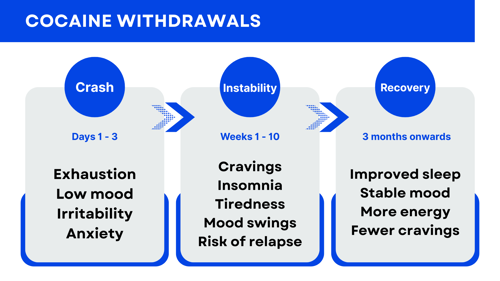
Stages of cocaine withdrawal and recovery
Some people choose to take other drugs, such as alcohol, sleeping tablets, opiates or benzodiazepines, to help ease the crash and withdrawal described in the first 10 weeks following cessation of cocaine use. This can lead to additional problems including dependence on different drugs, drug related harms and the risk of overdose.
It may be the case that a person will continue to use cocaine even though negative consequences are evident. This is a good indicator of drug dependence, albeit psychological. Binge use of cocaine is common and can quickly lead to a range of physical and mental health problems. It may be however, that social and financial problems appear before the physical or mental health consequences of cocaine use.