MyPsych App
Sharing needles and syringes carries the greatest risk of transmitting BBVs (Hepatitis B, Hepatitis C and HIV). Other injecting paraphernalia such as spoons, filters and water also carry a risk if shared, albeit it to a lesser degree. The indirect sharing of injecting paraphernalia is common, particularly if batches of drugs are prepared using previously used equipment. Drawing the drug solution from a contaminated spoon, filter or water has both bacterial and BBV infection risks. It is also common for all the drugs to be drawn into one syringe and then divided equally by back-loading or frontloading into people’s syringes, which again creates infection transmission risks.
Injecting related harm

Warning
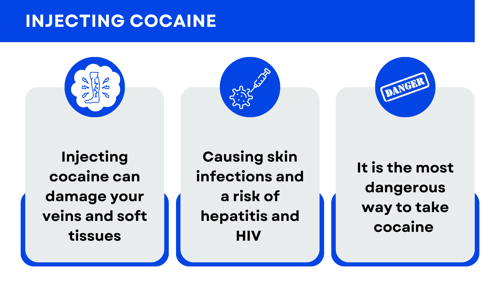
Injecting cocaine is likely to be the most harmful method of administration.
The effect of cocaine is short lived and so the compulsion to inject frequently occurs. This can lead to a “binge injecting session”. This frequent injecting can cause rapid deterioration of the veins, leading to vein collapse and circulatory problems. The anaesthetic effects of cocaine can make it difficult to ‘feel’ the injection properly, leading to missed hits and site damage.
Subcutaneous or intramuscular injecting under the skin (sometimes called skin or muscle popping) can cause significant damage to the skin, tissue and muscle. The muscle breakdown can cause toxins in the blood which cause damage to the kidneys. This can result in a rare condition called rhabdomyolysis.
It may be difficult for people to estimate how many times they are likely to inject in any given session. This can result in the person not collecting enough injecting equipment and so having to reuse. Even the reuse of someone’s own (not shared) injecting equipment can result in bacterial infection, vein and injection site damage.
It is possible that the frequency of injection, often across multiple geographic locations, is a driving factor in poor general hygiene and unsterile injection practices. This has been shown to cause a number of bacterial infections such as Staphylococcus aureus and Group A Streptococci. Infections can result in serious life threating conditions such as sepsis or necrotizing fasciitis.

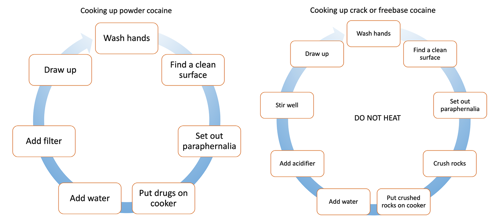
Each form of cocaine is prepared for injection slightly differently.
Powder cocaine is easily water soluble without the need for an acidifier or heat. Freebase and crack do need an acidifier added to facilitate the breakdown into a soluble state. Crack and freebase should not be heated as this will form an oil which may block the needle or cause damage if injected.
Snowballing (heroin and powder cocaine together in the one syringe) would be prepared on the spoon by cooking up the heroin as normal (using an acidifier and heat). When the solution is cooling, powder cocaine is added.
Snowballing with heroin and crack or freebase is a little trickier. The crack or freebase should be crushed as fine as possible before adding cold water and acidifier. When dissolved, heroin should be added and the solution heated. More acidifier can be added in very small amounts if needed.
- Injecting equipment such as needles, syringes, filters and spoons should not be shared with others
- All injecting equipment such as needles, syringes, spoons, filters and water should be new and unused
- All injecting equipment should be considered single use and disposed of in a suitable sharps bin immediately after use
- The drugs should be prepared and injected in as sterile an environment as possible. Ideally this environment should also be warm and well-lit with other trusted people there to help in an emergency
- Hands and target injecting sites should be washed well with warm water and soap. If this is not possible the best available method of cleaning should be used
- Techniques for raising veins (tourniquet, gentle exercise, warm water) should be used to keep lower risk sites accessible for longer
- The size of needle should be carefully chosen in relation to the intended injection site. The smallest possible needle should be selected. Deep vein injecting will require a longer more robust needle
- If batches must be prepared with others, all equipment that every person uses should be new and unused
- If preparing powder cocaine for injection then no acidifier or heat is required. Acidifiers cause vein damage and so should only be used if essential
- Proper rotation of injection sites is advised. Ideally 5 or 6 low risk veins on the arm should be identified and kept clean in between use
- Injecting intramuscularly or subcutaneously should be avoided as this carries a significant risk of skin, tissue and muscle damage
| Colour and description | Gauge | Length | Suitable for | Drugs normally injected with this size | Available in single use packs |
| Fixed needle and syringe | 29g | 1 inch | Superficial veins, arms, hands, feet | Heroin, cocaine, steroids, powder hormones | Yes (black writing) |
| Blue | 23g | 11/4 inch |
Femoral vein, intramuscular |
Heroin, cocaine, steroids |
Yes (blue writing) |
| Blue | 23g | 1 inch | Femoral vein, intramuscular | Heroin, cocaine, steroids | No |
| Orange | 25g | 1 inch | Femoral vein, other partially deeper veins | Heroin, cocaine | Yes (orange writing) |
| Orange | 25g | 5/8 inch | Partially deeper veins | Heroin, cocaine | No |
Please note that the above table may need to be scrolled horizontally or vertically in order to view all information, depending on your device.