Working with people at harm from cocaine use

Warning

Data from over 5000 comprehensive Assessments of Injecting Risk (AIR) suggests that cocaine has become the primary drug of injection for most people who prepare and inject drugs in Greater Glasgow and Clyde.

Although we now have cocaine only injecting groups, there are people who also inject heroin or alternate between the two. Many individuals who inject cocaine and heroin are linked with services and receiving Opioid Substitution Therapy (OST). This provides us with an opportunity to explore their cocaine use and suggest a plan to reduce harm and facilitate treatment. We must do this in order to support individuals holistically and address the real harms that they face.

Many of the harm reduction techniques and treatment options available to people using cocaine vary greatly from the traditional interventions we use when working with people using opioids. There is currently no substitute prescribing option for people using cocaine. For those at risk of overdose from cocaine, there is no equivalent drug to naloxone, which is used in opioid overdose to quickly reverse symptoms. Advice on preparation and methods of administration of cocaine vary, as do the implications of polydrug and alcohol use when combined with cocaine. Therefore, it is vitally important that through training we develop skills and become familiar with the approaches needed to engage with individuals using cocaine.

Similarly, the presentation of people using cocaine and stimulants can be quite different to those using depressant drugs alone. An understanding of these differences in presentation can be key to identifying the best supports for people. In particular, cocaine has a significant impact on mental and physical health, both acutely and over a period of time. The sections on mental health and physical health within the toolkit will give the reader a greater understanding of these risks and the skills to use to identify and address them.

This toolkit provides educational content on cocaine and its impact on the person taking the drug, along with current detail of street terms used, costs and the local drug market. It also offers practical tools to use directly with individuals, such as the assessment tool, advice on crisis intervention and de-escalation, along with the motivational enhancement, developing control and developing a rewarding lifestyle worksheets.

We would encourage anyone working with people who use cocaine to navigate through the content in their own time and print or share resources to support those using cocaine, those impacted by cocaine use and also other allied services or service providers.


Whole family approach

Drug and Alcohol Services are underpinned by family inclusive practice. People will be given the opportunity to involve family in their care or express their wishes not to have information shared. Services have a role in supporting families and signposting them to partner organisations to access additional support where required. Staff will consider if people have caring responsibilities and offer support with this.
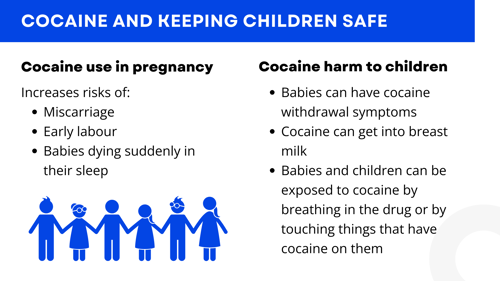
Infographic explaining the impact of cocaine use on children within the family - as covered in text above.

Cocaine presents a risk to infants and children when used in the environment where a child is. This could be due to passive inhalation or touching surfaces contaminated with residue from cocaine use. Staff should discuss preventative measures such as handwashing, awareness of food preparation and minimising consumption in places where adults interact with children. It is essential that staff promote safe sleep guidance with patients using cocaine and other substances, including alcohol, and avoid co-sleeping. The magnitude of this risk is not yet known but may be significant.

Drug and Alcohol Services have an important role in the protection of unborn babies, children and young people. If staff believe that a child or young person is a risk of harm then NHSGGC Child Protection processes must be followed and a notification of concern submitted. Robust communication with other agencies involved in the care of the family is key.

The Public Protection Service can provide advice and support to any staff who have a concern about a child or young person. The Public Protection Service in NHS GG&C can be contacted on 0141 451 6605.

Assessing cocaine use and impact

This is an assessment tool that can be used with people using cocaine, with a particular focus on injecting cocaine and smoking crack/freebase cocaine. It is not intended for use with people who use cocaine on a more occasional or recreational basis. The tool should be used to better understand an individual's cocaine use, including the patterns of use and potential risks and harms. It is intended to help highlight areas where further exploration and support may be required. It does not replace a formal physical, mental health or sexual health assessment.

The assessment does not have to be completed in any particular order and works best when completed in conversation with the person using cocaine. The questions act as prompts to open up discussion, rather than requiring staff to read all questions verbatim. This allows focus on the relevant questions for the person and ensures the full assessment can be completed comfortably within one appointment.

It is recognised that for some people it may not be possible to complete the assessment in its entirety, or that it may require to be done over more than one appointment. The more information gathered the better, and where it has been necessary to complete the assessment over several appointments, it is important to note that responses can change over time. It may be necessary to review previous answers.

Cocaine Assessment Tool

Editorial Information

Last reviewed: 01/09/2025

Next review date: 01/09/2027

Author(s): MAT SPMG.

Version: 2

Author email(s): ggc.nhsggc.mypsych@nhs.scot.

Approved By: Medicated Assisted Treatment - Substitute Prescribing Management Group

Reviewer name(s): Injecting Equipment Provision Manager.