Back to:
Hospital doctors

As clinicians we must focus on delivering better care by reducing interventions which are not considered helpful and may be harmful to the people we care for.

Reducing inappropriate interventions will also contribute to a more sustainable health and care system by reducing waste, and redirecting resources to higher-value care. Careful and kind care has Realistic Medicine as its foundation, and this is the care we must aspire to provide consistently across Scotland. By doing so, we can deliver better value care for both the people we care for and our healthcare system.

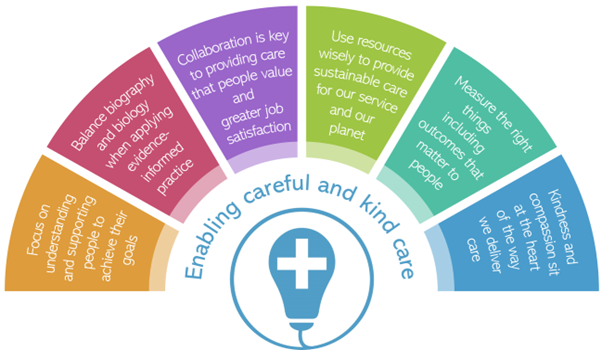
Enabling careful and kind care diagram
Realistic Medicine: Taking Care - Chief Medical Officer for Scotland Annual Report 2023–2024

This National Referral Protocol (NRP) contains a series of procedures where evidence suggests that there is less clinical benefit and as such, they must not be routinely offered by NHS Scotland.

By practising Realistic Medicine we can deliver the best outcomes for the people we care for based on what matters to them and their capacity to benefit from their treatment and care options. Evidence based practice sits at the heart of Realistic Medicine and helps us to optimise resources and achieve outcomes that people value.

Under this umbrella of evidence-based practice, there are treatments where current evidence suggests that the majority of people are unlikely to benefit clinically, and good outcomes will be limited to a small number of people.

Inappropriate treatment and care use resources that could be used to deliver higher value care, namely interventions where the evidence shows they provide greater health benefits. We must focus on ensuring that all procedures are offered fairly and consistently, promoting evidence informed practice. This approach will help ensure more appropriate use of our healthcare resources and help to ensure equity of access for those who are likely to benefit from them.

NRP criteria

This protocol contains clinical criteria that must be met before considering whether a person is likely to benefit from any procedure listed. This guidance applies to all specialties and to all healthcare professionals who request and carry out procedures contained in this protocol and must be adhered to in all circumstances.

NHS Boards must ensure that the criteria in this protocol are applied by all health and care professionals equally across all specialties involved in requesting and delivering these procedures, including Primary Care practitioners through their local integrated arrangements.

NHS Boards must ensure that this guidance is:

  1. Consistently and fairly applied to avoid inequity and to ensure the best outcomes for those deemed likely to benefit from these procedures.
  2. Effectively and consistently communicated to all health care professionals across primary and secondary care.

Development of this protocol

Clinicians have been instrumental in the development of this protocol. This guidance is expected to expand as more procedures are added over time. All future work will be clinically led and will involve professionals from relevant specialties.

Reviewing evidence

Healthcare Improvement Scotland have conducted thorough evidence reviews for each of the procedures contained in this guidance and will continue to review and update the evidence underpinning these criteria as the protocol evolves. The evidence reviews that support this protocol can be accessed here on the Right Decision Service.

Review process

All NHS Boards are required to enable vetting panels to review all referrals for procedures covered by this guidance and determine whether people meet or do not meet the agreed criteria for treatment. The clinicians involved in this review process will be more familiar with the exact requirements for treatment than referring clinicians, who may only see a very small number of people living with these conditions each year. The recommended constitution of a vetting panel is described at Annex B.

In applying these criteria, healthcare professionals will consider whether:

  • the person will benefit clinically from this procedure; and,
  • whether there are more appropriate treatment or care alternatives.

Five core principles to aid decision-making are that decisions must:

  • be based on the clinical evidence;
  • be rational and socially inclusive;
  • be clear and open to scrutiny;
  • recognise that healthcare resources including equipment, theatre time and staff time are finite. There is a duty to ensure that use of resources is optimised. Wherever possible, resource must be directed from low value to higher value treatment and care.
  • be cognisant that investment in one area of healthcare may divert resources away from other areas.

Decisions must be based on the agreed criteria within this guidance and careful consideration given to optimising the use of healthcare resources; both in the short and longer term to deliver higher value treatment and care.

Our population

This protocol is not about saving money. It is first and foremost about ensuring that we achieve good outcomes for people that they benefit from which will in itself reduce the waste and potential harm caused by inappropriate care.

To improve access to clinically appropriate care, we must reassure the people we care for that a rigorous clinically led process has been carried out and that our priority is to ensure that people who will benefit clinically are able to access these procedures. We will do this by considering the evidence and applying the agreed criteria for each procedure to ensure that we deliver the outcomes that matter to the people we care for. It is important that the same care is offered across the country in a fair & equitable way. This is expected to improve access to these procedures for those who will benefit as those unlikely to benefit are referred for more appropriate care.

This policy will be reviewed every three years or as soon as new evidence that will result in changes to the criteria comes to light.

Equality statement

The Population Health Framework sets out our long-term collective approach to improving Scotland’s health and reducing health inequalities. Improving Scotland’s health and reducing health inequalities is a fundamental contributor to our shared aim of ‘A Scotland where people live longer, healthier and more fulfilling lives’.

The Service Renewal Framework shares this aim to reduce health inequalities by ensuring that services are designed and delivered in ways that are inclusive, equitable, and responsive to the needs of all communities.

NHS Scotland is committed to ensuring equity of access and non-discrimination, irrespective of age, gender, disability (including learning disability), gender reassignment, marriage and civil partnership, pregnancy and maternity, race, religion or belief, sex (gender) or sexual orientation. In carrying out its functions, each NHS Board will have due regard to the different needs of protected equality groups, in line with the Equality Act 2010.

In Scotland, people are protected by the Human Rights Act 1998 and provisions of the Scotland Act 1998. This applies to all activities for which NHS Boards are responsible, including service development and delivery. NHS Boards are required to consider completing an Equality Impact Assessment (EQIA) of the impact this guidance will have on the populations they serve.

Exclusions to this guidance

This guidance does NOT apply to the following:

  • Urgent Suspected cancer: diagnoses should be dealt with via the 31- and 62-day pathway and NOT through this process.
  • Emergency or urgent care. In relation to the above exclusion, the decision maker should be able to demonstrate clinical need as part of their Board’s process using the agreed criteria albeit it will be after the event.
  • Transgender surgery.

Performance monitoring

Performance measures and audits must be introduced to monitor protocol procedure activity across all NHS Boards. These will be carried out by NHS Boards and will be monitored through performance monitoring of NHS Boards and reviews of progress with 15 box grid priorities.

The Director General wrote to Board Chief Executives on 13 March 2025 to confirm the refreshed 15 Box Grid (the ‘Grid’) for 2025-26. The Grid identifies several improvement priorities across NHS Scotland’s Health Boards and forms the basis for benchmarking platforms issued throughout the year.

The Grid requires NHS Boards to perform clinical variation reviews in 2025-26, including implementation of NRP guidance. Accordingly, NHS Boards are required to implement NRP guidance as soon as possible.

Board progress will be monitored by PHS and presented in a Discovery dashboard. The NHS Scotland Finance Delivery Unit will also issue quarterly 15 Box Grid Power BI benchmarking packs to the NHS Scotland finance community which will compare and contrast NHS Board uptake throughout the year. Each NHS Board’s uptake will be discussed as part of quarterly finance reviews.

Boards through the National Intelligence Leads will work collectively to agree, maintain and review coding to support current versions of policies.

Conclusion

This National Referral Protocol should be implemented with immediate effect.


Professor Sir Gregor Smith

Chief Medical Officer for Scotland