

 NHS Ayrshire & Arran guidelines
Preventing catheter associated urinary tract infections - acute settings
Source: Health Protection Scotland/NHS National Services Scotland. September 2014.

Daily bathing or showering is recommended. If this is not possible, the patient must be advised to clean the meatal/ostomy area with normal soap and water twice daily or following a bowel movement to reduce the risk of infection3. Encourage patient self care and good hand hygiene techniques.
To reduce the risk of catheter associated urinary tract infection (CAUTI), standard infection control precautions (SICPS) must be implemented at all times as per the National Prevention and Control of Infection Manual.
REMEMBER: Antibiotics should not be considered for catheterised patients asymptomatic of infection.
Preventing catheter associated urinary tract infections - acute settings
Source: Health Protection Scotland/NHS National Services Scotland. September 2014.
Preventing catheter associated urinary tract infections - community settings
Source: Health Protection Scotland/NHS National Services Scotland. September 2014.
| Possible reasons | Possible solutions |
| Traction/pulling of catheter | Repositioning/ensure fixation device applied |
| Too large a catheter | Smaller gauge catheter/coated catheter |
| Latex allergy | Use all silicone catheter |
| Eyelets maybe occluded by urothelium | Raise the drainage bag above the level of the bladder for 10-15 seconds only |
| Catheter associated urinary tract infection (CAUTI). See section on Catheter associated urinary tract infection (CAUTI) |
|
| Possible reasons | Possible solutions |
| Incorrect position of drainage system |
Ensure drainage bag below bladder level. Straighten tubing. |
| Constipation |
Rectal examination and appropriate treatment. Increase fluid intake and dietary fibre. |
| Encrustation/debris | See catheter maintenance solution information. |
| Trigone irritation | Review balloon size and ensure balloon is fully inflated as per manufacturer instructions. |
| Bladder overactivity/spasms |
Smaller gauge catheter if appropriate. Ensure adequate intake of non stimulant fluids. Check bowel history. Consider anti-cholinergic therapy. |
| CAUTI - See section on Catheter associated urinary tract infection (CAUTI) for diagnosis of CAUTI |
See section on Catheter associated urinary tract infection (CAUTI) |
| Possible reasons | Possible solutions |
| Incorrect position of drainage system |
Ensure drainage bag below bladder level. Straighten tubing. Ensure bag stand and fixation device. |
| Faecal impaction |
Rectal examination and appropriate treatment. Increase fluid intake and dietary fibre. |
| Encrustation/debris | See appendix 3 and 4 |
| Anuria | Consult medical team |
| Possible reasons | Possible solutions |
| Trauma post catheterisation especially following chronic retention | Encourage fluid intake and if haematuria persists seek medical advice |
| Prostatic enlargement | Encourage fluid intake and if haematuria persists seek medical advice |
| Calculi | Encourage fluid intake and if haematuria persists seek medical advice |
| Carcinoma | Encourage fluid intake and if haematuria persists seek medical advice |
| CAUTI - See section on Catheter associated urinary tract infection (CAUTI) for diagnosis of CAUTI | See section on Catheter associated urinary tract infection (CAUTI) |
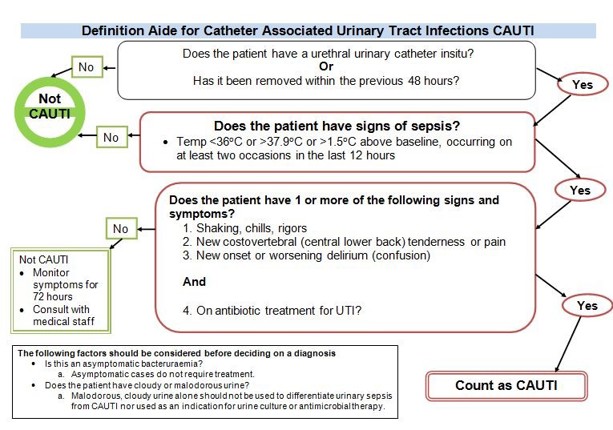
CAUTI is diagnosed when all of the following are identified:
This should always be planned, based on an assessment of the patient’s history, circumstances and needs and this should always be documented. Urinary catheters should be removed as soon as possible guided by HOUIDINI. Consider intermittent self catheterisation (ISC) where possible.