Provision of pressure relieving equipment for care home residents - standard operating procedure

Warning

Introduction

The impact of pressure ulcers to patients can be considerable, they can be painful, have been found to increase bed days, hospital duration of stay and decreased quality of life1. It’s broadly acknowledged that a significant number of cases could have been avoided with appropriate pressure relieving measures.

There are many risk factors associated with developing pressure ulcers. These include increasing age, immobility, illness, frailty, being undernourished and conditions such as diabetes.  It is therefore understandable, why there are high populations of “at risk” individuals residing within care homes.  Adopting and embedding effective pressure ulcer care, with a focus on prevention is an essential component in care planning to prevent iatrogenic harm.

In 2023, a systematic review and meta-analysis found the pooled prevalence of pressure injury at any grade within the care home setting to be 11.6%, with heel (34%), sacrum (27%) and foot (18%) to be the most reported locations of damage2.

The roles and responsibilities around the provision of pressure relieving devices for care home residents are often poorly understood, which is recognised to be a barrier in care planning, which may be contributing to pressure damage case numbers.

Pressure injuries represent a substantial financial burden to local National Health Service (NHS) and care providers.  In 2004, pressure ulcers were estimated to cost the NHS £1.4–£2.4 billion per year, which was 4% of the total NHS expenditure3. In 2015, the cost of managing an individual pressure ulcer was estimated to vary between £1214 and £14 108 depending on the depth of tissue involved and severity4

Importantly, published studies have found higher costs associated with treating pressure ulcers than preventing them5,6.

Purpose, scope and definition of terms

Purpose of this SOP

  • Clarify roles and responsibilities around provision of pressure relieving equipment in nursing and residential care homes.
  • Outline a pressure relieving equipment library.
  • Define a loan process available to all care homes through community equipment store.
  • Clarify onward referral process to District Nursing, Podiatry, Tissue Viability Nursing (TVN) and Care Home Liaison Nurse Service (North).
  • Detail the educational support available to care home staff on pressure ulcer prevention and management strategies and set out procedures on how to access training.
  • To define and underpin a PU Equipment Provision Pathway for Care Homes.

Scope

Applicable to all care homes providing nursing and residential care within Ayrshire & Arran.

Definition of terms

ANP = Advanced Nurse Practitioner

CH = Care home

CHCP = Community Health Care Partnership

CHLN = Care Home Liaison Nurse

CHPST = Care Home Professional Support Team

COSLA = Convention Of Scottish Local Authorities

DN =District Nurse

EQUIP AGENCY = local equipment service

GP = General Practitioner

HSCP = Health & Social Care Partnerships

HSCP assessor =  District Nurse, Tissue Viability Nurse, Care Home Liaison Nurse, Podiatrist, Occupational Therapist or physiotherapist     

NDC =  National Distribution Centre

NMP = Non-Medical Prescriber

OT= Occupational Therapist

PT = Physiotherapist 

PC = Primary Care  (NHS) which supplies health equipment not normally part of the local equipment service

PU = Pressure ulcer

RWS = Regional Wheelchair Service (Provider of bespoke Wheelchairs).

SDTI = Suspected deep tissue injury

SIT = Sensory Impairment Team

SWT = Social Work Team

TVN =  Tissue Viability Nurse 

Roles & responsibilities

All placements should be made to a care home that is able to provide for the individual’s assessed need and is ‘fit for (that) purpose'  

The equipment list is not exhaustive, but indicates how the principles set out in the Protocol for the Provision of Equipment in Care Homes (COSLA 2012), determine responsibility for supplying the most common items of equipment required for the care of people in Care Homes.

Assessment and referral for equipment to prevent or manage pressure ulcers must be undertaken by an appropriately qualified assessor.  There are many professions with the scope and remit of managing pressure ulcer care in the community setting.  The term Health & Social Care Partnership assessor refers to any of the following; District Nurses (DN), Tissue Viability Nurses (TVN), Care Home Liaison Nurse, Podiatrists, Occupational Therapists and physiotherapists. 

Table 1: Pressure Ulcer Equipment Provision Responsibilities COSLA 2012

(Use landscape view to view on smartphone)

Item of equipment Care home setting Comments
  Nursing Residential  
Beds
Standard range of beds Care home to supply Care home to supply Subject to Health & Safety risk management
Standard hospital beds - variable height profiling Care home to supply See comments Only in non-nursing settings after full risk by appropriately qualified HSCP assessor
Standard electric profiling bed Care home to supply See comments Only in non-nursing settings after full risk assessment via appropriately qualified HSCP assessor
Non-standard beds e.g. for people with complex treatment and care needs - such as bariatric

Health & Social Care partnership to provide following assessment from appropriate qualified HSCP assessor

Health & Social Care Partnership to provide following assessment from appropriately qualified HSCP assessor

 
Static mattresses (non powered)
Foam Overlay (e.g. Parkhouse Permapad)  and Memory foam overlay (e.g.NP140 Hill Rom) Care home to supply Care home  
Air Filled Overlay (e.g. Medical Frontier Repose, Roho) Care home to supply Health & Social Care Partnership to provide following assessment from appropriately qualified HSCP assessor  
Foam Replacement (e.g Permaflex Care home to supply Care home to supply  
Dynamic mattresses (requires power source)
Overlay (e.g. Parkhouse Eclipse, Talley Quatro Care home to supply Health & Social Care Partnership to provide following assessment from appropriately qualified HSCP assessor  
Replacement (e.g. Nimbus Huntleigh, Parkhouse Elite) Care home to supply Health & Social Care Partnership to provide following assessment from appropriately qualified HSCP assessor  
Patient repositioning and transfer
Hoist, slings, transfer boards and glide sheets Care home to supply Care home to supply  
Pressure reducing cushions
Foam Overlay (e.g. Propad Invacare, Permaflex low profile Care home Care home  
Air Filled Overlay (e.g. Repose, Medical Frontier) Care home Health & Social Care Partnership to provide following assessment from appropriately qualified HSCP assessor  
Foam Replacement (e.g. Flo-tech, Invacare) Care home Health & Social Care Partnership to provide following assessment from appropriately qualified HSCP assessor  
Dynamic (requires power source)
Replacement (e.g. Park house dynamic, Hillrom Response) Care home Health & Social Care Partnership to provide following assessment from appropriately qualified HSCP assessor  
Pressure relieving foot protectors (e.g. Pro levo, HeelPro, Repose) and elbow protectors Care home Health & Social Care Partnership to provide following assessment from appropriately qualified HSCP assessor  

The Scottish Government Guidance on the Provision of Equipment and Adaptations endorsed by COSLA Health and Well-Being Executive Group in November 2009, included a number of Key Actions relating to the provision of equipment to care homes.  These were:

  • In the circumstances where a care home is out of stock of items of equipment for which it is responsible, and the equipment can support early discharge from hospital, or prevent admission, it must be loaned, with urgency, free of charge for a period of up to four weeks.
  • Staff must be appropriately trained in the use, cleaning and maintenance of equipment as set out on H&S and MHRA regulations.
  • Statutory providers should work with the care home sector to agree the suitable makes and models of equipment to be used in care homes to allow for the supply of appropriate bespoke attachments or accessories, when required.

Pressure Relieving Equipment Library

  • Profiling bed
  • Extremely high specification dynamic mattress system
  • Step up dynamic mattress from hybrid
  • Toto turning platform
  • Hybrid mattress alternating system
  • Hybrid foam mattress
  • Pressure relieving cushion
  • Air filled mattress overlay
  • Heel offloading boots
  • Pressure relieving mat for feet
  • Pressure relieving bed end mat
  • Pressure relieving inflatable wedge.

Loan process

Any equipment loaned by NHS equipment stores, is on the basis that there has been an appropriate risk assessment by a competent HSCP assessor and that the equipment is for the use of the assessed individual only.  

Individuals receiving residential care can access any pressure relieving equipment required on loan from NHS equipment store.  Referrals should be made by the HSCP assessor.

If the care home is responsible for providing a nursing care resident with pressure reliving equipment which they do not have available, they may be able to loan the items on an interim basis from Equipment Stores.  Referrals should be made by the HSCP assessor.  Efforts must then be made by the care home to source the appropriate equipment.  On receipt of the purchased equipment, the care home should contact Equipment Stores to arrange uplift of loaned equipment.

Equipment Store  01292 885999

The care home is entirely responsible for ensuring any loaned equipment is cleaned and maintained appropriately while on their premises for the duration of the loan period. See next section on Cleaning and inspection of loaned equipment.

It is recognised that there is a broad variety of brands available for each specification of mattress, and the brand selected by care home for purchase may vary between care homes and be different to the brand on loan.

Specification Equipment stores brand Examples of other brands available
Extremely high specification dynamic mattress system Artemis

Pro-care auto very high risk air mattress system, Heritage 11 Digital turn

Step up dynamic mattress form hybrid Apollo Phase 3, nimbus, biwave,  Dyna-form Mercury, Advance Park house dynamic, Hillrom Response
Hybrid mattress alternating System Drive Hybrid Power activated power unit

Invacare (powered on), spearhead hybrid replacement (powered on),  Alerta (powered on), Nimbus Huntleigh, Parkhouse Elite

Hybrid foam Drive Hybrid Power non-activated unit

Softform premier, Invacare (non-powered), Alerta (non-powered), Parkhouse Permapad and NP140 Hill Rom


Cleaning and inspection of loaned equipment

Standard Infection Control Precautions (SICPs) must be used by all staff, in all care settings, at all times for patients whether infection is known to be present or not to ensure the safety of those being cared for, as well as staff and visitors in the care environment.   

SICPs are the fundamental Infection Prevention Control measures necessary to reduce the risk of transmission of infection agents from both recognised and unrecognised sources of infection.  Potential sources of infection include blood and other body fluids, secretions or excretions (excluding sweat), non-intact skin or mucous membranes and any equipment or items in the care environment that could have become contaminated. 

Mattress decontamination

Mattresses should always be decontaminated:

  • when contaminated with blood and blood fluids
  • regularly (weekly) while in use
  • on receipt from storage
  • prior to being sent for storage or collection by external contractors
  • at terminal cleaning following discontinuation of isolation precautions
  • prior to sending mattress back to stores to reduce risk to the handler
  • If it is not possible to fully decontaminate the mattress on loan e.g. foam. The mattress must be bagged for returning to stores.

Decontamination should be undertaken according to the manufacturer’s guidelines and the National Infection Prevention and Control Manual (see appendix 1) and link below regarding cleaning and decontamination.

National Infection Prevention and Control Manual: Care Home Infection Prevention and Control Manual (CH IPCM)

Mattress inspection

Mattress inspection should be carried out as part of the weekly mattress decontamination process.

The outer cover, the inner cover and the inner foam core should all be inspected for cleanliness.

If the mattress cover is damaged or there is contamination inside the cover and/or foam the mattress should be withdrawn from use until they can be replaced. 

If the mattress damaged or contaminated is on loan, Equipment stores must be contacted to report issue on  01292 885999.

Mattresses must be inspected:

  • prior to use
  • during and after each patient use
  • at a minimum this should be carried out when mattresses are cleaned and/or at monthly intervals (minimum requirement)
  • before going to storage.

Mattress storage

To avoid damage to the mattresses they must be:

  • stored off the floor
  • stacked no more than 8 mattresses high
  • stored in dry conditions and out of direct sunlight
  • stored with no other items placed on top of the mattresses
  • stored on the flat side of the base rather than upright.

Bespoke equipment

In line with the COSLA 2012 protocol, when the requirement for equipment is bespoke or out of the ordinary, and where the equipment could not be used for another client when the need has passed, responsibility lies with Local Authority Social Work Services or NHS Boards for provision.      

Bespoke equipment is defined in the National Equipment and Adaptions Guidance 2023 as:

  • Any item of equipment specifically manufactured to meet the unique needs of an individual e.g. the care home would be unable to purchase the seating ready-made.
  • Bespoke attachments or accessories for a standard piece of equipment, to meet the assessed needs on an individual (e.g. accessories for standard off the shelf seat to support complex postural management needs)
  • An item of equipment that would rarely be required by the population within the care home, and unlikely to be used again for another service user, e.g. this mainly applies to bariatric equipment. It is important to highlight that local community equipment services should have a core stock of standard bariatric equipment e.g. beds and mattresses, that can be provided in a responsive and timely way for use in all areas of service provision.
  • *note: 'bespoke' does not apply to any of the standard support seating described above, including chairs with tilt in space attributes, as this is considered equipment which meets common and frequently occurring needs within the older and frail population.

Bespoke Equipment Available on Loan from NHS Equipment Store

If the resident is considered to have bariatric requirements due to their weight or weight distribution, equipment may be accessed by care homes for residential or nursing care residents on loan from Equipment Stores for the duration of the requirement.

All equipment will specify a safe working load which must be adhered to, in order to support safe care. The load value for equipment will vary between brands and specification of equipment.  It’s important to be aware that the safe load for mattresses may differ from the bed frame they sit on. Standard profiling beds can safely load up to 191kg / 30 stone

  • Bariatric bed- Bradshaw (suitable for up to 318kg / 50 stone)
  • Bariatric mattress- Drive Simple Plus (suitable for up to 400kg /62 stone)
  • High specification dynamic mattress system – Apollo (200kg / 31.5 stone)
  • Artemis (267kg / 42 stone) (only available through joint funding)
  • Toto turning platform (only available through joint funding)
  • Bariatric Pro pad (suitable for up to 43 stone)
  • Bariatric Foam mattress – Acclaim ( suitable for up to 320kg / 50 stone)

Joint funding

If the required equipment is not core stock at Equipment Stores then joint funding may be required to source e.g. Artemis. This should be requested through local partnership.

Delivery

The HSPC assessor will be advised on a date for delivery of loaned equipment at point of referral.  This should be communicated to the care home.

Pressure relieving devices for feet

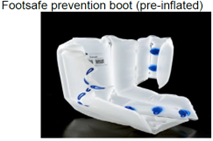
CPR for feet is a national initiative designed to prevent and manage pressure damage to the foot and ankle across all care settings (see appendix 2)  There is a national contract in place for 3 devices to support this initiative. The purpose of the national contract is to ensure devices are evidence based to be effective at preventing pressure damage, ensure quality and to keep the cost lower than other similar devices. 

The national contract was extended to include care homes. Devices are available for purchase through the National Distribution Centre (NDC) (see appendix 3)        

Talarmade Ltd currently hold the contact for these devices and have committed to support all Scottish health boards and social care teams with staff training.

Current national contract devices - CPR for feet

Company details

Talarmade Ltd Springwood House, Foxwood Industrial Park, Chesterfield, S41 9RN Tel :01246 268456

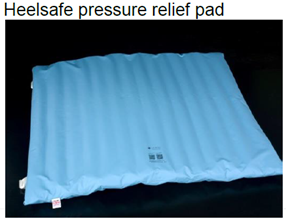
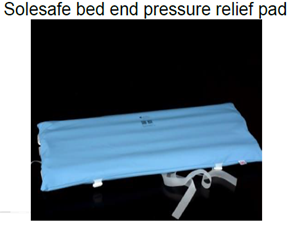
Product name Footsafe prevention boot Heelsafe pressure relief pad Solesafe bed end pad
Cost £44 + VAT £66 + VAT £66 + VAT
When to use

If patient is immobile, or moves very little.

 Or

1 or more CPR for feet risks identified.

(current or previous foot/ankle ulcer/pressure damage, diabetes, CVA, amputee, severe kidney disease - eGFR <30ml/min)

If CPR for feet risk identified but boots are unsuitable eg- the patient may attempt to ambulate with boots on.

Important note:-

Not required if patient is on an active pressure relieving mattress.

If patient is prone to sliding down bed causing feet to press against base of bed.

Important note:-

Profiling bed position or bed extender may help to prevent feet pressing against bed end.
Order codes

Size guide:

Small - UK 2-7


Standard UK – 7.5-11

XL – UK 11.5+


Small (x 1pair)  PHPB-UC-PL-SM-P

Standard (x1 pair) PHPB-UC-PI-ST-P

XL (x 1 pair) PHPB-UC-PI-XL-P

Heelsafe over mattress pad, covered (x1)

-PHP-C-PLOS

Solesafe bed end pad, covered (x1)

-PSP–C-PI-OS
Single/multi patient use? Multi patient use.  Must be cleaned as per local infection control protocol. Multi patient use.  Must be cleaned as per local infection control protocol. Multi patient use.  Must be cleaned as per local infection control protocol

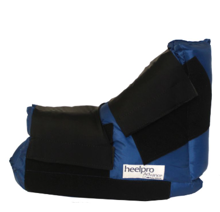
Pressure relieving boot available on prescription

Heel Pro protector boot

Heelpro protector boot
  • One size
  • Offloads the heel
  • Suitable for use on either foot
  • Machine washable
  • Single patient use
  • Current cost £21 +VAT (July 2025)
  • Vacuum packed to reduce storage space required
  • Available to prescribe on FP10

Residential care home staff should seek a prescription for boots when risk is identified (through pressure ulcer risk assessment or CPR for feet criteria) to support preventative care. Prescriptions requests should be made to:

  1. Any non-medical prescriber that is involved in the patients care eg. Advanced Nurse Practitioner (ANP), District Nurse, Podiatrist.

Or

  1. To the GP practice pharmacotherapy team in cases where there is no non-medical prescriber involved in the residents care.

The following details should be used to make the request:

Heel Pro advance protector boot, Talarmade LTD, (single boot) -  PIP Code   414-6411 x 2 boots

Referral criteria and process

Care Home Liaison Nurse (CHLN) referral (North Partnership only)

Nursing home - If pressure damage above the ankle is substantial, fails to improve or damage without an open wound develops to the foot/ankle, the resident should be referred to the CHLN using the North Ayrshire CHLN referral form (see appendix 4)

North - 07921492166 (Kaye)

District Nursing (DN) Service referral

Nursing home - If pressure damage above the ankle is substantial or fails to improve, the resident should be referred to the DN service (East & South).  

Residential home - Any resident developing pressure damage (any grade) above the ankle should be immediately referred to the District Nursing Service (East, North & South).  Referral process varies between partnerships as below.

East referral – Call single point of contact line on 01563 826600 or email clinical mailbox of the appropriate DN team.

South referral - Call or email referral to clinical mailbox of appropriate DN team.

North referral - Call or email referral to clinical mailbox of appropriate DN team.

Urgent out of hours DN referrals (between Friday at 4.15pm and Monday at 8.30am)

Pan Ayrshire out of hours DN referrals should be made by calling 01292 617292, selecting the area required and leaving a message on the answerphone.  Please note, messages are picked up between 8.30-9.00am on Saturdays and Sundays.

Referrals after this time on weekends should be directed to the DN co-ordinator by calling:

East  -  01563 545575

North -  01563 545544

South  -  01292 617292

Podiatry Service referral

If a nursing or residential care home resident develops an open wound to the foot or ankle, they should be immediately referred to the Podiatry Service. The Podiatry Service runs Monday-Friday.

East Intermediate Care Hub  -  01563 554222 

North Intermediate Care hub -  01294 400616

South AHP Referral Management Team - 01563 826361

If a nursing care resident develops intact damage - grade 1, grade 2 (if an intact blister) or suspected deep tissue injury (SDTI), a pressure relieving device should be put in place by the care home and pressure ulcer management strategies adopted.  Referral to podiatry will only be required if damage deteriorates with a device in place or they develop an open wound.

If a residential care resident develops pressure damage to the foot or ankle without an open wound, a request for a prescription of pressure relieving boots should be made to the ANP/GP practice (see previous section on Pressure relieving devices for feet)

Tissue Viability Nurse (TVN) referral

If the wound or pressure damage is substantial or fails to improve, the DN or CHLN may refer onwards to the Tissue Viability Nursing team for advice and support.

Pan Ayrshire referral pathway for tissue viability support

In the event that the Care Home team require support they should refer as below

EAST & SOUTH
  • East & south locality - please contact local district nurse team for review
NORTH
  • North locality. Nursing homes - please contact Kaye MacDonald, Care Home Liaison Nurse - 07921492166.
  • North locality. Non-nursing homes please contact your local district nursing team.
RESIDENT REVIEW
  • Once the district nurse or Kaye MacDonald has reviewed the resident a plan of care will be provided.
  • The nurse within the care home will follow the plan of care and discuss progress regularly with the district nurse or Kaye.
  • Where the district nurse or Kaye require further advice a referral can be made by the District Nursing Team or Kaye to the Tissue Viability Service.
  • aa.clinicalcarehomeprofessionalsupportteam@aapct.scot.nhs.uk
TISSUE VIABILITY VISIT
  • Care Home TVN will be in touch within 2 working days to make arrangements to see the resident with the nurse within 7 days if it is an urgent referral.
  • When Care Home TVN is on leave - the wider TVN team will be updated on any urgent referrals by the Care Home Professional Support Team.

Educational support available to all care homes

Turas Learn

Anyone who volunteers or works in the public sector in Scotland (including third/voluntary sector or if you work in care homes or day care) can sign up for a Turas account, enabling access the pressure ulcer short modules via links below:-

Turas Learn. Prevention and management of pressure ulcers.

Turas Learn. CPR for feet.

Educational short Vimeos

The A&A tissue viability nurse (TVN) service have developed a Youtube channel where you can access pressure ulcer learning Vimeos via a QR code. See Appendix 5 for more information.

Face to face training

  • In home TVN and Podiatry training sessions are available to all A&A care home staff on request to the CHPST.

aa.clinicalcarehomeprofessionalsupportteam@aapct.scot.nhs.uk

  • Training sessions are also available at University Hospital of Ayr and University Hospital of Crosshouse throughout the year and are available to care home staff.

Contact TVN admin for more information

Mary.Lotter@nhsaa.scot.nhs.uk

  • CPR for feet education is available from the National contract holder for devices.

Currently Talarmade LTD

Training requests should be made by contacting Jane Fitzpatrick for more information

jfitzpatrick@talarmade.com

  • Infection prevention and Control education including cleaning of equipment can be arranged by contacting the Infection Prevention and Control team on:

 01563 82765 or email: infectioncontrol@aapct.scot.nhs.uk

Related NHSA&A guidelines, linked documents and references

Related NHS A&A guideline

Pressure ulcers - prevention and management (G075)

Linked documents

Scottish Government. Guidance on the provision of equipment and adaptations. CCD5/2009.

COSLA. Protocol for the provision of equipment in care homes. 2012

Scottish Government. Equipment and adaptations: guidance on provision. 2023. 

Healthcare Improvement Scotland. Infection prevention and control standards. For health and adult social care settings. May 2022. 

References

  1. Graves N, Birrell F, Whitby M. Effect of pressure ulcers on length of hospital stay. Infection Control Hospital Epidemiology. 2005 Mar; 26(3): 293-297.
  2. Latimer S, Balasuriya, Chaboyer W, Thalib L, Gillespie BM Prevalence and incidence of pressure injuries among older people living in a nursing home : a Systematic review and meta-analysis 2023, International Journal of Nursing Studies Vol 148.
  3. Wood J, Brown B, Bartley A, et al Reducing pressure ulcers across multiple care settings using a collaborative approach, BMJ Open Quality 2019;8:doi: 10.1136/bmjoq-2018-000409)
  4. Pressure ulcers: applying all our health, 2015. Available: https://www.gov.uk/government/publications/pressure-ulcers-applying-all-our-health/pressure-ulcers-applying-all-our-health[Accessed 24 Feb 2018]
  5. Medical Advisory Secretariat. Pressure ulcer prevention: an evidence-based analysis. Ont Health Technol Assess Ser. 2009;9(2):1-104. Epub 2009 Apr 1. PMID: 23074524; PMCID: PMC3377566.
  6. McInnes E, Bell-Syer SE, Dumville JC, Legood R, Cullum NA. Support surfaces for pressure ulcer prevention. Cochrane Database Syst Rev. 2008 Oct 8;(4):CD001735. doi: 10.1002/14651858.CD001735.pub3. Update in: Cochrane Database Syst Rev. 2011;(4):CD001735. PMID: 18843621.

Appendix 1: Best practice: Decontamination of reusable non-invasive care equipment

Health Protection Scotland. National Infection Prevention and Control Manual (NIPCM) Appendix 7: Best practice - Decontamination of reusable non-invasive care equipment. July 2018.

Appendix 2: CPR for feet

East Ayrshire Health & Social Care Partnership/North Ayrshire Health & Social Care Partnership/South Ayrshire Health & Social Care Partnership. CPR for feet care home guidance.

Appendix 3: Prolevo NDC codes heel protection range

Medicare Innovations Ltd. Prolevo NDC codes heel protection range.

Appendix 4: North Ayrshire Care Home Liaison Nurse (CHLN) referral

Appendix 5: NHSA&A Tissue Viability YouTube channel

NHSA&A Tissue Viability YouTube channel information sheet

Tissue Viability now have a YouTube channel for all educational material, including:-

  • Foot for thought (8mins)
    • Risk factors and prevention
    • CPR for feet
    • Device related pressure damage
    • Solesafe pressure relief pad
    • Sheering and friction
    • Bed profiling
    • What if you can't see their feet?
    • Pressure relieving boots
  • Head to toe skin inspection (8 mins)
    • When and how to do
    • Where to look
    • Positioning
    • How to check for tissue damage
    • Impact of restrictive movement and medical devices
    • Dressings
    • PRESSURE mnemonic
  • How to complete the SSKIN bundle (8 mins)
    • Responsibilities of trained and non-trained staff
    • Use of acronyms
    • How to use reverse of sheet
    • 'Preventing pressure ulcers' - guide for patients
  • Moisture vs pressure (14 mins)
    • How to inspect skin (5 second test, skin colour and blanching)
    • Common locations of tissue damage
    • Tissue damage using EPUAP
    • Excoriation and moisture related skin damage tool
    • Incontinence and skin damage
    • Prevention and treatment options
    • How to identify moisture lesion vs pressure damage.

Editorial Information

Last reviewed: 28/07/2025

Next review date: 28/07/2028

Author(s): Ingram Z.

Version: 01.0

Approved By: North South and East Care Home Governance Groups