Glucose-lowering Therapy Guidelines for Type 2 Diabetes Mellitus

Warning

Guideline for use of Tirzepatide (Mounjaro®) in Type 2 Diabetes

Introduction

Tirzepatide is a long-acting GIP (glucose-dependent insulinotropic polypeptide) receptor and GLP-1 (glucagon-like peptide-1) receptor agonist that increases insulin sensitivity and secretion, suppresses glucagon secretion and slows gastric emptying.

It is associated with improved glycaemic control and weight loss, with randomised control trial evidence suggesting significant benefit when compared with GLP-1 treatment.

This guideline does not cover prescription of Tirzepatide for obesity without Type 2 diabetes .

Indication for therapy

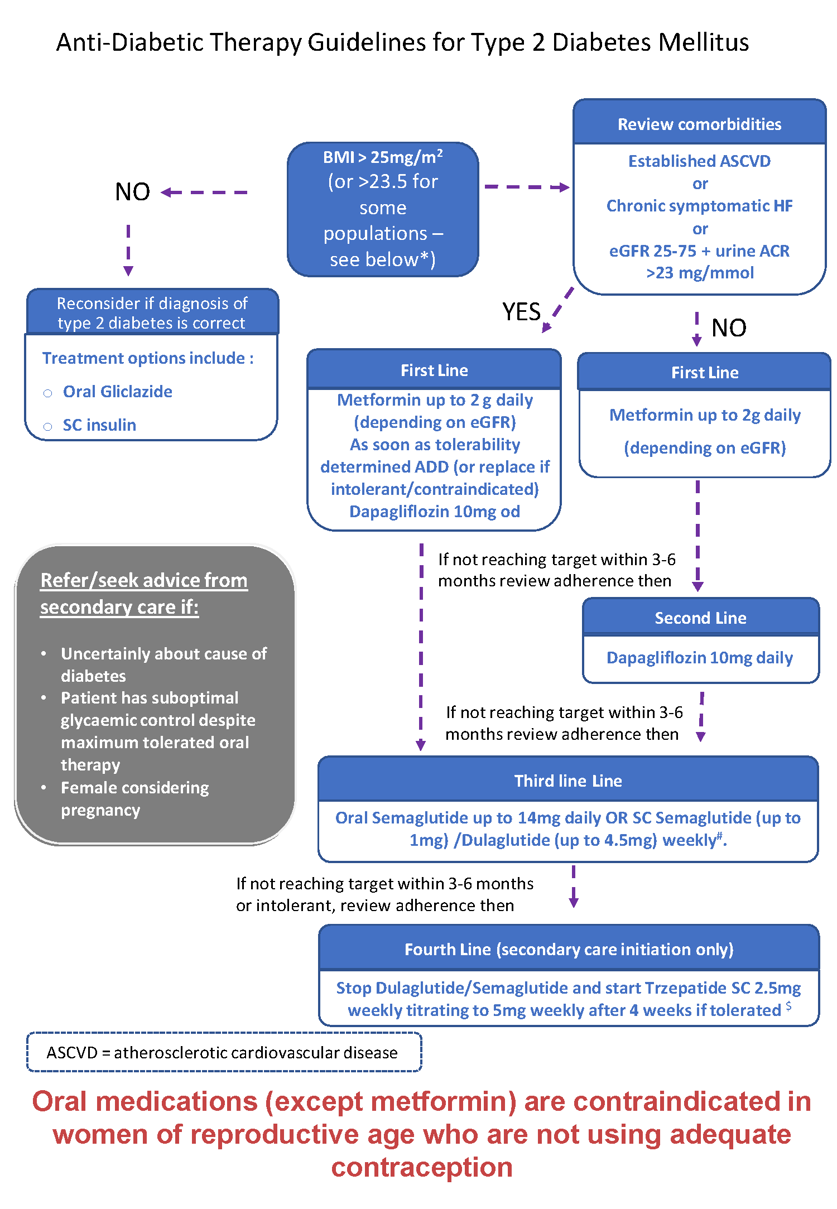
Tirzepatide is a 4th line agent for treatment of Type 2 diabetes with BMI > 25.

It will be considered where metformin, a drug of the SGLT2 (sodium-glucose co-transporter 2 inhibitor) class and a GLP1 agonist are either not tolerated or are insufficiently effective. For patients in this category the GLP1 agonist treatment may be substituted for Tirzepatide.

Refer to current edition of the British National Formulary (BNF), available at https://bnf.nice.org.uk/, and Summary of Product Characteristics (SPC), available at https://www.medicines.org.uk/emcfor detailed product and prescribing information and specific guidance.

Preparations available

Sterile solution of Tirzepatide for injection in a multi-dose prefilled pen (MOUNJARO KwikPen)

4 doses of 2.5 mg/0.6 mL (10 mg in 2.4 mL)

4 doses of 5 mg/0.6 mL (20 mg in 2.4 mL)

4 doses of 7.5 mg/0.6 mL (30 mg in 2.4 mL)

4 doses of 10 mg/0.6 mL (40 mg in 2.4 mL)

4 doses of 12.5 mg/0.6 mL (50 mg in 2.4 mL)

4 doses of 15 mg/0.6 mL (60 mg in 2.4 mL)

Recommended dosage and administration

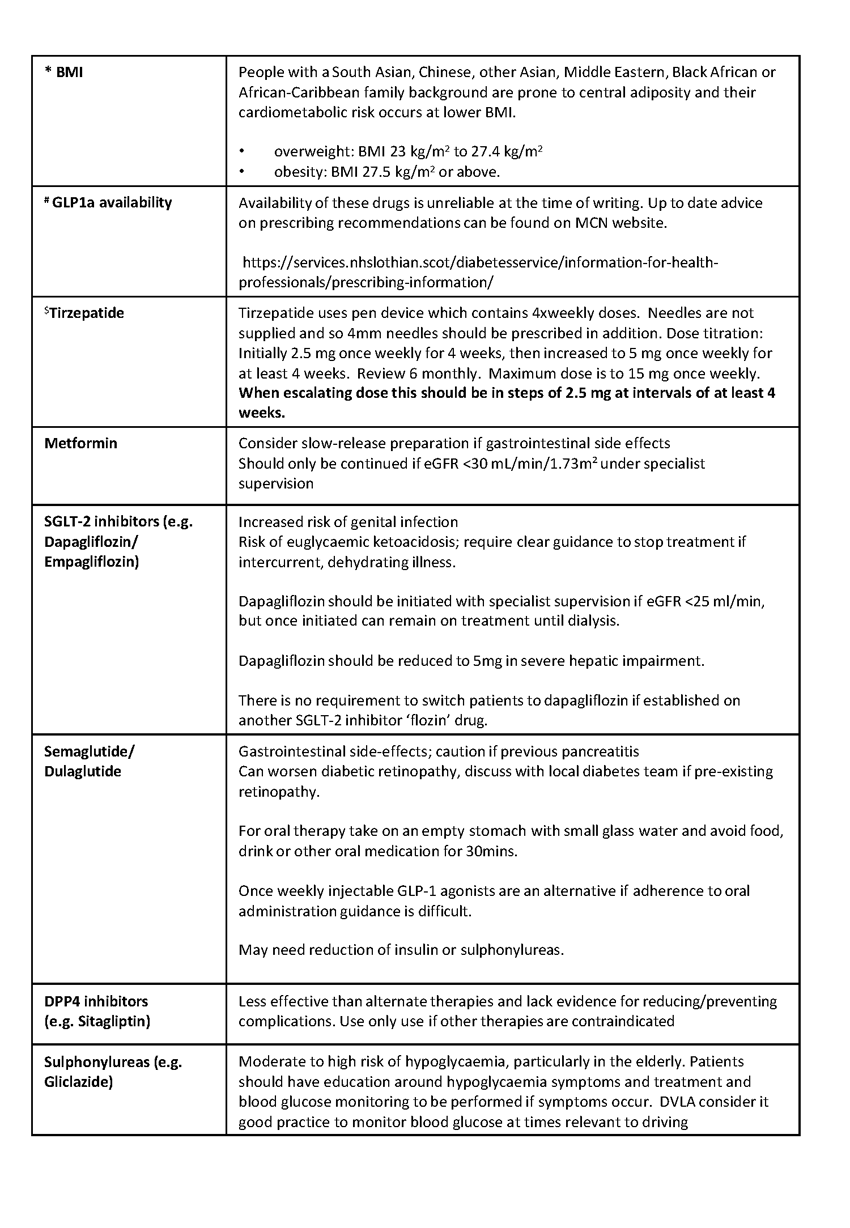
Starting dose is 2.5 mg once-weekly by subcutaneous injection for at least 4 weeks,

Then, if tolerated, increased to 5 mg once-weekly for at least 4 weeks

As required, dose can be increased in 2.5 mg increments no more frequently than every 4 weeks to a maximum of 15 mg once-weekly

Adverse effects

  • The most common side effect is gastrointestinal disturbance.
  • Pancreatitis is a rare but serious side effect and patients should be warned of the signs to look out for. Caution should be used in patients with a previous history of pancreatitis and only prescribed after specialist discussion.
  • Hypersensitivity reactions are reported to be similarly common to GLP1 agonists. Injection site reactions occur in up to 1 in 20 patients. The Mounjaro KwikPen contains benzyl alcohol which can cause allergic reactions and should not be used in patients with a history of hypersensitivity to this compound.
  • Tirzepatide is contraindicated in women of child-bearing age who are not using adequate contraception. See “drug interactions” below. It is also contraindicated while breastfeeding.

Drug interactions

  • Tirzepatide delays gastric emptying which may slow absorption of concomitant oral medications.
  • The risk of a delayed effect should be considered for oral medications where a rapid onset of action is important. Patients who are on medications in which there is a narrow therapeutic index - including digoxin and warfarin - should be monitored after starting and dose increases. Review of risk/benefit of prescription in this patient group and discussion with patient will important. There may be some people (e.g. labile INR control in a patient with a metal heart valve) in whom risks of prescription might be felt to outweigh benefit. If being suggested/prescribed from secondary care then the requirement for extra monitoring should be made explicit and primary care asked if will give assistance in this monitoring.
  • Reduced efficacy of oral contraceptives cannot be excluded and it is advised that women of child bearing age should add barrier method of contraction or switch to a non-oral contraceptive during the titration phase of Tirzepatide and for four weeks after any subsequent dose increase.

Anti-Diabetic Therapy Guidelines for Type 2 Diabetes Mellitus - Flow Chart

Editorial Information

Next review date: 31/12/2026

Author(s): Williams R.

Version: 1.0

Co-Author(s): Muthukrishian B, Pacitti S.

Approved By: ADTC

Reviewer name(s): Williams R.