NHS Borders clinical guidelines

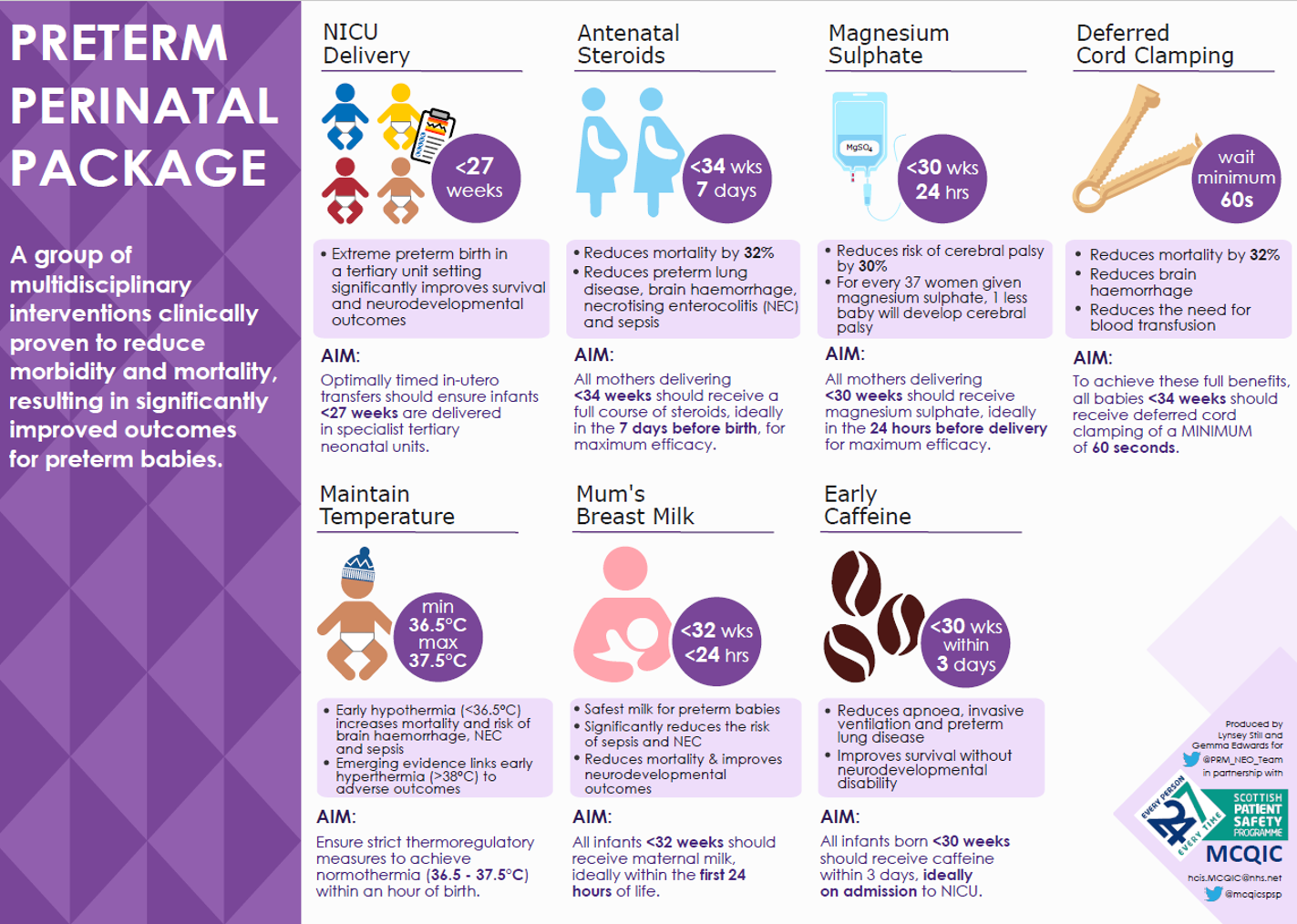
There are 4 maternity-led strategies that should be offered/considered dependent on gestation to reduce mortality and morbidity in cases of preterm labour and planned preterm birth. See below sections for detailed guidance on each. These form part of the Scottish Patient Safety Programme (SPSP) perinatal optimisation package.
- Delivery at unit with level 3 NICU service when appropriate.
- Antenatal corticosteroids.
- Magnesium sulphate.
- Delayed cord clamping.
In addition:
Tocolysis may be considered to facilitate in-utero transfer and administration of steroids.
Intrapartum antibiotics for group B strep prophylaxis reduce the rate of neonatal sepsis.
Thermal care of the neonate.
Delivery unit
- Borders General Hospital has a level 1 Special Baby Care Unit. Aim to transfer to a maternity unit with a level 2 Neonatal unit if 28-32 weeks and a level 3 unit if less than 28 weeks
- Please start the Preterm Perinatal Checklist for all women suspected of preterm labour or preterm prelabour rupture of membranes or planned delivery <34 weeks.
- MDT discussion between Consultant Obstetricians and Neonatologists should follow re safety and feasibility of transfer. If transfer recommended contact the In-utero Coordination Service (ScotSTAR) on 03333 990 210
- Delivery in a NICU significantly improves survival and neurodevelopmental outcomes and should be accommodated if safe to do so
- Factors to consider when considering IUT:
- Gestation
- Maternal condition
- Current fetal condition including background risk factors and fetal monitoring
- Active labour/progress of labour.
- Neonatal and obstetric unit activity and cot/bed status.
- Be aware that transfer takes time. It is appropriate to commence both steroids and magnesium prior to transfer. Magnesium bolus can be given +/- infusion can be started, discontinued for transfer and restarted in receiving hospital. This approach can ensure babies get the best chance of full optimisation
- Perform a pretransfer pause
- Prior to transfer, reassess the patient clinically to ensure they remain appropriate for transfer. Ensure observations are up to date and this may also warrant repeat vaginal examination (digital vaginal examination (VE) or speculum) to assess for possible progress in labour if there has been delay since last assessment
Antenatal Corticosteroids
Antenatal corticosteroids reduce perinatal mortality and morbidity for premature babies.
Maximal benefit occurs in pregnancies that deliver 24 hours after and up to 7 days after administration of the second dose of antenatal corticosteroids.
There is no/very limited benefit if birth occurs >7 days following steroid administration (RCOG 2022).
Maternal corticosteroid therapy has been shown to reduce the risk of neonatal death and morbidity even if delivery occurs within the first 24 hours. A steroid course should be commenced even if delivery is anticipated with 24 hours.
There is no evidence of other significant maternal harm caused by steroid administration. Steroids do not increase maternal infection rate but may worsen already present systemic infection therefore caution and individualised plan should be used in this scenario.
Administration:
Betamethasone: two doses of 12 mg IM given 24 hours apart (or 12 hours apart if delivery anticipated within the 24 hours)
Or Dexamethasone: two doses of 12mg IM given 24 hours apart (or 12 hours apart if delivery anticipated within the 24 hours)
See Diabetes guidelines regarding use in diabetic pregnancies as steroids cause maternal hyperglycaemia. Women treated with insulin will need additional insulin therapy and may need a variable rate infusion.
Recommendations per gestation
There is some variation in national and international guidance regarding the use of steroids per gestation. Benefits and risks in late preterm birth remain controversial.
NHS Borders recommendations for steroid administration per gestation
| 22+0 - 23+6 weeks | Individualised discussion |
| 24+0- 34+6: Offer | Offer steroids |
| 34+6 – 36+6 | Consider steroids. Risk vs benefit discussion with woman |
2+0- 23+6: individualised discussion
Babies born at this gestation have the highest risk of mortality and severe morbidity (BAPM). Discussion should be had involving senior obstetrician, neonatologist and the pregnant person/parents regarding the decision for either survival or comfort focused care and may be offered steroids thereafter.
24+0- 34+6: Offer steroids
Offer steroids to all women in preterm labour or having a planned preterm birth.
34+6 – 36+6: Consider steroids
Consider steroids. This should involve shared decision-making with the parents. Risks and benefits of steroids at late preterm gestations should be discussed. Take into account other risk factors such as caesarean birth, known underlying neonatal conditions and fetal growth restriction.
Repeated course of steroids
Repeat courses of steroids are not routinely recommended but may be considered in certain circumstances. This would be a consultant decision taking into account timing of steroids and likelihood of imminent birth. There is poor evidence of benefit from steroids when birth is > 7 days from administration.
NICE (2022) and WHO advises to consider a single repeat course if <34+0, steroids >7 days ago and are at very high risk of giving birth in the next 48 hours.
Magnesium sulphate for fetal neuroprotection
Preterm delivery is a known risk factor for cerebral palsy. Magnesium Sulphate reduces this risk.
Magnesium sulphate should be offered to all women <30 weeks’ gestation (individualised decision 22+0-23+6) where delivery is planned or expected within 24 hours.
Offer magnesium sulphate to those who are in established preterm labour of having planned preterm birth within 24 hours. Ideally it should be given in the 24 hours prior to birth for maximum efficacy.
Bolus +/- infusion can be commenced prior to in-utero transfer, discontinued for transfer and restarted in receiving unit.
30- 33+6 Do not routinely offer. May occasionally be considered in certain circumstances
Administration and dosage of magnesium sulphate
A 4g bolus dose should be given followed by an infusion of 1g/hour until birth or for 24 hours whichever is sooner.
If magnesium sulphate use is for preterm optimisation only (i.e. not pre-eclampsia), discontinue at delivery.
For planned delivery commence infusion as close to 4 hours before delivery as practical. For unplanned situations, ideally at least 4 hours of magnesium should be given but treatment should not be withheld if delivery is anticipated before this.
If there is maternal and/or fetal compromise delivery should not be delayed to allow administration of magnesium. Multiple pregnancies should receive the same dose and treatment. Anaesthetic and neonatal medical staff should be aware of the decision to give magnesium sulphate.
Contraindications: allergy, severe aortic stenosis, cardiogenic shock.
Caution: oliguria, renal impairment, pulmonary oedema
The dosing and monitoring regime are the same as given in severe pre-eclampsia and eclampsia.
Loading Dose (bolus):
- 4 grams IV over 15-20 minutes through an Alaris pump @ 120ml/hr
- 40 mls of 10% Magnesium Sulphate (4 amps)
Maintenance Infusion Dose:
- IV infusion 1 gram Magnesium Sulphate per hour 10mls/hr
Maintenance Infusion Preparation:
- 5 grams (50 mls of 10% Magnesium Sulphate (5amps)
- Infusion rate is 1 gram (10 mls) per hour via a syringe driver
Infusion is maintained at 1 gram/hr for 24 hours provided:
- Respiratory rate > 14 per minute
- Urine output > 25mls/hour, and
- Patellar reflexes are present
Use the same monitoring for patients with preeclampsia/eclampsia receiving magnesium sulphate.
Delayed Cord clamping (DCC)/optimal cord management
DCC results in a significant (32%) reduction in mortality in preterm babies.
When survival focused care is being offered, all babies <34 weeks should receive deferred cord clamping for a minimum of 60 seconds.
Practicalities
- We now routinely offer DCC to all babies in our unit, however the impact on preterm babies is significant and we should ensure preterm babies in particular receive this.
- When birth is expected or planned, there should be discussion with neonatal team regarding attendance. Initial stabilisation of the baby can be offered with the cord intact. This may also involve placing the baby in plastic bag as part of thermal management.
- Neonatal attendance at safety briefs prior to planned preterm caesarean births is of benefit for planning of this and should be part of routine practice.
- Whenever possible timing of cord clamping should be guided by the neonatal team in conjunction with the obstetric team.
- Decision to perform earlier cord clamping due to concerns regarding the condition of the baby should be a shared decision with the neonatal team.
- Take care to assess cord length to prevent disruption of cord from traction.
- Administration of active 3rd stage drugs (oxytocin/syntometrine) should be administered as normal at normal time.
- DCC should be passive with the baby ideally at the level of the placenta or below. The cord should not be routinely milked.
DCC special circumstances
- General anaesthesia is not a contraindication to DCC.
- Initial management of caesarean related traumatic bleeding may be able to be managed whilst the cord is intact. This is for a relatively short time and given DCC results in a significant reduction in neonatal mortality, every effort should be made to provide this. This may involve e.g. the use of Green Armitage clamps on bleeding vessels.
- If the placenta delivers with the baby, BAPM recommend that DCC can still continue for 60 seconds (the beneficial effects are not in relation to oxygenation from the placenta but in relation to blood volume) and the placenta can be held at a level above the baby.
- At caesarean birth for DCDA twins, if possible delivery of second twin should continue whilst DCC being performed for first twin.
Contraindications to DCC:
- The need for maternal resuscitation for massive, acute haemorrhage
- Ruptured vasa praevia, snapped cord or other trauma to the cord vessels which will result in haemorrhage from the baby
- Hydrops
Individualised decision:
- Abruption
- FGR with abnormal umbilical artery Doppler.
- Monochorionicity with twin-twin transfusion syndrome
Tocolysis for preterm labour
There is no clear evidence that tocolytic drugs improve neonatal outcomes and therefore it is reasonable not to use them.
Tocolysis can be considered <33+6 to allow administration of steroids and or transfer to an appropriate unit for neonatal care dependent on gestation.
Tocolytic drugs are contraindicated when delayed delivery may have adverse effects on maternal health or may keep the fetus in a potentially hostile environment. (E.g. known chorioamnionitis)
Contraindications include:
| Intrauterine infection/ maternal pyrexia | Maternal condition requiring delivery |
| Advanced gestation (>34 weeks) | Ruptured membranes |
| Fetal death or lethal abnormality | Abruption/vaginal bleeding |
| Suspected fetal compromise |
Following discussion with the on call obstetric consultant, if tocolysis is deemed necessary then the agent of choice is Nifedipine.
Dose: Nifedipine Modified Release 20 mg TID x 48 hrs.
Side effects: hypotension, tachycardia, headache, nausea, flushes
Contraindications: allergy, severe aortic stenosis, cardiogenic shock.
Caution: concurrent administration of Magnesium Sulphate. May cause maternal hypotension.
If Tocolysis has been commenced but labour is progressing: Stop Nifedipine and start Magnesium Sulphate for fetal neuroprotection if <30 weeks