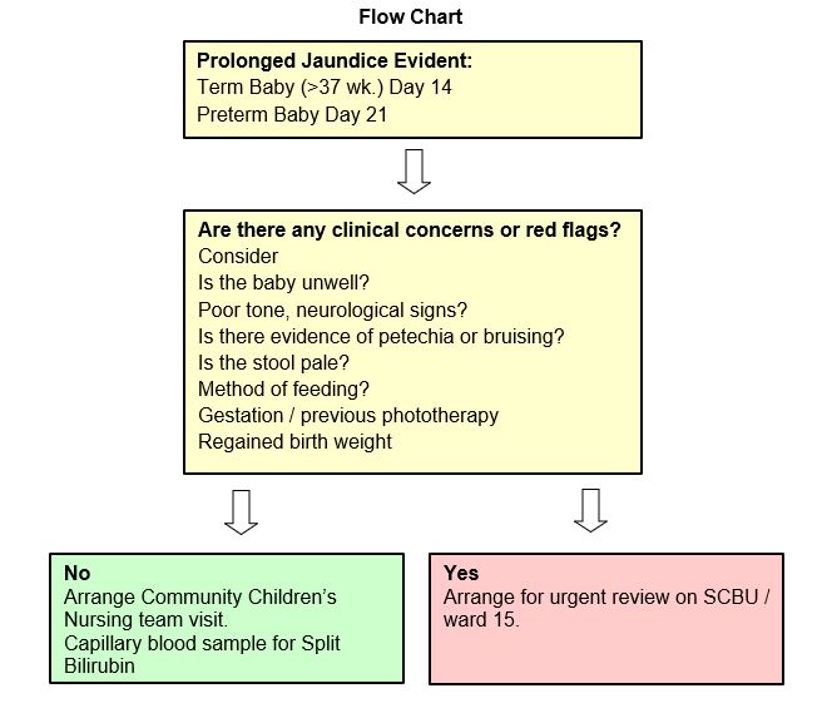
Term babies who remain visibly jaundiced beyond 14 days and preterm babies beyond 21 days require further assessment.
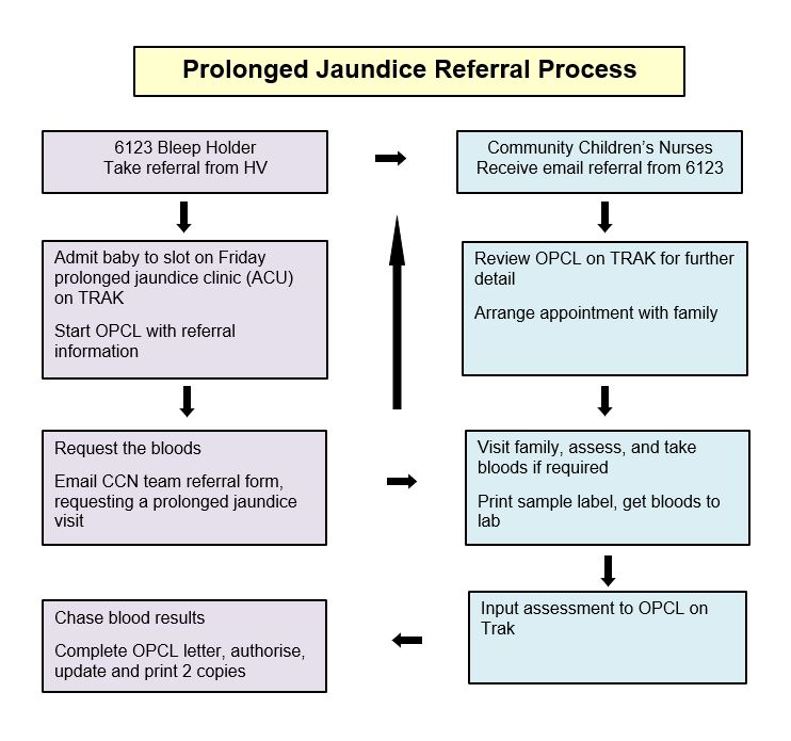
The baby is referred to bleep 6123 by the community team.
At the time of referral, the baby is admitted to a slot in the ACU Prolonged Jaundice Clinic to allow generation of a letter and printing of labels.
The referral information becomes the start of the outpatient clinic letter (OPCL) and this is done by the person taking the call. The letter is prewritten (\pjaun) but does involve options and deleting the parts not relevant.
CCNs abbreviated referral form is completed and emailed to CCN team, the ANNP mailbox and the consultant of the week.
CCN team should see term babies by D21 and preterm by D28
History and information from the referral should be clarified and clinical assessment, including weight (if not done recently), carried out. The information is added to the OPCL by the CCN.
In the absence of any other concerns, investigations are limited to:
Total and conjugated bilirubin
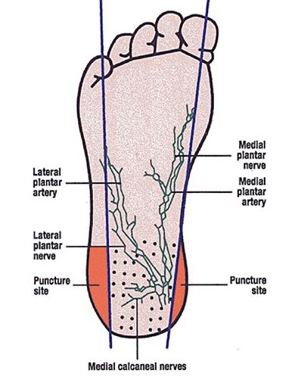
The blood should be taken from a capillary sample, using the baby’s heel and be collected into lithium heparin (orange or small green) tube, labelled and returned to the BGH lab.
Guidance on good technique for capillary blood sampling is attached to this guideline
Sucrose can be used for pain
The ANNP / Dr carrying 6123 should be made aware of this to allow them to chase results and complete OPCL.
Parents should be informed they will be phoned if the results are abnormal and given the information leaflet within this document.
NB Breast milk jaundice can take up to 12 weeks to resolve, it is not a reason to stop breast feeding
Total bilirubin significant if > 300
Conjugated bilirubin significant if > 30 or 20% of total bilirubin
Information to clarify on referral:
Age of infant in days
Breast or formula fed
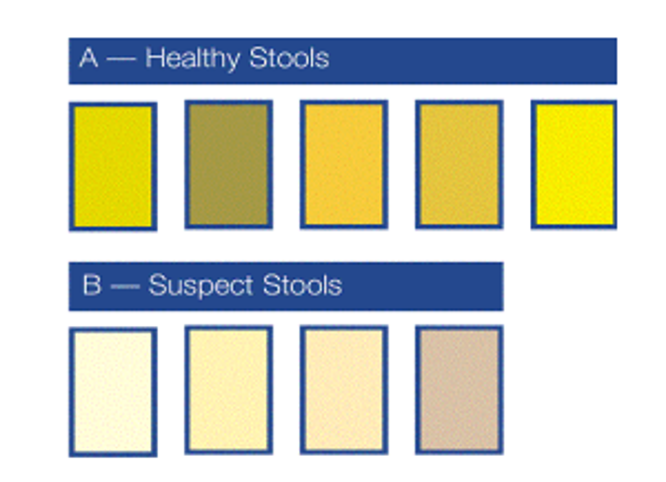
Urine and stool colour and frequency
Regained birth weight by D14
Gestation < or > 37 weeks
Are they unwell (e.g. large vomits, poor feeding, lethargy, breathlessness)
Is the mother Rh –ve or known to have antibodies
Was the newborn blood spot screening done?
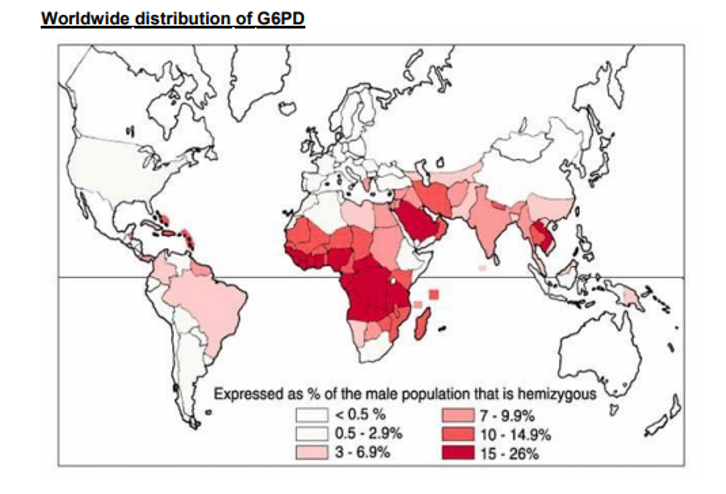
Risk of G6PD


 NHS Borders clinical guidelines