Protocol for the Care of Non-Tunnelled Central Venous Catheters (CVC)s (Excluding PICC & Hickman lines)

Warning

Objectives

This protocol provides guidance for all Registered Staff involved in management of Central venous catheter (CVC). The aim is that all Registered staff involved in the process of Insertion assistance, care and maintenance, blood sampling and removal of CVCs are competent to the level appropriate to their role.  

Insertion

A competent practitioner (i.e. Dr) should insert central Venous Catheters (CVC) with nursing assistance to maintain asepsis, reassure patient, observe the monitor and support as required. 

The nurse must familiarise themselves with the procedure, equipment required and potential complications. 

Kit should be gathered, checked and prepared prior to starting the procedure. May be inserted in theatre or at the bedside maintaining strict asepsis throughout. BP, HR, RR, SpO2 & ECG monitoring must be available along with capacity to provide Oxygen. 
Confirmation of correct position

A new line should be transduced via the distal port, brown lumen on our current central lines, to identify a central venous pressure waveform if inserted in an area equipped to do so.  

After siting and securing Subclavian or Jugular CVCs, an erect chest x-ray must be obtained and reviewed by a competent practitioner (i.e. Dr) prior to use. They must sign an insertion checklist verifying there have been no complications and the line is safe to use. 

For patients in ITU (or theatre prior to ITU) this must be completed on the ‘Medical Devices Chart.’ For Ward based patients, a sticker found in the insertion box must be completed and added to the patients notes.  

Ensure all 3-way tap and smart site connections are secure, and if unused, in the off position with the line clamped closed to prevent air embolism if the 3 way tap or needle free port were to become disconnected. 

Kit Required

Ideally, a box should be available containing standardised insertion equipment in all areas where CVC insertion could occur. All staff should know where to find this and each area is responsible for ensuring items are re-ordered/stocked at all times. 

The box should include: 

  • A standard central line insertion pack (which includes line, scalpel, insertion kit, sterile drapes, 3-way taps, smart sites, gown and hand towel) 
  • Sterile gloves x2 of sizes 6, 6.5, 7, 7.5 and 8 
  • Surgical hat 
  • Surgical face mask 
  • 4x 10ml 0.9% Saline ampules 
  • 10ml Chloroprep stick or equivalent. (Note risk of allergy/anaphylaxis) 
  • 10mls 2% Lidocaine 
  • 10ml syringe 
  • Red, blue and orange needle  
  • 2-0 Mersilk suture 
  • Biopatch (only for use in those with increased risk of infection) 
  • Large Tegaderm 
  • Curos cap (Green alcohol impregnated cover to save line for TPN) 
  • Insertion Sticker (out-with ITU) 

Potential Complications 

Complications Signs Actions
Arrhythmias, particularly during insertion  Seen on ECG monitor, patient reports palpitations, dizziness, chest pain and/or found to have irregular pulse  Alert operator immediately if occurs during insertion. If found after insertion, take full observations including ECG, and escalate to Critical Care Outreach(CCOT)/Hospital at Night (HAN)/Medical team immediately 
Infection at insertion site  Erythema, discharge, pain, oedema  Obtain swab, clean and redress using an aseptic procedure. Inform medical team and re-evaluate need for line. Consider re-siting if indicated.  
Air Embolus  Desaturation, wheezing, breathlessness, hypotension, chest pain, heart failure, cardiovascular collapse, altered mental status, cerebral embolism 

Immediately stop gas entrapment: 

  • Apply Pressure to the insertion/exit site 
  • Ensure 3-way taps are off to patient & line is clamped if still in situ - It may be safer to remove if dislodged enough to see exit ports on line (will allow air entry) 
  • Move patient onto Left side 
  • Tilt bed into steep head down (Trendelenburg) position  
  • Administer high flow Oxygen via non-rebreathe mask 
  • Call for senior medical assistance & Critical Care Outreach Team/Hospital at Night (CCOT/HAN) 
  • Start BP. HR, SpO2 and ECG monitoring 
  • If haemodynamically compromised bleep 3933 for the Anaesthetist on call 


If peri-arrest or suffering respiratory or cardiac arrest call 2222 and follow resuscitation guidelines. Inform team of recent CVC removal. 

Systemic infection  Increasing NEWS2, Tachycardia, Hypotension, Pyrexia/hypothermia, chills/rigors, high/low WCC, raised CRP/PCT, raised PCT  Escalate to CCOT/HAN/Medical team, obtain peripheral and central blood cultures at the same time before administering antibiotics. Consider removing the line & consider sending the tip to microbiology for culture & sensitivity (C&S) 
Thrombus/Occlusion/Leakage  Line not aspirating or flushing. Visible blood blocking line. Visible leakage at insertion site.  Gently try to aspirate with nothing smaller than a 10ml syringe. If still unable to aspirate, do not flush. Turn 3-way tap to the off position, clamp the line and clearly label ‘do not use.’ If the whole line is blocked, removal should be discussed with the medical team. If leakage is seen around the insertion site, stop any infusions immediately (arranging alternative access for medications which cannot be ceased) & alert the CCOT/HAN/Medical team for urgent review.  
Pneumothorax, most likely at time of insertion, especially with subclavian placement  Increased respiratory rate, increased work of breathing, tachycardia, hypotension, tracheal deviation, increased pressures in ventilated patients.  Escalate immediately to Medical team/CCOT/HAN – Give clear SBAR and request immediate review. Prepare to set up for potential chest drain insertion. 
Bleeding  Visible blood or swelling/bruising around insertion site  If visibly bleeding, apply apron and gloves then apply gentle pressure with a sterile gauze swab until ceased. If not settling, seek medical advice. If oozing, apply OKCEL haemostat dressing using an aseptic technique and regularly review the site for ongoing bleeding. Observe any bruising or swelling regularly. Consider physiological causes for bleeding. Consider checking Coag & FBC. 

Safety Checks

The following safety checks must be done and documented in the appropriate paperwork for your clinical area every shift.  

  • Review ongoing need for CVC 
  • Ensure smart-sites are clean, secure and present on all ports.  
  • Ensure unused ports are clamped with 3-way taps (if in use) off to the patient 
  • Ensure completed infusions are removed immediately and line is flushed manually 
  • Inspect insertion site for signs of infection 
  • Ensure dressing is clean and intact 
  • Ensure staff accessing the line are trained to do so 
  • Ensure line is securely sutured to the skin and does not protrude further than at time of insertion (ensure this is documented on insertion)  
  • If line is transduced, the port at the transducer should be secured with a white cap to prevent air embolus and discourage use for injection. This port should not be used for injection when an arterial line is also in place due to risk of accidental arterial infusion 
  • Ensure patency is confirmed 

Aseptic Non-Touch Technique

In line with Infection Control Guidelines, when accessing a CVC you should wash your hands, don an apron then gel hands. Gloves are necessary if you expect to be in contact with blood or bodily fluids so are not required for tasks such as connecting or removing an infusion or flushing. Use an aseptic non-touch technique, which avoids touching/contaminating any key parts reduces risk of introducing infection. Attend patient prepared with everything you need to minimise interruptions and repeated access of the device. The needle free ports should be cleaned with a Chlorhexidine/alcohol wipe prior to accessing the port. 

Syringe choice and Flushing method

The smaller the syringe the more pressure it will exert on the line. Too small a syringe could result in line fracture and potential air embolus. Do not use anything smaller than a 10ml syringe. Draw up approximately 8mls 0.9% Saline, attach to smart site and gently draw back to check patency. If it draws back, proceed to flush using a push-pause method. Clamp the line on the push of the last ml to maintain a positive pressure in the line which will prevent blockage. 

Smart Sites

Also known as Bioconnectors, needleless valves or needle-free connectors. There must be one on every port to reduce the risk of air embolus and infection. They can stay in situ for 7 days unless contaminated. Before removing, ensure line is clamped at the end nearest to the smart site. When applying a new one, the dead space must be flushed through with 0.9% Saline before attaching to the line. Have new smart site ready to attach before removing the old one. Use ANTT. 

Curos (alcohol impregnated) Caps

Curos caps are alcohol impregnated caps used to prevent contamination of the smart site. One should be applied to the smart site on the Medial 2, green lumen at time of line insertion to maintain asepsis if it is suspected the patient may require TPN. They should also be considered for use in patients receiving intermittent TPN. When TPN is disconnected, the smart site should be cleaned with a Chlorhexidine and alcohol wipe then flushed before attaching a Curos cap, all using an ANTT.  

Use of 3-way Taps

If a patient needs multiple infusions, 3-way taps can facilitate. Refer to pharmacy matrix of compatible drugs. If adding a new one, ensure new smart sites are attached before priming dead spaces with 0.9% Saline. Ensure line is off to port receiving new tap. If removing, ensure line is clamped off nearest to tap. Use ANTT. 

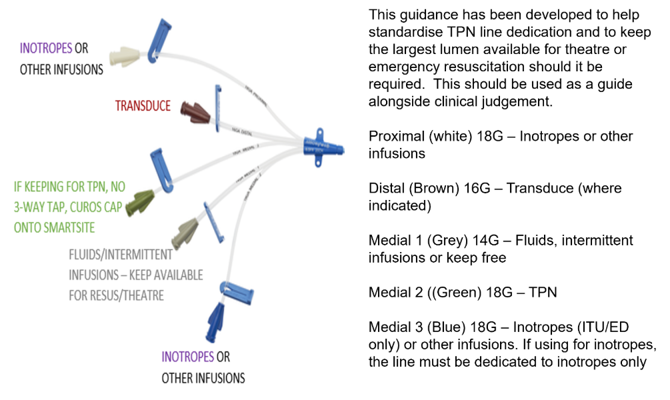
Guidance on Lumen use

A close-up of a medical device

AI-generated content may be incorrect.

TPN

See above regarding Curos caps. Adhere to TPN Protocol. Change TPN bag, line, filter and smart site every 24 hours. Monitor blood glucose levels a minimum of 4 hourly. Ensure a port is dedicated for TPN only. If administering intermittent TPN, aspirate and flush the line then apply a fresh Curos cap after disconnecting and discarding infusion. When reconnecting, use the same line and follow procedure. 

Check Patency, Transduce, Administer IV Bolus & Infusion

All ports should be checked for patency. 

Pre Procedure   
  • Gather Kit 
  • Cleaned plastic tray 
  • Chlorhexidine/Alcohol wipe 
  • 2 x 10ml Syringes 
  • 10ml NaCl 
  • Appropriate PPE - Apron 
Procedure 
  • After prepping kit, wash hands and don PPE 
  • Using ANTT prep kit 
  • Check ID, explain procedure & gain consent 
  • ‘Scrub the hub’ (thoroughly clean with a Chlorhexidine/alcohol wipe) for 30 seconds and allow to air dry  
  • Without contaminating the smart site, attach your first 10ml syringe (never anything smaller) 
  • Turn 3-way tap (if in use) open between patient and syringe and unclamp the line 
  • Draw back on plunger to aspirate blood from the line. It may be necessary to draw back multiple times 
  • Aspirate 3-5 mls 
  • Turn 3-way tap off to patient and or clamp the line 
  • Disconnect syringe and replace with 10ml saline flush 
  • Unclamp and re-open 3-way tap between patient and syringe 
  • Flush using the push-pause method 
  • Turn 3-way tap to the ‘off position’ (off to patient) and re-clamp line  
  • Dispose of clinical waste & PPE 
Transduce 
Pre Procedure 
  • Gather Kit 
  • Monitor 
  • Transducer cable 
  • Transducer Holder 
  • Pressure Monitoring Kit 
  • 1000ml bag Saline 
  • 1000ml Pressure bag 
  • Drip stand 
  • 10ml syringe of Saline 
  • Smart site 
  • White cap 
Procedure 
  • On Mindray monitor, select ‘Screen set up’ which opens the ‘Tile Layout’ menu. Press on waveform and select ‘IBP, then ‘Any IBP’ before exiting using the cross in the top right corner 
  • Document batch number of the Saline onto the Infusion prescription sheet 
  • Secure the transducer holder onto the drip stand 
  • Slide bag of Saline into pressure bag, securing in place and lay on a hard surface 
  • Unsheathe spike on pressure monitoring kit and pierce Saline 
  • Close roller clamp on pressure monitoring kit 
  • Hang pressure bag on drip stand 
  • Sit the transducer on the transducer holder 
  • Inflate pressure bag to 300mmHg then turn 3-way tap on pump off to the bag 
  • Open roller clamp which will fill part of line 
  • Tighten all connections on the pressure monitoring kit 
  • Turn 3 way tap at transducer off to end of line and pull flush to flush port out to air 
  • Close 3 way tap and apply a white cap 
  • Turn 3 way tap closest to bag off to end of line and pull flush to flush port out to air 
  • Close 3 way tap to this port and apply a Smart site flushed with Saline 
  • Pull flush again to ensure whole line is fully primed to the end with no air bubbles 
  • Identify the distal port and ensure the line is clamped 
  • Using an ANTT, remove smart site from port and attach the pressure monitoring line 
  • Attach pressure monitoring cable to the pressure monitoring kit 
  • Adjust the transducer holder to the level of the right atrium which is around the 4th intercostal space in the mid-auxiliary line 
  • Remove white cap and turn 3-way tap on transducer holder off to patient (open to air) 
  • On monitor, select ‘Zero lines’ then ‘CVP Zero’ 
  • When the monitor reads CVP 0, open the 3-way tap between bag & patient (off to air) and re-apply the white cap 
  • You should now see a CVP waveform and a reading will display in mmHg 
  • Document and report where indicated 
  • Immediately after checking patency, without contaminating the smart site, attach bolus syringe 
  • Open 3-way tap between patient and syringe, then unclamp the line 
  • Deliver over recommended period of time, using a push pause motion 
  • When complete, flush with 10mls Saline using the push-pause method 
  • Immediately after checking patency, without contaminating the smart site, attach the infusion line 
  • Open 3-way tap between infusion and patient, then unclamp the line 
  • Programme the pump to ensure medicine is delivered at a safe rate. There is a risk of increased speed of delivery through a CVC 
  • When complete, ensure CVC is attended immediately to prevent line occlusion 
  • Turn 3 way tap off to patient and clamp the line 
  • Disconnect infusion 
  • Flush with 10mls Saline using the push pause method  

Blood Sampling

Taking blood samples from CVCs increases the likelihood of line infection and blockage which could both indicate need for removal.  

Using the CVC for blood sampling should only be done if there is no other option for obtaining venous blood and should not be done as a routine. 

Pre Procedure 
  • Gather Kit 
  • Plastic tray cleaned with alcohol wipes or a dressing pack 
  • Chlorhexidine/Alcohol wipe x2 
  • 2 x 10ml Syringes 
  • 10ml Normal saline 
  • Blood sampling adapter 
  • Appropriate blood tubes 
  • Appropriate PPE – Apron & gloves 
Procedure 
  • After prepping kit, wash hands and don PPE  
  • Using ANTT prep kit 
  • Check ID, explain procedure & gain consent 
  • ‘Scrub the hub’ for 30 seconds and allow to air dry  
  • If taking blood for cultures, omit the next 3 steps – do not discard first sample from line – go straight to filling culture sample tubes x2 before usual tubes 
  • Without contaminating the smart site, attach your first 10ml syringe (never anything smaller) 
  • Turn 3-way tap (if in use) open between patient and syringe and unclamp the line 
  • Draw back on plunger to aspirate 10mls blood from the line & discard. It may be necessary to draw back multiple times 
  • Lock first blood tube into sampling adapter then using ANTT connect into smartsite. This is not luer lock so ensure it is secure before drawing back to fill the tube 
  • Clamp line, remove tube, leaving adapter in place and repeat with subsequent tubes. Unclamp and re-clamp with each to mitigate the risk of air embolus in the event of adapter falling off. 
  • When sampling complete, clamp the line before attaching 10ml 0.9% Saline flush 
  • Flush using the push-pause method, clamping on last ml to secure positive pressure in the line. 
  • Label samples and dispose of waste products as policy. 

Dressings

A large Tegaderm dressing should be placed over the insertion site by the operator. It can remain in place for 7 days unless it becomes dislodged, contaminated or gathers moisture beneath. In which case it should be changed using an aseptic technique. 

Removal & Air Embolus

Rationale for keeping CVC in situ should be reviewed daily by medical staff and removed as soon as it is appropriate and safe to do so.

CVC removal (not for Hick/PICC) 
Pre Procedure 
  • Decision to remove must come from the medical team 
  • Check recent bloods for coagulopathy & need for electrolyte replacement 
  • Confirm patient identity, explain procedure and gain consent. 
  • Ask patient to practice the Valsalva manoeuvre 
  • Discontinue any IV infusions currently running (if safe to do so) 
  • Clamp all lumens and ensure 3-way taps are in the off position 
  • Ensure alternative IV access is in place if required 

Gather kit: 

  • Trolley/clean work area 
  • Appropriate PPE – Apron & non-sterile gloves 
  • Dressing pack 
  • Cleaning solution – 0.9% Saline 
  • Extra pack of swabs 
  • Stitch cutter 
  • Small occlusive dressing with absorbent patch (Leucomed) or small Tegaderm with sterile swab 
Procedure 
  • Explain procedure to patient 
  • After prepping kit, wash hands and don PPE 
  • Remove dressing and change gloves (can use sterile ones from dressing pack or non-sterile) 
  • Use stitch cutter to remove sutures – usually 1 to each side but may be more depending on inserting practitioner 
  • When satisfied all sutures are out, ensuring line is secure (do not let go), put the bed into Trendelenburg position with the head down (head lower than heart level) 
  • Ask patient to perform the Valsalva manoeuvre by gently but firmly exhaling through closed mouth & nose (straining) to increase pressure in the chest (reducing risk of air emboli) 
  • With one hand maintaining pressure over the insertion site with gauze, use the other to gently but firmly remove the line during the Valsalva manoeuvre. Ensure no air is able to reach the exit site – keep covered 
  • If the tip is required for C&S sampling hold the line out and ask an assistant to cut the tip with sterile scissors, catching it in a white topped container (This is rarely asked for) 
  • Maintain pressure on the exit site for around 5 minutes until bleeding has ceased 
  • Cover with Leucomed or small Tegaderm dressing +/- gauze 
  • Label the dressing with date and time – remove in 72 hours 
  • Flatten bed to neutral position 
  • Dispose of all waste products & sharps as policy
Post Procedure 
  • Unless contra-indicated ask patient to lie flat for 30 minutes after line removal. If uncomfortable or suffers from respiratory compromise aim for a minimum of 10 minutes.  Use your clinical judgement & discretion 
  • Observe for signs of air embolus – Desaturation, wheezing, breathlessness, hypotension, chest pain, hear failure, cardiovascular collapse, altered mental status, cerebral embolism 
  • Do not delay Daltaparin after CVC removal unless there is evidence of coagulopathy or ongoing bleeding from site. However, do consider delay following removal of large bore CVCs such as dialysis catheters (Vascath). Use clinical discretion. (Once haemostasis secured, risk of DVT may be greater than risk of bleeding) 
In the event of Air Embolus 

Immediately stop gas entrapment: 

  • Apply Pressure to the insertion/exit site if line out, or aspirate line if still in situ 
  • Move patient onto Left side 
  • Tilt bed into steep head down (Trendelenburg) position  
  • Administer high flow Oxygen via non-rebreathe mask 
  • Call for senior medical assistance & Critical Care Outreach Team/Hospital at Night (CCOT/HAN) 
  • Start BP. HR, SpO2 and ECG monitoring 
  • If haemodynamically compromised bleep 3933 for the Anaesthetist on call 

If peri-arrest or suffering respiratory or cardiac arrest call 2222 and follow resuscitation guidelines. Inform team of recent CVC removal. 

Replacement Line

If a new CVC is sited, drugs attached to the old line must not be moved onto the new one. New infusions and giving sets must be used to reduce the risk of infection transference. For inotropes it will be necessary to continue to run the old infusion via the old line whilst filling the dead space of the new line. Observations must be closely monitored while both are infusing to ensure the old is switched off in a safe and timely manner. This theory may be applied to other medications as indicated. Use clinical judgement or seek advice if unsure. 

Education Requirements

  • First you must complete e-Learning on the CARS section of Learn Pro 
  • You must then attend face to face training to consolidate your e-learning and practice clinical skills 
  • Next your competence must be assessed by a competent practitioner. If they deem you competent they should sign your competency document (downloaded from CARS) 
  • When all sections of your competency document have been signed you are deemed competent you may proceed to use CVCs unsupervised and if Level 4, can also assess others 
  • Upload this to CARS and complete all sections – your line manager will be notified and will sign you off as complete 
  • Please repeat competency assessment every 2 years  

Editorial Information

Next review date: 15/09/2028

Author(s): Prentice H.

Version: Version 6

Co-Author(s): Irving C.

Approved By: Acute Services Clinical Governance Group

Reviewer name(s): Bacon K - Charge Nurse/Clinical Nurse Educator ITU, Turnbull J - Team Lead Clinical and Professional Development.

References

Dumfries and Galloway (2019) Central Venous Access Devices Workbook  

Greater Glasgow and Clyde (2017) Vascular Access Procedure and Practice Guidelines 

Doncaster and Bassetlaw Teaching Hospitals (2022) Vascular Access Device Policy 

HS Fife (2019) Procedure for the care, maintenance and removal of venous access devices (excluding renal lines) in adults 

Antimicrobial Resistance and Health Care Associated Infection Scotland (2022) Quality  

Improvement Tool (QIT) Literature Review Insertion and Maintenance of Central Venous Catheters (CVC)  

O’Grady, N. (2023) Prevention of Central Line–Associated Bloodstream Infections. The New England Journal of Medicine. DOI: 10.1056/NEJMra2213296