Emergency Management of Opioid Dependency in Inpatients - overnight or out of hours

Warning

Objectives

This guideline is intended to assist staff in the emergency management of patients who experience opioid withdrawal in an NHS Borders inpatient setting overnight or out of hours.

Scope

This guideline is intended to assist staff in the emergency management of patients who experience opioid withdrawal in the inpatient setting overnight or out of hours.

  1. To manage withdrawal symptoms.
  2. To identify those at high risk of significant complications of withdrawal.
  3. To provide treatment and symptomatic relief for opioid withdrawal symptoms

This guideline is not to be used for patients when contact can be made with Borders Addiction Service for further advice.

Audience

Clinical staff managing opioid withdrawal in the out of hours period.

Recognition and Assessment

Opioid dependence suspected or declared by patient / signs of opioid withdrawal seen
  • Take a full drug history, asking particularly about daily dependent use and withdrawal symptoms.

  • Look at injection sites (for complications & confirms recent use), if reports injecting.

  • Obtain full details of all prescribed medication including;
    • Any current/past prescriptions for Opioid agonist therapy (OAT) for example: methadone, buprenorphine, Buvidal® (long-acting buprenorphine injection) or dihydrocodeine.
    • Usual prescriber of any opioid medication.
    • Dispensing pharmacy of any opioid medication and supervision frequency.
    • When last dispensed/taken any prescribed medications.

  • Confirm on EMIS, if open to Borders Addiction Service and if currently prescribed opioid agonist therapy (OAT). If you don’t have access to EMIS please contact Borders Crisis Team (01896 827320) who can access this information.

  • Check recent drug screen toxicology on SCI Store (note these may be under Lothian or Local SCI Store).

  • Undertake an instant urine dip toxicology (available from Huntlyburn ward).

  • Send urine to lab for a formal urine drug screen (order available on TRAK).

Assess risk of other drugs or alcohol taken that may contribute to cumulative CNS depression in particular respiratory depression.

Patients who are prescribed OAT in the community

  • Please advise BAS during working hours of an admission so that assertive outreach can be arranged for follow-up if they have been discharged. If not discharged then the Substance Use liaison team will provide support during the admission. Please contact on 01896 664436.

  • If prescribed Buvidal® (long-acting buprenorphine injection) and are either due or overdue please contact BAS during working hours on 01896 664436. Information on when next dose is due is available on EMIS.

  • For other opioids, if possible, confirm prescription with community pharmacy including when last collected. Contact details of Pharmacies can be found on NHS Inform via this link
    • If confirmed to be receiving a substitute opioid prescription in the community (Methadone or Buprenorphine) and has had a supervised dose within the last 72 hours, please continue prescription. Ensure that a second dose of Methadone / Buprenorphine is not given if the patient had already had that day’s dose.
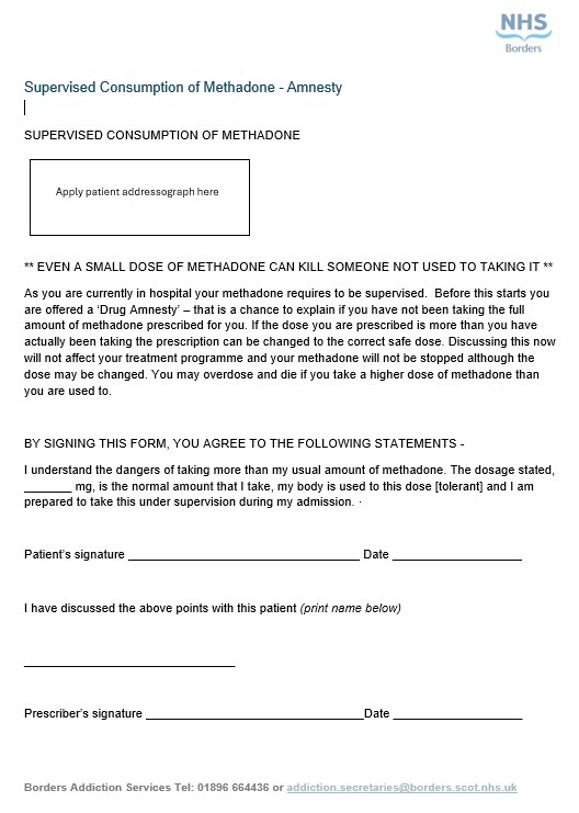
    • If confirmed to be receiving a substitute opioid prescription in the community (Methadone or Buprenorphine) that isn’t supervised, confirm with pharmacy when last dispensed. Ask the patient when they last took the prescribed opioids and confirm the dose. If they state they have taken their prescription within the last 72 hours, continue prescription. If they state they are taking a lower dose than prescribed, prescribe the lower dose.  A discussion about the risk of overdose if they have not been using their medication as prescribed should be had and this documented on an Amnesty form (Appendix A).  Monitor the patient for four hours following dose.

  • NEVER prescribe methadone or buprenorphine without confirmation of existing or current prescription (including dose and when last taken).

Patients not on maintenance opioid prescription (or unable to confirm)

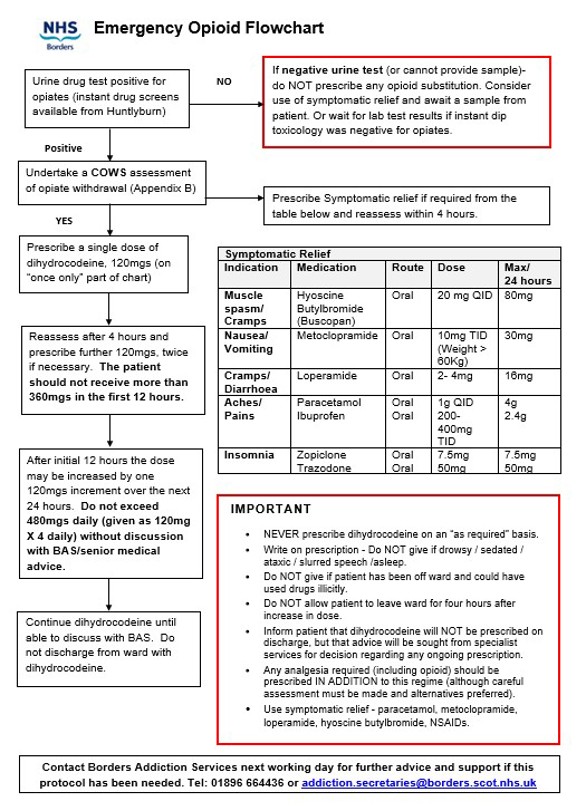
  • If the patient is not prescribed a maintenance opioid prescription or the prescriber is unable to obtain confirmation, then please use the flow chart to support decision making with regards to prescribing of symptomatic relief.

Emergency Opioid Flowchart below also available as link to PDF.

APPENDIX A - Supervised Consumption of Methadone - Amnesty

APPENDIX B - Clinical Opiate Withdrawal Scale (COWS)

Clinical Opiate Withdrawal Scale (COWS)

For each item, write in the number that best describes the patient’s signs or symptom. Rate on just the apparent relationship to opiate withdrawal. For example, if heart rate is increased because the patient was exerting self just prior to assessment, the increased pulse rate would not add to the score.

Resting Pulse Rate: (record beats per minute) Measured after patient is sitting or lying for one minute

0 pulse rate 80 or below

1 pulse rate 81-100

2 pulse rate 101-120

4 pulse rate greater than 120

GI Upset: over last ½ hour

0 no GI symptoms

1 stomach cramps

2 nausea or loose stool

3 vomiting or diarrhoea

5 Multiple episodes of diarrhoea or vomiting

Sweating: over past ½ hour not accounted for by room temperature or patient activity.

0 no report of chills or flushing

1 subjective report of chills or flushing

2 flushed or observable moistness on face

3 beads of sweat on brow or face

4 sweat streaming off face

Tremor observation of outstretched hands

0 No tremor

1 tremor can be felt, but not observed

2 slight tremor observable

4 gross tremor or muscle twitching

Restlessness Observation during assessment

0 able to sit still

1 reports difficulty sitting still, but is able to do so

3 frequent shifting or extraneous movements of legs/arms

5 Unable to sit still for more than a few seconds

Yawning Observation during assessment

0 no yawning

1 yawning once or twice during assessment

2 yawning three or more times during assessment

4 yawning several times/minute

Pupil size

0 pupils pinned or normal size for room light

1 pupil possibly larger than normal for room light

2 pupils moderately dilated

5 pupils so dilated that only the rim of the iris is visible

Anxiety or Irritability

0 none

1 patient reports increasing irritability or anxiousness

2 patient obviously irritable anxious

4 patient so irritable or anxious that participation in the assessment is difficult

Bone or Joint aches If patient was having pain previously, only the additional component attributed to opiates withdrawal is scored

0 not present

1 mild diffuse discomfort

2 patient reports severe diffuse aching of joints/ muscles

4 patient is rubbing joints or muscles and is unable to sit still because of discomfort

Gooseflesh skin

0 skin is smooth

3 piloerection of skin can be felt or hairs standing up on arms

5 prominent piloerection

Runny nose or tearing Not accounted for by cold symptoms or allergies

0 not present

1 nasal stuffiness or unusually moist eyes

2 nose running or tearing

4 nose constantly running or tears streaming down cheeks

Total =

5-12 = mild

13-24 = moderate

25-36 = moderately severe

more than 36 = severe withdrawal


Editorial Information

Last reviewed: 30/11/2025

Next review date: 30/11/2028

Author(s): Gordon, R, Mackenzie, A.

Version: 1.0

Co-Author(s): Campbell, N, Muthukrishnan, B, Hayward, I, Bennison J, Ker, L, Burdett, G.

Approved By: NHS Borders Area Drug & Therapeutics Committee

Reviewer name(s): Gordon, R.

References

Clinical Guidelines on Drug Misuse and Dependence Update 2017 Independent Expert Working Group (2017) Drug misuse and dependence: UK guidelines on clinical management. London: Department of Health. https://www.gov.uk/government/publications/drug-misuse-and-dependence-uk-guidelines-on-clinical-management

Joint Formulary Committee (2025) British National Formulary. Available at: https://bnf.nice.org.uk/  (Accessed: 11 March 2025).

https://www.medicines.org.uk/emc/browse-medicines

National Institute of Clinical Excellence. Drug Misuse in over 16s: opioid detoxification. London: NICE Clinical Guidance CG52. July 2007 (Updated 2025). Available at: https://www.nice.org.uk/guidance/cg52 (Accessed: 11 March 2025)

National Institute of Clinical Excellence. Opioid dependence. London: CKS Guidance. February 2025. Available at: https://cks.nice.org.uk/topics/opioid-dependence/ (Accessed: 11 March 2025)

NHS Lothian. (2023) Guidelines on the management of people who inject drugs in Lothian hospitals. https://www.rightdecisions.scot.nhs.uk/infectious-diseases/inclusion-health-and-pwid/guidelines-on-the-management-of-people-who-inject-drugs-in-lothian-hospitals-2023/