Warning

Objectives

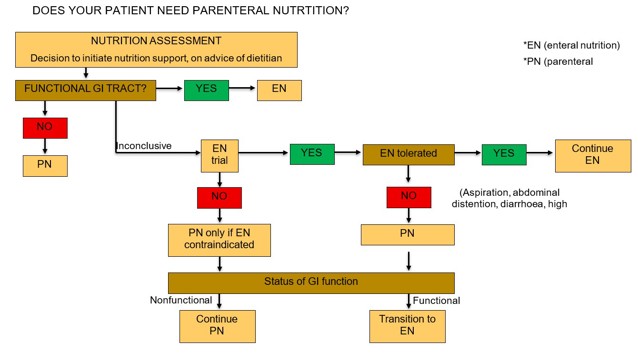
Parenteral nutrition (PN) is a sterile, nutritionally balanced, intravenous infusion of artificial nutrients.   It may be the sole provision of nutrition (total parenteral nutrition) or a form of supplementary nutrition to enteral feeding or oral diet.

The nutritional status of inpatients is the responsibility of all clinicians.  The preferred method of delivering nutrition is via the oral/enteral route and should always be used if the gastro-intestinal tract is functioning.  For some patients the enteral route is not possible, and the parenteral route should be considered. 

The aim of this guideline is to provide guidance on the safe and effective delivery of parenteral nutrition to appropriate patients. This guidance should help meet the nutritional and fluid requirements of adult patients to help prevent and treat disease-related malnutrition and complications related to poor nutritional status. This guidance is only for short term use of parenteral nutrition, less than 28 consecutive days8.

Patients who require parenteral nutrition longer than 28 consecutive days must have access to individually tailored bags where this is clinically necessary9. It is recommended these patients are referred to an Intestinal Failure Unit3. For NHS Borders, our nearest unit is the Western General Hospital Complex Nutrition Care Team.

Scope

PN is indicated for those who have been assessed as malnourished or are at risk of malnutrition.

Parenteral nutrition (PN) should be avoided if patient’s nutritional requirements can be met via the enteral/oral route.

PN should only be used if the intestine is unavailable or unable to absorb nutrients.  PN is not an emergency and should only be started with clear aims and should not be started before a patient has had a full clinical and dietetic assessment, plan for feed formulated and adequate venous access in place. In the intensive care setting, there is an agreed protocol to start PN outside of dietetic working hours.

The rationale for PN, the clinical purpose, and goals of treatment should be documented at assessment 1. These goals should be reviewed at each contact to facilitate effective monitoring and appropriate use of PN 5.

Indications and Contraindications

Indications:

PN is indicated for those who have been assessed as malnourished or are at risk of malnutrition, who have either:

  • An inadequate and/or unsafe enteral nutritional intake.

OR

  • A non-functioning, inaccessible or perforated gastrointestinal tract.

Consider signs/symptoms below that may indicate if enteral nutrition is not adequate:

  • Inability to tolerate adequate caloric intake
  • Persisting vomiting
  • Increased abdominal distension
  • Inability to gain or maintain weight
  • Clinical/biochemical evidence of malabsorption
  • High output fistula
  • Evidence of intestinal obstruction

Contra-indications include:

  1. Well-nourished patients whose GI tract is likely to be useable within 5-7 days (including post-op period).
  2. When dependence on PN is anticipated to be less than 5 days.
  3. Proven untreatable disease.

Responsibilities

Nursing Staff

  • Complete MUST screening tool weekly and refer to dietitian if MUST score 2 or more or there is a consideration that the patient may need TPN.
  • Nursing staff must contact the dietitian on ext. 26450 or bleep 6450.
  • Nursing staff are the responsible members who will be connecting the PN to the central line for delivery.
  • Skilled in aseptic non-touch techniques and trained in using central venous catheters and Hickman line if required.
  • Monitoring capillary blood glucose levels (every 4-6 hours until stable).
  • Weighing patients twice weekly while on PN.
  • Keeping accurate fluid balance charts daily.
  • NEWS monitoring 4 hourly.

Ward Medical Staff

  • It is the decision of the middle grade or consultant doctor to use the parenteral route and obtain consent from the patient or their representative.
  • The rational for PN and clear goals should be established and documented at the initial assessment.
  • Refer to anaesthetics for insertion of central line.
  • Refer to the dietitian (if not done by nursing staff).
  • Contact the ward pharmacist.
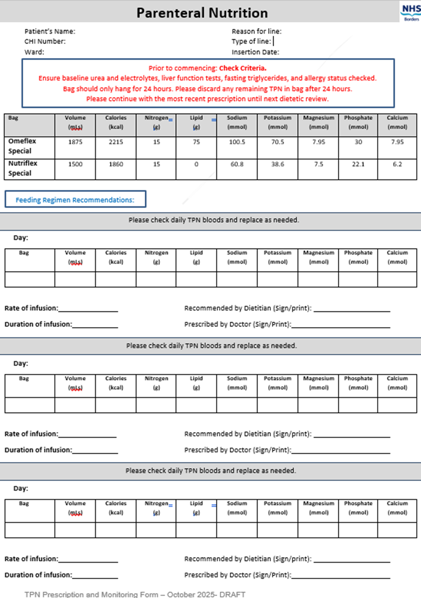
  • Prescribe the parenteral nutrition in consultation with the dietitian using Parenteral Nutrition Chart (see Appendix 3).
  • Order parenteral nutrition bloods using TPN order set and fasting triglycerides.
  • Prescribe additional IV fluids if required.
  • Request bloods via TrakCare for monitoring and correct as per NHS Borders Guidance for treatment of Electrolyte Deficiency here – via IV route. Trakcare has an order set for Daily, Weekly and Monthly TPN profile.

Dietitian

  • Ensure patients have adequate and appropriate nutritional support.
  • Assess the patient’s nutritional requirements (see appendix 2).
  • Assess the patient’s refeeding syndrome risk.
  • Provide a regimen to commence PN and review regularly.
  • Liaise with ward medical staff if additional IV fluids are required.
  • Liaise with medical staff regarding electrolyte monitoring.

Pharmacy

  • Ward Pharmacist
    • Responsible for checking the indication for PN is appropriate.
    • Checking the accuracy of the PN prescription.
    • Ensure the timely arrival of the PN on the ward.
    • Advise on administration of additional electrolytes if required (TPN cannot be made with additions at BGH Pharmacy).
  • Aseptic Services
    • Dispensing & preparation of PN.

Clinical Chemistry

  • Responsible for providing biochemical and haematological blood tests for the patient requiring PN.
  • Support to clinicians and other health professionals involved with the delivery of PN.

Infection Control Team

  • Responsible for investigating any line infections that may occur with the delivery of PN.
  • Advice on the prevention of the re-occurrence of line infections.

Route of Administration

  • CVC bundle: Protocol for the Care of Non-Tunnelled Central Venous Catheters (CVC)s (Excluding PICC & Hickman lines) | Right Decisions.
  • Dedicated single lumen catheter. If multiple lumen catheter in place one lumen should be dedicated solely to the parenteral nutrition (ideally the most distal)3.
  • When feeding through the central vein the catheter tip should be at the vena cava/right atrial junction3.
  • A Hickman line may be used if predicted longer term use of parenteral nutrition required.
  • Borders General Hospital do not use peripheral access for parenteral nutrition and do not use PICC lines (peripherally inserted central catheters).
  • Only staff trained in aseptic non-touch techniques should access a PN catheter2.

Planning and Implementing

Referral process

Once the decision for parenteral nutrition has been agreed by the consultant or middle grade doctor the following referrals must be made by the ward medical staff as soon as possible. Dietitian assessment must occur before commencing TPN (excluding intensive care).

  • Anaesthetic team:  for insertion of CVC
  • Dietitian: for nutritional assessment and regimen
  • Pharmacist:  delivery of PN to the ward

Dietetic Assessment

The ward dietitian will complete a nutritional assessment and provide a written regimen for the rate, volume, and type of parenteral nutrition bag. The ward dietitian will assess the allergy status of the patient before recommending PN. The Dietitians are available Monday to Friday and are contactable on bleeps (6447/6540).

Re-feeding Risk Assessment

Re-feeding Syndrome is a set of adverse effects occurring in malnourished patients if nutrition is given too quickly or in amounts exceeding their metabolic capacity.   This may lead to electrolyte shifts, metabolic dysfunction and severe fluid shifts.

Signs and Symptoms: Confusion, weakness, paralysis, tremor, seizures, impaired respiratory muscle function, arrhythmias, digoxin toxicity, tachycardia, insulin resistance, constipation, ileus and abdominal pain

Patients are at risk if one of the following:

  • BMI < 16kg/m².
  • Unintentional weight loss of  > 15 % within previous 3-6 months.
  • Minimal or no intake for > 10 days.
  • Low levels of Phosphate, Potassium or Magnesium.

Patients are at risk if two of the following:

  • BMI 16-18.5kg/m².
  • Unintentional weight loss 10-15% within previous 3-6 months.
  • Minimal or no intake for 5-10 days.
  • History of alcohol abuse, patients undergoing chemotherapy, on insulin or long-term prescribed antacids or diuretics.

If the patient is at risk of re-feeding syndrome – administer IV vitamin B&C, one pair daily for 10 days.


Prescription

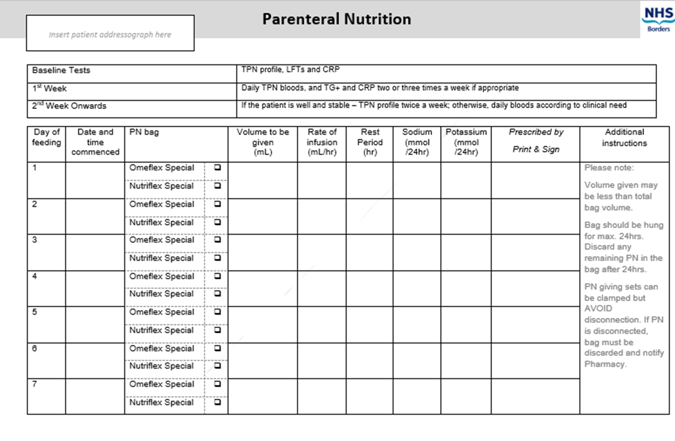
The prescription for TPN will be documented on the Parenteral Nutrition Prescription and Monitoring document. The request form should be completed by the ward doctor and provided to the ward pharmacist or sent to pharmacy prior to 2pm for dispensing, specifying duration (number of days supply).  

  • Omeflex Special 1875mls 8g/l Nitrogen (2215kcal & 15g Nitrogen; with electrolytes & supplements).
  • Nutriflex Special LIPID FREE 1500mls 10g/l Nitrogen (1860kcal & 15g Nitrogen; with electrolytes & supplements) can be sourced if required but are not stocked in Pharmacy. These may be ordered on a named patient basis, on the advice of dietitians. There is a 48 hour lead time for the supply of these bags.
  • The volume of PN to be infused (over 24 hours) must be clearly documented on the infusion chart as well as the infusion rate / duration.

Composition

In the Borders General we use all-in-one parenteral nutrition bags.  The standard bags contain a combination of an amino acid solution, fat emulsion, glucose solution, water and electrolytes.

  • Omeflex Special 1875mls 8g/l Nitrogen (2215kcal & 15g Nitrogen; with electrolytes & supplements)
Bag

Volume

(mLs)

Calories

(kcals)

Nitrogen

(g)

Fat

(g)

Sodium

(mmol)

Potassium

(mmol)

Magnesium

(mmol)

 Phosphate

(mmol)

 Calcium

(mmol)

Omeflex Special 1875 2215 15 75 100.5 70.5 7.95 30 7.95 

Fat free bags can be sourced on a named patient basis on the advice of dietitians; these are not stocked in Pharmacy. The bags contain a combination of amino acid solution and glucose solution.

  • Nutriflex Special Lipid Free 1500mls 10g/l Nitrogen (1860kcal & 15g Nitrogen; with electrolytes & supplements)
Bag

Volume

(mLs)

Calories

(kcals)

Nitrogen

(g)

Fat

(g)

Sodium

(mmol)

Potassium

(mmol)

Magnesium

(mmol)

 Phosphate

(mmol)

 Calcium

(mmol)

Omeflex Special 1500 1860 15 0 60.8 38.6 7.5 22.1 6.2

Storage

Once arrived on the ward the PN bag should be stored in the ward’s drug fridge.  The bag should be removed from the fridge 2 hours before use to bring to room temperature. 

Administration of Parenteral Nutrition

  • The PN bag should arrive on the ward by 5pm.
  • The PN should be administered at the rate recommended by the dietitian as per the PN regimen.
  • The PN should be given at room temperature and via a volumetric pump with occlusion and ‘air in line’ alarms.
  • PN should be administered via a dedicated lumen solely for use of PN.
  • Fat containing bags (Omeflex Special) should be administered through a 1.2micron filter.
  • Fat free bags (Nutriflex Special) should be administered through a 0.2micron filter.
  • Continuous feeding is the preferred route of infusion.
  • PN should be run for a maximum of 24 hours and bags should be changed every 24 hours. 
  • The IV catheter administration set and inline filter should be changed every 24 hours.
  • PN should be administered and disconnected using strict aseptic techniques.
  • Blood should not be sampled from the lumen providing PN.


  • In the out of hours period, three chamber bags are available from ITU. These bags must be mixed prior to administration. See bag for instructions.

The parenteral nutrition should never be disconnected and then reconnected unless for an emergency. If it is disconnected during the middle of an infusion, the current bag must be disposed and a new one commenced.

Monitoring

It is the responsibility of all members of the multidisciplinary team involved in the patient’s care to ensure correct monitoring is complete.

Biochemistry

Biochemistry monitoring is the responsibility of the ward medical team.

Parameter

Frequency of Monitoring

Sodium, Urea, Potassium & Creatinine

Baseline, reviewed daily until stable

Magnesium & phosphate

Baseline, reviewed daily until stable

LFTs including INR

Baseline, reviewed daily until stable

Calcium and albumin

Baseline, reviewed daily until stable

CRP

Baseline, then twice weekly

WCC

Baseline, reviewed daily until stable

Cholesterol and fasting triglycerides

Reviewed weekly initially, reducing to 3 monthly once stable.

Clinical Monitoring

Clinical monitoring is a joint responsibility of the clinical team involved in the patients care.

Parameter

Frequency

To assess

Temperature

Daily.

Signs of sepsis & review fluid requirements

Fluid balance

Daily, then at each planned review once stable.

Hydration and compare nutrition prescribed versus delivered.

Blood glucose

Baseline, 1-2 times/day until stable, then at each review. 1 hour after stopping cyclical TPN. If has diabetes, follow local protocol.

Glycaemic control. Signs of sepsis. Rebound hypoglycaemia if PN timings change or if PN stopped.

Access route

Daily.

Signs of line infection or access issues.

Clinical condition and medical plan

Daily initially, reducing to twice weekly once stable.

Whether goals of PN are being met. Nutritional requirements.  Appropriateness of PN and manage complications.

Medications

Baseline then at each review once stable.

Drug-nutrient interactions. Establish whether medications are affecting gastro-intestinal function/clinical condition.

GI function and enteral intake

Daily initially, reducing to twice weekly.

Ability to take enteral nutrition. Tolerance to enteral nutrition. Establish the amount of PN required to meet nutritional needs. 

Catheter related sepsis (CRS) in continuously fed patients is often a low grade persistent temperature.  It usually originates from the hub connection so surgical non-touch techniques are needed for all procedures that access the catheter 2.

Glucose Monitoring

Glucose monitoring is the responsibility of ward nursing and medical staff.

  • Recommend diabetes team review if 2 or more BMs above 10mmol/l.
  • Glucose intolerance and mild hyperglycaemia is common when high concentrations of glucose are being administered.
  • When administering Cyclical PN it may be necessary to reduce the rate of infusion over the last 1-2 hrs to reduce the risk of rebound hypoglycaemia.
  • Glucose monitoring to be conducted within 1 hour after stopping cyclical PN, then 1-2 times daily until stable.

Nutritional Monitoring

Nutritional monitoring is the responsibility of the dietitian.

Parameter

Frequency

To assess

Weight

Daily if fluid balance concerns. Otherwise weekly.

Fluid balance and nutritional status

Height

Baseline. Review with growth/degeneration.

Body mass index

BMI

Baseline then repeated if dry weight or height changes.

Nutritional Status

Mid-arm circumference

Baseline, then monthly.

Estimate body composition and function

Tricep skin fold

Baseline.

Estimate body composition and function

Grip Strength

Baseline, then weekly.

Estimate body composition and function


Discontinuation of Parenteral Nutrition

  • Parenteral nutrition can be discontinued once adequate oral or enteral nutrition is tolerated and nutritional status is stable6.
  • Withdrawal should be stepwise with a daily review of the patient’s progress.
  • There is a risk of hypoglycaemia with sudden stopping of PN due to high serum insulin levels. This risk can be reduced by gradually reducing rate of PN over the last hour2. If patients are tolerating diet/taking oral nutritional supplements this will also reduce the risk and therefore reduce the need for gradually reducing the rate of PN.

Complications of Parenteral Nutrition

Complications related to Intravenous access

  • Catheter related blood stream infection (CRBSI) is a bacteraemia in a patient with an intravenously placed catheter and one or more positive blood cultures from a peripheral vein, clinical signs of infection and no apparent source of infection other than a catheter. Main causes:
    • Insertion without full aseptic measures
    • Subsequent suboptimal line care
  • Indications for line removal on suspicion of CRBSI
    • Tunnel or port abscess
    • Septic shock
    • Paired blood cultures positive for fungi or highly virulent bacteria
    • Complicated infections e.g. endocarditis, metastatic infection or septic thrombosis2.

Metabolic complications

  • Electrolyte Abnormalities
    • Low levels should be corrected as per NHS Borders Guidance for treatment of Electrolyte Deficiency here.
      • The patient’s fluid balance and electrolyte content of PN prescribed must be considered.
      • Replace via IV route.
      • Contact Pharmacy on bleep 6613 for advice if necessary.
    • Refeeding Syndrome Risk should be assessed by the dietitian.
      • Dietitian will consider if patient is at risk of refeeding on assessment/ review and will recommend IV vitamin B&C / supplementation of electrolytes, as necessary.
      • Rate of PN should be gradually increased depending on refeeding risk.  This will be assessed by the dietitian.
    • Continue monitoring and correcting low electrolyte levels.
  • Hyperglycaemia causes (list not exhaustive):
    • Sepsis – exclude underlying infection as possible cause.
    • Medications (e.g. steroids) - review medications.
    • Underlying Diabetes – monitor BMs, may require insulin.
    • Excessive Carbohydrate in PN solution – measure glucose oxidation rate to ensure not exceeding this. Usually not a concern with 3 chamber bags.
  • Abnormal Liver Function tests
    • Often arises due to reflection of underlying illness, sepsis, antibiotic treatment or other medication rather than solely as complication of PN.  Potential causes should be investigated from outset.  Abnormalities may manifest as mild cholestasis or transient rise in transaminases or alkaline phosphatase.
      • Reduce amount of lipid in feed (this requires specialised PN to be ordered promptly).
      • Increase the proportion of medium chain triglycerides: long chain triglycerides in the feed.
      • Cyclical feeding.
      • Introducing small amounts of enteral feed to reduce biliary stasis2.
  • Hepatobiliary complications:
    • The incidence of abnormal liver enzymes in patients receiving PN is common, but it is often related to underlying disease rather than PN formulation.


Practical feeding considerations

Comments

Provide a balance of nutrients

Balance of nitrogen, lipid, and glucose

Avoid overfeeding

Not exceeding glucose oxidation rate (4-7mg/kg/min/day).
Reduce lipid content to <1.0g/kg/day.

In long term patients consider use of lipid free days.

Avoid increasing glucose to meet full energy requirements.

Review lipid profile – ensure mixed lipid substrate (Omeflex Special – soya bean, coconut and omega 3 fish oil).

Consider nutrient deficiencies

To prevent fatty acid deficiency, give a minimum of 1g lipid/kg/week.

Introduce oral/enteral nutrition

Unless contraindications, start oral/enteral nutrition and increase the amount as tolerated.

Infusion period

Consider providing cyclical infusion over 12-16 hours/day

Fluid related Complications

  • Fluid management
    • Dietitian and medical staff to determine IV fluid requirements and if supplementary IV fluids required.
    • Ongoing clinical and biochemical monitoring of fluid status.
      • Fluid status should be monitored daily.

Mechanical Complication

  • Damage to adjacent organs during line placement, haemorrhage, line displacement or line blockage
    • Ensure careful line placement by trained operators
    • Be aware of early signs of blood clot


APPENDIX 1: TPN SCREENING CHECKLIST

APPENDIX 2: CALCULATION OF NUTRITIONAL REQUIREMENTS

Calculations for daily nutritional requirements in adults


BMI <30kg/m 2

BMI>30kg/m 2 

ITU Patients

Critically stable/unwell:

20-25kcals/kg

Mifflin St Joer:

Men: 10 X weight (kg) + 6.25 X height (cm) - 5 X (age) + 5

Women: 10 X weight (kg) + 6.25 X height (cm) - 5 X (age) - 161

Longer term ITU/Stable:

25-30kcals/kg

HDU/Ward Patients

BMI <18.5kg/m2:

25-30kcals/kg/day X PAL

Mifflin St Joer:

Men: (10 X weight (kg) + 6.25 X height (cm) - 5 X (age) + 5) X PAL

Women: (10 X weight (kg) + 6.25 X height (cm) - 5 X (age) - 161) X PAL

BMI 18.5-20kg/m2:

20-25kcals/kg/day X PAL

(PENG Requirements Guideline Group Consensus Opinion, 2018

On assessment of patient, dietitians may use additional calculations specific to individual patient requirements.


APPENDIX 3: PARENTERAL NUTRITION FORM - EXAMPLE

Parenteral Nutrition Form - Example

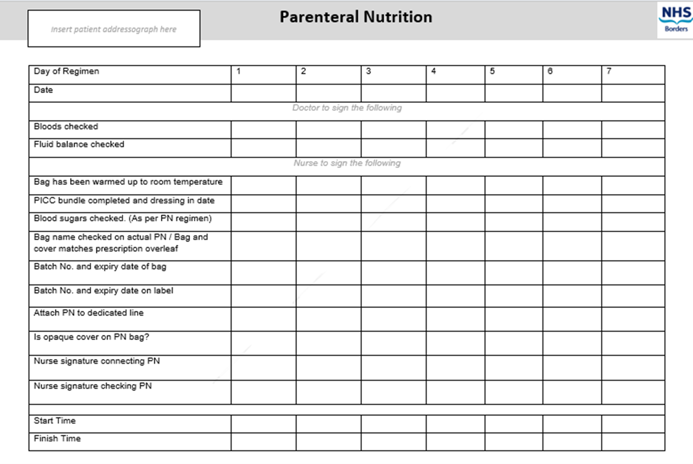
APPENDIX 4: TPN MONITORING FORM - EXAMPLE


APPENDIX 5: NUTRITIONAL CONTENT (10,11)

  1. Omeflex Special emulsion for infusion 1875mls 8g/l Nitrogen with electrolytes, emulsion for infusion

Qualitative and quantitative composition

The ready-for-use emulsion for intravenous infusion contains after mixing the chamber contents:

from the top chamber (glucose solution)

in 1875 ml

Glucose monohydrate

297.0 g

equivalent to glucose

270.0 g

Sodium dihydrogen phosphate dihydrate

4.680 g

Zinc acetate dihydrate

13.17 mg

from the middle chamber (fat emulsion)

in 1875 ml

Medium-chain triglycerides

37.50 g

Soya-bean oil, refined

30.00 g

Omega-3-acid triglycerides

7.500 g


from the bottom chamber (amino acid solution)

in 1875 ml

Isoleucine

6.158 g

Leucine

8.220 g

Lysine hydrochloride

7.463 g

equivalent to lysine

5.973 g

Methionine

5.130 g

Phenylalanine

9.218 g

Threonine

4.763 g

Tryptophan

1.500 g

Valine

6.758 g

Arginine

7.088 g

Histidine hydrochloride monohydrate

4.440 g

equivalent to histidine

3.286 g

Alanine

12.73 g

Aspartic acid

3.938 g

Glutamic acid

9.203 g

Glycine

4.335 g

Proline

8.925 g

Serine

7.875 g

Sodium hydroxide

2.196 g

Sodium chloride

0.710 g

Sodium acetate trihydrate

0.470 g

Potassium acetate

6.917 g

Magnesium acetate tetrahydrate

1.706 g

Calcium chloride dihydrate

1.169 g


in 1875 ml

Amino acid content [g]

105.1

Nitrogen content [g]

15

Carbohydrate content [g]

270

Lipid content [g]

75


Electrolytes [mmol]

in 1875 ml

Sodium

100.5

Potassium

70.5

Magnesium

7.95

Calcium

7.95

Zinc

0.06

Chloride

90

Acetate

90

Phosphate

30

Excipient(s) with known effect:

The total amount of sodium per 1000 ml in the ready to use emulsion is 54.1 mmol (1244 mg).


Emulsion for infusion

Amino acids and glucose solutions: clear, colourless up to straw-coloured solutions

Fat emulsion: oil-in-water emulsion, milky white


in 1875 ml

Energy in the form of lipids

[kJ (kcal)]

2985

(715)

Energy in the form of carbohydrates

[kJ (kcal)]

4520

(1080)

Energy in the form of amino acids

[kJ (kcal)]

1755

(420)

Non-protein energy

[kJ (kcal)]

7510

(1795)

Total energy

[kJ (kcal)]

9260

(2215)

Osmolality [mOsm/kg]

2115

Theoretical osmolarity [mOsm/l]

1545

pH

5.0 - 6.0


  1. Nutriflex Special Solution for Infusion

Qualitative and quantitative composition

Amounts of active substances 1500 ml size of the product are given below.

Composition

in 1500 ml

from the upper chamber (750 ml)

Isoleucine

6.17 g

Leucine

8.22 g

Lysine hydrochloride

(equivalent to lysine:)

7.46 g

(5.97 g)

Methionine

5.13 g

Phenylalanine

9.23 g

Threonine

4.77 g

Tryptophan

1.50 g

Valine

6.81 g

Arginine monoglutamate

(equivalent to arginine:)

(equivalent to glutamic acid:)

13.08 g

(7.10 g)

(5.99 g)

Histidine hydrochloride monohydrate

(equivalent to histidine:)

4.44 g

(3.29 g)

Alanine

12.74 g

Aspartic acid

3.95 g

Glutamic acid

3.23 g

Glycine

4.34 g

Proline

8.93 g

Serine

7.88 g

Magnesium acetate tetrahydrate

1.62 g

Sodium acetate trihydrate

2.45 g

Potassium dihydrogen phosphate

3.00 g

Potassium hydroxide

0.93 g

Sodium hydroxide

1.71 g


from the lower chamber (750 ml)

Glucose monohydrate

(equivalent to glucose:)

396.0 g

(360.0 g)

Calcium chloride dihydrate

0.90 g

Electrolytes:

in 1500 ml

Sodium

60.8 mmol

Potassium

38.6 mmol

Magnesium

7.5 mmol

Phosphate

22.1 mmol

Acetate

33.0 mmol

Chloride

74.3 mmol

Calcium

6.2 mmol


in 1500 ml

Amino acid content

105 g

Nitrogen content

15 g

Carbohydrate content

360 g

Infusion bag with two compartments

Amino acids and glucose solutions: clear, colourless or slightly yellowish aqueous solution


in 1500 ml

Energy in the form of amino acids [kJ (kcal)]

1758 (420)

Energy in the form of carbohydrates [kJ (kcal)]

6028 (1440)

Total energy [kJ (kcal)]

7786 (1860)

Theoretical osmolarity [mOsm/l]

2100

pH

4.8 – 6.0


Editorial Information

Last reviewed: 26/11/2025

Next review date: 30/11/2028

Author(s): Gale, A, Mundell, A.

Version: 1.0

Approved By: NHS Borders Area Drug & Therapeutic Committee

Reviewer name(s): Gale, A.

References
  1. NCEPOD (2010) PN: A mixed bag report. National confidential enquiry into patient outcomes and death.
  2. Inayet N, Neild P (2015). Parenteral Nutrition. Journal Royal College of Physicians Edinburgh: 45: 45-8.
  3. Dr Jeremy Nightengale on behalf of the RCP Nutrition Committee. RCP Ten Top Tips for Parenteral Nutrition
  4. Pittiruti et al (2009). ESPEN Guidelines on Parenteral Nutrition: Central Venous Catheters (access, care, diagnosis and therapy of complications). Clinical Nutrition 28 (2009), p365-377.
  5. BAPEN 2016. Parenteral Nutrition Monitoring. bapen.org.uk/nutrition-support/parenteral-nutrition/monitoring.
  6. National Institute of Health and Clinical Excellence (NICE) February 2006. Nutrition Support in Adults: oral nutrition support, enteral tube feeding and parenteral nutrition. Clinical Guideline 32.
  7. Guidelines for the Prevention of Intravascular Related Infections 2011. O’Grady et al.
  8. M Baker and L Harbottle (2014). Manual of Dietetic Practice, fifth edition. Edited by Joan Gandy, The British Dietetic Association. Published by John Wiley and Sons Ltd.
  9. Health Improvement Scotland, Complex Nutritional Care Standards – December 2015. Standard 4: Parenteral Nutrition.
  10. Summary of Product Characteristics - Omeflex special 1875mls 8g/l nitrogen, 1181 kcals/l with electrolytes, emulsion for infusion.Braun Medical. Accessed via: https://www.medicines.org.uk/emc/product/15234/smpc/print [date of revision of the text: 25-Jun-2024 

Summary of Product Characteristics- Nutriflex special 1500mls 10g/l nitrogen, 1240kcals/l with electrolytes,Solution for Infusion. B.Braun Medical Accessed via: https://www.medicines.org.uk/emc/product/15210/smpc/print: [date of revision of text: 9th September 2024