Prescribing Medicines in NHS Borders not on the East Region Formulary

Warning

Scope

When clinically appropriate, prescribers may wish to prescribe a medicine that is not on the East Region Formulary (ERF). The East Region Formulary is a formulary of medicines approved for use in NHS Borders, NHS Fife and NHS Lothian. The ERF committee assess applications for drugs to be added to the formulary once the Scottish Medicines Consortium has deemed them “recommended for use in Scotland”. The ERF contains medicines and treatment pathways with medicines approved for use. If a medicine is not approved for use or if it has not been assessed by the ERF committee, a non-formulary application is required. The guidance in this document describes NHS Border’s policy for the prescribing of medicines in such circumstances, specifically:

• Unlicensed medicines
• Off-label medicines
• Medicines which are awaiting consideration by the Scottish Medicines Consortium (SMC)
• Medicines which have not been approved by SMC for use in Scotland.

Introduction

Medicines are assessed for clinical and cost effectiveness by the East Region Formulary. If a medicine is approved for use it is placed on the formulary (in the appropriate treatment pathway) and may be prescribed in NHS Borders without further restriction.

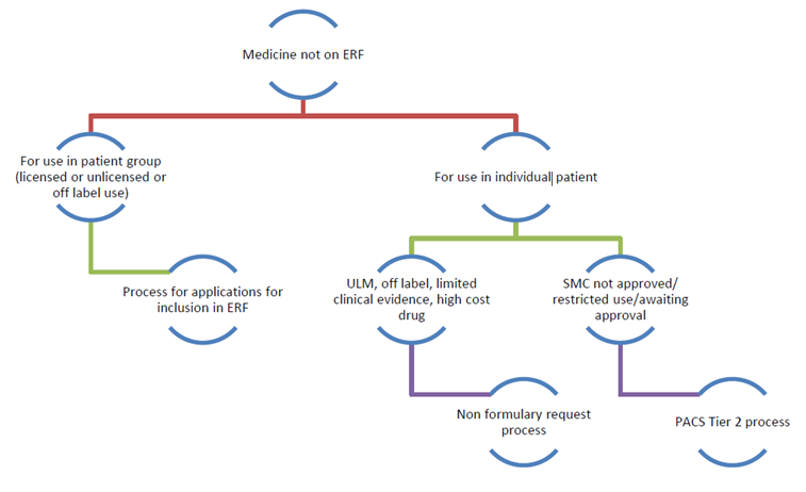
If a medicine is not on the ERF or has not been assessed for inclusion in the ERF there are several pathways to consider whether the medicine should be prescribed within NHS Borders. These include applications for ERF inclusion, the non-formulary request process and the peer assessed clinical system (PACS) tier 2 process. Each of these processes are detailed below.

Definitions

Area Drugs and Therapeutics Committee (ADTC): The committee in NHS Borders which provides overarching governance on medicines, clinical guidelines, prescribing decisions, and non-formulary request forms for approval for use in NHS Borders.

East Region Formulary (ERF): NHS Borders, NHS Lothian and NHS Fife all approve drugs together and place drugs on the East Region Formulary . Drugs on the ERF may be prescribed in NHS Borders without further approval or paperwork. The ERF implements advice from the Scottish Medicines Consortium. Formulary status options are approved for use, specialist initiation only, specialist use only, not approved for use, formulary application in process.

Marketing Authorisation (MA): A marketing authorisation defines the clinical indications for which a licensed medicinal product can be marketed and defines the form, dose, route of administration and the patient age group which the medicine can be used in and the container in which the product is supplied.

Medicine and Healthcare Regulatory Agency (MHRA): The regulatory body in the UK (on behalf of the UK Government) which assesses medication for safety and efficacy and provides medicines with a marketing authorisation in the UK. If a medicine has a marketing authorisation in the UK, it is considered a “licensed” medicine. The MHRA undertakes regulation of medicines in the UK market in accordance with the Human Medicines Regulations 2012.

Medicines Resource Group (MRG): The committee in NHS Borders which is accountable for the management of the medicines budget and provides advice on the financial aspects of managing new medicines and prescribing decisions. New medicines approvals from the ERF, non-formulary requests and PACs Tier 2 applications are reported to MRG along with an estimate of patient numbers and likely spend.

Off label medicine: The MHRA accepts that when a licenced medicine is prescribed and/or used by a healthcare professional out with its licensed use, this does not create an unlicensed medicine and falls under the scope of off-label use.

Peer assessed clinical system (PACS) tier 2: A process in which clinicians may request to use a medicine for a named patient that is not recommended for use in NHS Scotland by the SMC or is approved for restricted use and the planned use is out with the SMC criteria. This process can also be used if the medicine is undergoing SMC evaluation.

Scottish Medicines Consortium (SMC): In NHS Scotland, the Scottish Medicines Consortium considers and issues advice on the clinical and cost effectiveness of newly licensed medicines at, or close to, the point of licensing. The medicines advice will be “recommended”, “recommended for restricted use” or “not recommended” for use in NHS Scotland. SMC decisions are available on Medicines advice.

Unlicensed medicine (ULM): Unlicensed medicines are medicines without a UK marketing authorisation and may include medicines undergoing clinical trial, medicines awaiting UK marketing authorisation, medicines withdrawn from the UK market, specials or imported medicines; can be prescribed by doctors, dentists and nurse and independent pharmacist prescribers.
Process for applications for inclusion in ERF

  • Applications for addition of new medicines to the ERF for a cohort of patients are made to the East Region Working Group (ERWG) and East region Formulary Committee (ERFC). This includes SMC approved medicines, medicines which pre-date SMC and unlicensed/off label medicines.

  • Full guidance on the application process to the ERF is available HERE

  • Contact the clinical pharmacist associated with your area of practice and/or this email bor.prescribing@borders.scot.nhs.uk for support in applying for amendment to or application for a new medicine to the ERF.

Process for non-formulary request form

  • For approval to prescribe a medicine that is not on the ERF for named patient which is
    either:
    • Medicines recommended by SMC but an application has not yet been made to the East Region
      Formulary
    • Medicines recommended by SMC but following consideration by the East Region Formulary are ‘not
      routinely available’
    • Unlicensed medicines prescribed for individual named patients.
  • Contact the appropriate clinical pharmacist and/or bor.prescribing@borders.scot.nhs.uk for
    support in the application process.
  • Fill out the following two forms for submission to the non-formulary subgroup of ADTC, both found on the Medicines intranet page/forms:
    • Non formulary medicine/wound product request form
    • Request form to use an unlicensed medicine if required (ULM only)
  • Submit relevant forms for review to bor.prescribing@borders.scot.nhs.uk with supporting evidence
    and relevant signatures of approval. The non formulary subgroup meets every month. If the request
    is urgent state clearly in the email when a decision is required so that a timely electronic review
    of the request is completed by the panel.
  • The process for requesting an urgent review of a non-formulary medicine is:
    • Admin lead for ADTC acknowledges request by responding to email sent to
      bor.prescribing@borders.scot.nhs.uk
    • Admin lead for ADTC circulates the relevant paperwork to the non-formulary subgroup requesting a response within 3 working days/within timeframe of request.
    • A minimum of 5 members of the subgroup are required to make a decision on the request. These members email bor.prescribing@borders.scot.nhs.uk with their comments and decision. These are collated by the NFR chair.
    • The NFR chair (or lead pharmacists in case of absence) will respond using the bor.prescribing@borders.scot.nhs.uk to the clinician requesting the drug and the appropriate clinical pharmacist.
    • The decision will be ratified at the next ADTC meeting
  • Non-formulary request panel is a subgroup of ADTC, comprised of primary and secondary care pharmacists and clinicians.

Process for application to PACS tier 2

  • The clinician should contact the appropriate clinical pharmacist and/or bor.prescribing@borders.scot.nhs.uk for support in the PACS tier 2 paperwork.

  • The requesting clinician is required to demonstrate the clinical case for the patient to be prescribed the medicine within its licensed indication(s) where the following criteria apply:
    • The clinician can demonstrate that a reasonable attempt, or appropriate consideration, has been made to treat the patient in the first instance with medicines currently accepted by the SMC for routine use in NHS Scotland for this condition and for the patient in question that these medicines are deemed unsuitable or have been found to be ineffective.
      AND
    • The clinician can present an evidence-based case to demonstrate the potential that the patient will achieve a measurable clinical benefit at least comparable to if not better than that experienced by the population considered by SMC.
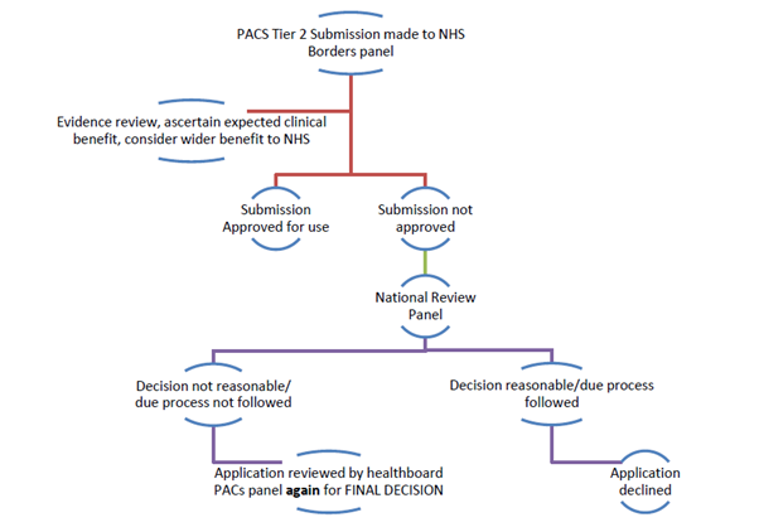
  • Fill out the PACS tier 2 paperwork (found on the Medicines intranet page) and submit to bor.prescribing@borders.scot.nhs.uk stating the urgency or any time sensitive factors of the request.

  • A member of the NFR panel will undertake an initial assessment of the evidence provided, identifying any deficiencies and will advise the requesting prescriber accordingly.

  • A PACS tier 2 panel in NHS Borders will be called to review the submission. The panel makes a clinical decision, not taking account of funding/cost effectiveness.

  • If the NHS Borders PACs tier 2 panel declines the submission, the clinician can request an appeal at the National Review Panel using the original form above. The appeal will only review whether:
    • That a decision, with reference to the information and/or evidence on which the health board decision is based is or is not reasonable, or
    • Whether or not due process has or has not been followed

  • All decisions made by either the health board PACS tier 2 panel or the national review panel should be discussed with the patient by the responsible clinician.

Considerations when prescribing off label and unlicensed medicines

  • If an adverse event occurs with a licensed medicine that is the result of a product defect, or a problem with its use in an approved clinical situation (as defined in the marketing authorisation) any liability arising may in part or whole be transferred to the manufacturer.

  • If a patient suffers harm as a result of the effects of an unlicensed / off-label medicine, then the manufacturer is not liable (unless the medicine was shown to be defective) and a claim against either the prescriber or the pharmacist is less easy to defend.

  • NHS Borders carries liability for the actions of its employees and may accept liability for the prescription of unlicensed medicines where such use has been authorised and agreed by ERFC/ADTC/Non-formulary request panel, provided local policies and procedures are adhered to.

  • Medicinal products, whether licensed or unlicensed, must be produced in accordance with Good Manufacturing Practice (GMP).

  • When prescribing ULMs or off label medicines, the prescriber must:
    • Be aware of the status of the medicine and the inherent risks these pose to both patients and NHS Borders
    • Only prescribe these medicines if no alternative is suitable.
    • Discuss the status of the medicine with the patient and document patient consent.
    • Supply the patient with appropriate patient information.
    • Provide the GP with sufficient information about the product and it’s availability in primary care.

  • When supplying a ULM or an off-label medicine, the pharmacy team must:
    • Alert the prescriber to the status of the medicine where reasonably possible.
    • Inform the prescriber of any additional risks or problems (e.g. imported from EU may have delays, made in specials manufacturer in China may have safety concerns).
    • Give sufficient information to use the product safely and correctly.
    • Follow the pharmacy standard operating procedure for processing ULMs including batch tracking and risk assessment.

Roles and Responsibilities


Role Responsibilities
Clinician Make prescribing decision, complete paperwork, discuss with patient, document rational for treatment in notes
Clinical Pharmacist  Support prescriber in application processes and review of evidence
Formulary Pharmacist  
NHS Borders Area Drug & Therapeutic Committee Non-Formulary Request Panel – subgroup of ADTC

Development & Review Groups

Development Group
Kyna Harvey Lead Pharmacist Specialist Services, Innovation and Technology
Liz Leitch, Formulary Pharmacist
Review Group
Area Drugs and Therapeutics Committee