Warning

Objectives

Through the implementation this policy, NHS Borders aims to promote a balanced partnership
between patients and healthcare staff delivering care and treatment and promote supported
decision making. The policy acknowledges the rights of the person under Common Law and in
keeping with the Equality Act 2010 that to give or withhold consent prior to the provision of
clinical treatment is a basic principle of health care.

Introduction

This document offers guidance to NHS Borders’ employees who are involved in seeking consent from a person  or from a person’s proxy/welfare attorney/welfare guardian where legal posers to provide consent on the patient’s behalf in respect of assessment and treatment have been granted.

People have a legal, fundamental, ethical and moral right to decide what happens to their bodies. Healthcare  staff have a responsibility to ensure they obtain valid consent from a patient before undertaking any type of care or treatment intervention, failure to do so may leave healthcare staff open to criminal charges, civil action and allegations of misconduct.

Healthcare professionals must work in partnership with their patients, respecting their right to make decisions about their care. The partnership must be based on openness, trust and good communication. Key to  establishing this is respect for patient autonomy and the patient’s right to make a decision whether or not to accept any medical or clinical intervention even if refusal of such may be to their detriment. The responsibility is on the healthcare professional for ensuring that their patient is fully involved, has all the information they wish and need, understands the details and implications of the intervention including any risks that may be pertinent to them and is informed of alternative treatment options. Alternative options include the option of having no treatment. The concept of material risk introduced. Only then can the patient, and not the healthcare professional, make a decision about what they believe to be in their best interest.

There is no definitive definition of ‘supported decision making’. The Mental Welfare Commission refers to it as ‘any process in which the individual is provided with as much support and information as they need in order for them to be able to’:

  1. make a decision for themselves; and/or
  2. express their will and preferences within the context of substitute decision-making.

Any discussion about a person’s condition or treatment options should be carried out with them in a way the person can understand and, whenever possible in a place and at a time when the person is best able to understand and retain what is discussed. The discussion may be supported by the use of accurate and up to date written material, including visual or other aids.

Consent:

  • may be implied or explicit and may be obtained verbally or in writing
  • is only valid if it is voluntary and informed and if the person consenting is deemed to have the capacity to make the decision
  • is not usually a single event but is part of an ongoing process
  • requires a number of steps in the process including ensuring the patient is fully informed of the risks and benefits of any proposed treatment and alternative options and the risks and benefits of no intervention
  • may be withheld or withdrawn in respect of all or any aspect of the care or treatment being provided at any point during an episode of care or treatment even if given initially

    NHS Borders Completion of Health Records Policy states:
It is the responsibility of all NHS Borders staff providing direct care, whether a
registered practitioner or someone in a support role, to make a note of all
encounters and interventions relating to the patient in the appropriate section of
the patient’s health record.

This includes the recording of having obtained the person’s consent, whether verbal or written, prior to a procedure or treatment being carried out and in particular where the intended procedure or treatment is of an intimate nature.

This policy relates to all patients receiving care provided by NHS Borders. The policy is applicable to all staff working in clinical environments within NHS Borders premises where care and treatment is provided to individuals. It is applicable to all NHS Borders staff who delivers care and treatment in an individual’s home and/or other community setting. Healthcare professionals must also be aware of any standards, guidance or policies pertaining to consent that have been issued by their respective professional and/or regulatory bodies.
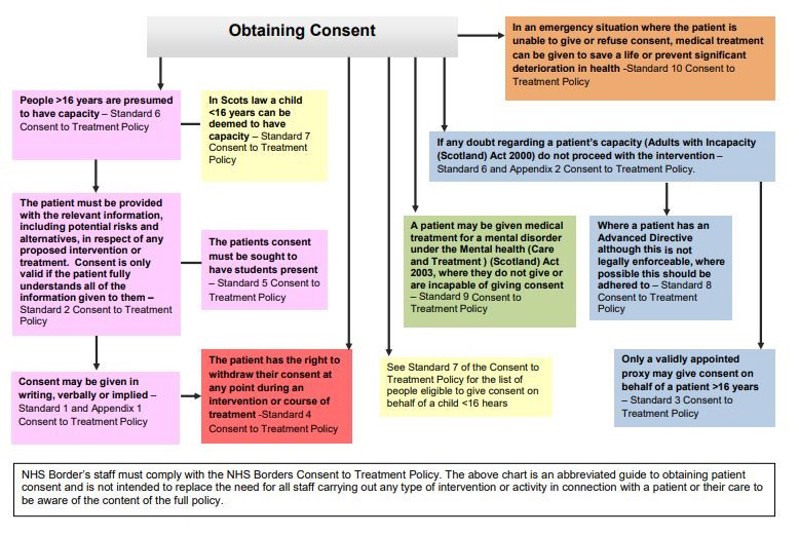
Standard 1 Obtaining Consent

The prime responsibility for obtaining consent for any clinical intervention lies with the healthcare professional undertaking the intervention. See Appendix 1

If it is not possible for the healthcare professional undertaking the intervention to seek consent this duty can be delegated to someone else, provided that the person it is delegated to:

  • is suitably trained and qualified.
  • has suitable knowledge of the proposed intervention and understands the risks involved
  • understands and agrees to act in accordance with this policy

The healthcare professional who delegates the consent process remains responsible for ensuring that the patient has been given sufficient time, information and support to make an informed decision, and has given their consent before the intervention is started.

Where there is any doubt about consent having been given the intervention should not proceed, and the person who is undertaking the intervention or the person in charge of the case should be informed. In the course of obtaining a person’s consent, healthcare professionals must not exert pressure or undue influence, nor employ deceit.

Health care professionals must ensure that where a person has communication difficulties every method, including human and mechanical, is employed in the attempt to support the person’s decision making regarding consent. Consent does not always have to be given in writing.  It can be given verbally or implied by a person’s actions.

When consent is not given in writing a summary of salient points in relation to verbal and/or written information provided to the person or their proxy/ welfare attorney /welfare guardian, and the outcome of any discussion, must be documented in the patient’s health record.

Senior healthcare staff should ensure that monitoring arrangements are in place to ensure consent is obtained appropriately.

Standard 2 Provision of Information

Information must be provided to the person in respect of the proposed examination, procedure, treatment or anaesthesia prior to consent being sought. Information should be specific to the circumstances of the person to whom it is being given. The healthcare professional has a duty to take reasonable care to ensure that the patient is aware of any material risks involved in any recommended treatment, and of any reasonable alternative treatments including the option of no treatment. A material risk is one which a reasonable person in the patient’s position would be likely to attach significance to.

Alternatively it is one which the healthcare professional should be reasonably aware that their patient would attach significance to. This is a major change from previous legislation about consent which described and quantified risk in terms of what a reasonable body of medical opinion would consider significant. The significance of the risk is now likely to reflect a variety of factors besides its magnitude:

  • the nature of the risk, the effect which its occurrence would have on the life of the patient
  • the importance to the patient of the benefits sought to be achieved by the treatment
  • the alternatives available and the risks involved in those alternatives

The assessment of risk is therefore fact-sensitive and also sensitive to the characteristics of the patient. In circumstances when the healthcare professional believes that disclosure of certain information would cause severe harm to the person, withholding information would not be unlawful.  However healthcare professionals should recognize that such circumstances when this “therapeutic exception” applies are expected to be rare. Information given should be supplied in a manner and format that can be understood by the person receiving it, e.g. in easy read material, in a language they understand (using an interpreter if required), using diagrams, pictures, or symbols, etc.

Information regarding accessing Interpretation and Translation Services can be found on NHS Borders intranet – Equality and Diversity site http://intranet/microsites/index.asp?siteid=92&uid=1

When an interpreter is used they must be independent and impartial. The Learning Disability Liaison Nurse can provide support and advice and obtain information in easy read format for patients with a Learning Disability. Technical information and language should, as far as possible, be used to explain any proposed treatment. When giving information healthcare staff should be aware that the person may require extra support, e.g. a relative, carer or advocacy support, to enable him/her to make an informed decision.

With the agreement of the person and where circumstances allow, a relative, carer, friend or patient advocate, may be present during any discussion where consent is being sought. Where there is a relative, carer, or other present, the healthcare professional must be alert to the potential for the person to be pressured into a particular decision. Enough time requires to be given to allow the person to consider the information provided and permit him/her to discuss it with his/her family and friends if desired. All questions must be answered honestly Should the person not wish to know all the facts this should be respected but in case he/she has a change of mind, further opportunities to receive information should be offered before commencement and during the course of the treatment The person’s wishes should be documented accordingly.

Standard 3 Written Consent

A ‘Consent for treatment form’ where required, must be completed prior to an examination or treatment being commenced. 

  • Staff responsible for the care of the person will check that the form is completed
  • written consent will be obtained in relation to all routine blood tests carried out in connection with screening in pregnancy
  • it is considered good practice to seek written consent where:
    • a treatment or procedure is complex or involves significant risk
    • the procedure involves general anaesthesia or sedation
    • provision of clinical care is not the primary purpose of the procedure
    • there may be significant consequences for the person’s employment, social or personal life
  • where the ‘consent for treatment’ form has been signed prior to the day of the intervention staff must confirm on the day of the procedure that the person still wishes the intervention to go ahead. This should be documented in the person’s health records
  • a signature on a form can be taken as evidence that the person has given consent. However if a person does not understand the proposed procedure, if English is not their first language or they are a British Sign Language user, the consent, even when a signature is obtained, may not be valid
  • only the recipient of the proposed procedure can sign the ‘consent for treatment’ form. The exception to this is where the person has been deemed to be incapable of giving consent. In such circumstances the welfare guardian with stated medical views can sign on behalf of the person – please refer to Adults with Incapacity (Scotland) Act 2000). In the case of children see standard 7 of this policy
  • completed ‘Consent for treatment’ forms should be secured and retained within patients’ healthcare records

Standard 4 Withdrawal of Consent

A person has the right to withdraw his/her consent at any time.

  •  a person has the right to withdraw his/her consent after he/she has signed a ‘Consent to Treatment’ form; the signature is evidence of the process of consent giving, not a binding contract
  • consent to any intervention should be treated as an ongoing process
  • the person may choose to consent to only part not all of a proposed treatment/ intervention
  • the person may change his/her mind and withdraw consent at any point during the course of treatment/ intervention
  • the person’s right to refuse treatment at any time during his/her care extends to the pregnant woman, even when failure to treat may harm the foetus

Standard 5 Presence of Students

The person’s consent will be sought regarding students being present during a treatment/ intervention.

  • the person has the right to refuse to have students present
  • healthcare staff must respect the patient’s wishes regarding the presence of students

Standard 6 Capacity and Consent

If in the course of obtaining a person’s consent to an intervention, the healthcare professional is led to doubt the person’s capacity to give consent, the intervention cannot proceed except in an emergency situation as outlined in Standard 10 of this policy. Where there are doubts regarding capacity, the Adults with Incapacity (Scotland) Act 2000 must be referred to. See Appendix 2 

  • when a person’s capacity to give consent is in doubt, he/she must be referred to the medical practitioner primarily responsible for the episode of medical treatment. The medical practitioner must take action to ascertain if there are any current formal arrangements, e.g. Welfare Attorney or Welfare Guardian, in place under the Adults with Incapacity (Scotland) 2000 act. The Office of the Public Welfare Guardian may be consulted to confirm the existence of a proxy and whether the proxy has been granted the power of consent to medical treatment. Reasonable effort must be made to identify and consult with the person’s welfare guardian. A copy of the certificate of appointment of welfare guardianship must be obtained from the person’s welfare guardian and retained within the health records
  • common law authority to treat remains in place for persons unable to consent This allows emergency medical treatment to be delivered for the preservation of life or the prevention of serious deterioration in health
  • the medical practitioner primarily responsible for the episode of medical treatment can formally assess the person’s capacity to give consent to medical treatment and issue a certificate of incapacity, in keeping with the principles of the Adults with Incapacity (Scotland) Act 2000.  Issuing a medical certificate of incapacity grants the medical practitioner primarily responsible a general authority to treat someone who lacks capacity, providing the principles of the Adults With Incapacity(Scotland)Act 2000 (The Act) are followed
  • dental practitioners, ophthalmic opticians, nurses and others who have completed training in the assessment of capacity are authorised to sign a certificate for the purposes of Section 47(A1) of the Adults with Incapacity (Scotland) Act 2000 in respect of treatment that they are responsible for (Adults with Incapacity (Scotland) Act Part 5 Amendment)
  • people in Scotland aged 16 years and over are presumed to have capacity, i.e. to understand and remember what is being proposed, to weigh up relevant information taking account of the benefits, risks and options, and to use this to make a decision. A person may lack capacity due to impairment or disturbance of mental functioning that impairs his/her ability to make a decision to consent to or refuse treatment
  • where there is a dispute between the proxy and the primarily responsible medical practitioner about the medical treatment, a second opinion is required from a ‘nominated medical practitioner’, appointed by the Mental Welfare Commission (MWC). This opinion can be appealed against to the Court of Session by either party
  • having a mental disorder does not necessarily make a person incapable of giving or refusing consent. A mental disorder is defined by the Mental Health (Care and Treatment) (Scotland) Act 2003 as any mental illness, personality disorder or learning disability 'however caused or manifested'
  • a person who would otherwise be competent may temporarily be incapable of giving or refusing consent due to factors such as fatigue, drunkenness, sedation, shock, fear or pain
  • there are a number of exclusions to the general authority to treat under the Adults with Incapacity (Scotland) Act 2000, including:
    • treatments falling under the Mental Health (Care and Treatment)(Scotland) Act 2003
    • the use of force or detention (beyond the minimum immediately necessary)
    • covert medication (unless following principles outlined by the Mental Welfare
    • commissionand other professional bodies)
    • treatments regulated under section 48(2) of the Act, including: sterilisation, medical or surgical treatments to reduce sexual drive, electroconvulsive therapy, or abortion
  • where a Section 47 Adults with Incapacity certificate is in place a treatment plan should be used

Standard 7 Children & Young People

In Scots law, a child/young person under 16 years can have legal capacity to consent to any surgical, medical or dental treatment where in the opinion of a qualified medical practitioner attending, the child/young person is capable of understanding the nature and possible consequences of the procedure or treatment.

 The healthcare professional should take into account and fully document their assessment of the child in relation to:

    • can the child/young person understand the nature and potential complications and risks of the intervention
    • can the child/young person make a valued judgement and balance the risks and benefits in respect of the intervention
  • when a child/young person does not consent to treatment, this must be fully documented in his/her healthcare record as this can in some circumstances lead to a decision-making problem
  • giving information in stages should be considered to allow the child/young person (& parents) time to fully assimilate the information prior to making a decision regarding consent
  • consent may be given on behalf of a child/young person by:
    • their Mother
    • their natural Father if married to the mother or divorced from her
    • their natural Father if the child/young person’s birth is registered after 4th May 2006 and he is registered as the father on the birth certificate
    • their natural Father if not/never married to the mother where Parental Rights and Parental Responsibilities have been obtained via the court
    • their legal guardian
    • A person with Residence Order
    • A person with delegated parental responsibilities – does not include babysitters, child minders or teachers
  • where there is any doubt regarding the person’s legal entitlement to give consent the NH organisation will seek legal advice
  • when a child/young person is in hospital it is not always practicable to seek parental consent prior to every routine intervention such as blood tests, urine tests or x-rays. All anticipated routine procedures that will be necessary to carry out should be discussed with the parent(s) when the child/young person is admitted
  • should parents specify they wish to be consulted before particular procedures are carried out this must be respected unless a delay in carrying out a procedure would put the child/young person’s health at risk
  • where parental consent is refused and withholding of treatment is deemed to put the child/young person’s health at risk and if time permits an application can be made to a Court of Session Judge. If time is not available to pursue this, a second Consultant opinion should be sought and written support in respect of the necessity of treatment and that withholding treatment will put the patient’s life in danger is obtained.  In an emergency situation where a child’s life is in imminent danger treatment could proceed without a second opinion, a detailed record will be made in the child/young person’s healthcare record
  • when parental consent is withheld any discussion with the parents should be carried out in front of a witness. The discussion must be documented in the child/young person’s healthcare record and countersigned by the witness. Where consent is given this should also be documented
  • where examination or treatment is ordered under the Children (Scotland) Act 1995 by a Children’s Hearing and the child is deemed to have the necessary capacity, his/her consent should be obtained
  • were examination or treatment is ordered under the Children (Scotland) Act 1995 by a Children’s Hearing and the child/young person lacks capacity, parental consent should be obtained
  • Parents cannot authorise treatment which has been refused by a competent child/young person; the GMC provides further advice at https://www.gmc-uk.org/ethical-guidance/ethical-guidance-for-doctors/0-18-years/making-decisions

 It is good practice to encourage children/young people to involve their parents in decisions about their health. In situations where the child/young person and parent’s views differ, where the child/young person has capacity to make healthcare decisions, then the child/young person’s decision should be respected.

Standard 8 Advanced Directive

An Advance Directive is drawn up by a person at a time when they are considered to have full capacity.  The Advanced Directive gives instructions about medical treatment and interventions the person would and would not be prepared to accept.  Should the person subsequently lose the capacity to indicate their wishes directly, the Advance Directive may be enacted, depending on circumstances effective in law, especially where it concerns refusal of a particular treatment. Advance Directives are not legally enforceable under the Adults with Incapacity (Scotland) Act 2000 however, one of the principles of the Act states that the wishes of the adult should be taken into consideration when acting or making a decision on their behalf. A person’s Advanced Directive should where possible be adhered to in keeping with the principles of the Act. 

  • an Advance Directive cannot authorise actions that would be deemed illegal, inappropriate or end a person’s life although it may expressly refuse interventions which prolong life
  • in situations where something is done which conflicts with the person’s wishes the action taken and the reason for it must be recorded
  • in respect of Advance Directives relating to cardiopulmonary resuscitation (CPR) the NHS Scotland Do Not Attempt Cardiopulmonary Resuscitation Integrated Adult Policy must be referred to and followed
  • in the case of a person who is a Jehovah’s Witness, where there is written and immediately available evidence of an Advance Directive regarding the refusal of transfusion of blood and/or blood components, this must be adhered to
  • under the provision of the Mental Health (Care and Treatment) (Scotland) Act 2003, a person may choose to draw up an Advance Statement which is different to an Advance Directive. An Advance Statement only applies to the treatment the person does or does not wish in relation to a mental disorder and only comes into force when the person’s ability to make decisions is significantly impaired by the mental disorder

Standard 9 The Mental Health (Care and Treatment) (Scotland) Act 2003

The Mental Health (Care and Treatment)(Scotland) Act 2003, section 243, allows for a patient detained in hospital under an Emergency Detention Certificate or a Short Term Detention who does not give consent or is incapable of giving consent, to receive medical treatment for a mental disorder.  This would also apply when Section 299 which refers to nurses’ power to detain pending medical examination applies.  Only Registered Mental Health Nurses and Registered Learning Disability Nurses have the authority to use nurses’ power to detain a patient. See Appendix 3

  • if a person’s refusal to consent to treatment is considered to be because they may be mentally ill or a potential risk to him/her self or others then it may be that consideration should be given to whether it may be appropriate to use the Mental Health (Care and Treatment)(Scotland) Act 2003
  • where the person does not consent or is incapable of giving consent, urgent medical treatment for mental disorder can be given where it is to:
    • save the person’s life
    • prevent serious deterioration in the person’s condition
    • alleviate serious suffering on the part of the person
    • prevent the person from behaving violently or from being a danger to him/herself or others
  • under section 243, treatment will only be authorised for purposes other than saving the person’s life if this is not likely to entail unfavourable and irreversible, physical or psychological consequences
  • under section 243, the proposed treatment to be given to alleviate serious suffering or prevent the patient from behaving violently or from being a danger to him/her self or others, must not entail significant physical hazard to the person

Appendix 1 Consent Table

NHS Borders recognises that a person should give consent to any treatment/intervention to be
carried out. There are „generic‟ proposed procedures that will require consent; however the
manner in which consent is given may vary. The table below should be referred to for guidance
only as the list provided is neither prescriptive nor all-inclusive. The manner in which consent is
obtained should be considered in line with each person’s individual circumstances and needs.

Appendix 2 Capacity and Consent

Adults with Incapacity and Consent and Patient Information

All NHS Borders staff involved in providing examinations, treatments, operations or investigation should be aware of:

issues of informed consent, with particular attention to the implications of the Adults with
Incapacity (Scotland) Act 2000 and where relevant, the Mental Health (Care and
Treatment) (Scotland) Act 2003
 communication techniques, including awareness of the importance of the setting, timing,
level of understanding and the state of mind of the individual receiving the information
their responsibilities regarding consent. The expectation is that practitioners will maintain
clinical expertise appropriate to their level of responsibility. It is the duty of NHS Borders
to support, facilitate and monitor these skills.

Adults (patients 16 years and over)

Consent for medical treatment can only be provided by the patient, or a validly appointed proxy with powers  in relation to medical treatment. A proxy may be a welfare guardian, a welfare attorney or a person  authorised under an intervention order.

Incapacity to give consent

The Adults with Incapacity (Scotland) Act 2000 confers authority to treat patients incapable of giving consent. Intrinsic to this authority is the requirement to adhere to the principles of the act.

These include:

  • the present and past wishes and feelings of the patient
  • the views of the patient’s named person, carer, welfare guardian or welfare attorney
  • the importance of the patient participating as fully as possible
  • the importance of providing the maximum benefit to the patient
  • the importance of providing appropriate services to the patient
  • the needs and circumstances of the patient’s carer

The Act also sets out principles in relation to the way in which the function must be discharged.

The Smoking Health & Social Care (Scotland) Act 2005 amends Section 47 of the Adults with Incapacity (Scotland) Act 2000 so as to extend the authority to grant a certificate under Section 47(1) to health professionals other than “registered medical practitioners” provided they have successfully completed the relevant training in the assessment of incapacity.

An Incapacity Certificate may be issues by:

  • a medical practitioner
  • a dental practitioner, ophthalmic optician or registered nurse who has satisfied prescribed requirements  through completion of training
  • any other member of a healthcare profession, which the Minister may prescribe in regulations, who has satisfied prescribed requirements.

A certificate of incapacity issued by healthcare professionals other than ‘medical practitioners’
will only be valid within their own area of practice. The incapacity certificate can remain valid
for up to three years. This is however dependent on the nature of the illness from which the
patient is suffering.
Further information is available at: http://www.sehd.scot.nhs.uk/mels/CEL2008_11.pdf

Assessment of capacity


If in the professional opinion of any member of staff seeking consent to treat a patient there is
any doubt regarding the patient’s capacity to give permission, the intervention/treatment cannot
proceed. The only exception to this is an emergency or where significant harm to the patient
would occur as a result of waiting for formal assessment when common law allows treatment to
proceed:

the patient should in this circumstance be referred to the medical practitioner with primary responsibility for their episode of treatment

the doctor identified as having primary responsibility will depend on the facts and circumstances but is likely in the community to be the GP. In other areas of practice it will likely be the consultant in charge of the case. N.B. where the
 patient has a mental illness but the proposed treatment is of a physical nature, e.g.
a surgical operation, then capacity must be assessed in relation to the physical
treatment.
 patients referred to their primary medical practitioner will be assessed for their capacity to
give consent to the treatment in question. Every effort must be made to assist the adult
to understand his or her own medical condition. The assessment is individual to the
patient and his/her condition at the time of the assessment.

For the purposes of this Act, and unless the context requires otherwise, “adult” means a person
who has attained the age of 16 years; “incapable” means incapable of:
(a) acting; or
(b) making decisions; or
(c) communicating decisions; or
(d) understanding decisions; or
(e) retaining the memory of decisions,
as mentioned in any provision of this Act, by reason of mental disorder or of the inability to
communicate because of physical disability; but a person shall not fall within this definition by
reason only of lack or deficiency in a faculty of communication if that lack or deficiency can be
made good by human or mechanical aid (whether of an interpretative nature or otherwise); and
“incapacity” shall be construed accordingly.
The Adults with Incapacity Act (2000), Part V Medical Treatment Code of Practice
http://www.scotland.gov.uk/Publications/2008/06/13114117/3
1.22 Normally an assessment under Part 5 of the Act should seek to determine whether the
adult:
 is capable of making and communicating their choice
 understands the nature of what is being asked and why
 has memory abilities that allow the retention of information
 is aware of any alternatives
 has knowledge of the risks and benefits involved
 is aware that such information is of personal relevance to them
 is aware of their right to, and how to, refuse, as well as the consequences of refusal
 has ever expressed their wishes relevant to the issue when greater capacity existed
 is expressing views consistent with their previously preferred moral, cultural, family,
and experiential background
 is not under undue influence from a relative, carer or other third party declaring an
interest in the care and treatment of the adult
Consent to Treatment Policy 2022 19
Certification
A Certificate of Incapacity should be issued following formal assessment of capacity.
 if there is a proxy then formal agreement with the proposed treatment must be obtained
prior to this going ahead.
 the Certificate of Incapacity permits other staff authorised by or acting on behalf of the
primary medical practitioner, e.g. nursing staff, AHP staff, dentists, opticians, etc., to treat
the patient as detailed in the accompanying treatment plan.
Legal Proxies
 where the patient has been assessed incapable of giving consent the primary medical
practitioner should check if the patient has a validly appointed proxy with powers in
relation to medical treatment.
 where there is a validly appointed proxy with powers in relation to medical treatment, the
primary medical practitioner should seek their consent prior to any intervention or
treatment going ahead. A Certificate of Incapacity is required in this circumstance
 the proxy has the legal responsibility to involve the patient and promote the patient’s
rights and wishes, if known, throughout the process.
Further information is available at: www.publicwelfareguardian-scotland.gov.uk
Dispute
 if the proxy does not agree with the treatment proposed by the primary medical
practitioner, a second opinion can be sought from any of the practitioners listed on the
Mental Welfare Commission’s list of nominated medical practitioners.
 proxy decision makers have the right to be consulted regarding the dispute and to choose
their own nominee from the Mental Welfare Commission list of nominated medical
practitioners.
Further information may be obtained via the e-learning package and NES resources:
 Adults with Incapacity for Frontline Practitioners e-Learning Module, AWI can be
accessed on Learn Pro https://nhs.learnprouk.com/;
 NES learning resource to support the application of the Adults with Incapacity (Scotland)
Act (2000) (AWI) in Acute General Hospitals is available as an interactive PDF and
available at: http://www.nes.scot.nhs.uk/media/1557644/capacity_and_consentinteractive.p

Appendix 3 The principles of the Mental Health (Care and Treatment) (Scotland) Act 2003

The Act sets out some principles which the majority of people performing functions under the Act have to consider. These include:

  • the present and past wishes and feelings of the patient
  • the views of the patient’s named person, carer, welfare guardian or welfare attorney
  • the importance of the patient participating as fully as possible
  • the importance of providing the maximum benefit to the patient
  • the needs and circumstances of the patient’s carer

The Act also sets out principles relating to the way in which the function must be discharged. These require the person discharging the function to do so in a way which, for example:

  • involves the minimum restriction on the freedom of the patient that appears to be necessary in the circumstances
  • encourages equal opportunities
  • if the patient is a child, best secures their welfare.

Other sections within the Act place further duties on those discharging functions under the Act:

  • a duty to have regard to the Code of Practice on the Act, published by the Scottish Ministers. (This duty does not apply to the Commission, the Tribunal or any court)
  • a duty to lessen any harm to child-parent relations, where relevant
  • a duty to provide the Scottish Ministers with relevant information, such as research,
    subject to a number of safeguards.

Further information is available at: Mental Health (Care and Treatment) (Scotland) Act 2003 (legislation.gov.uk)

N.B. In relation to the Mental Health (Care and Treatment) (Scotland) Act 2003, a child is
someone who has not attained the age of 18 years

Appendix 4 Formatting Patient Information–Good Practice Guidelines

Do:

  • keep front covers
    - simple
    - uncluttered
    - write
  • write
    - title in sentence case, the first letter only should be in capital
    - headings in font two size bigger than the main body
    - in manageable sections, with logical link
    - with text aligned to left (justified text is difficult to read for the visually impaired)
    - including ‘white space’ between sections, for easier reading
    - stating the date of production, review date, department and contact number
    (individual should be identified as contacts)
  • Use
    - Century Gothic 14 font (Comic Sans 14 for persons with Learning Disability and
    children)
    - everyday words where possible (simplest for e.g. use not utilise and start not
    commence)
    - active rather than passive verbs
    - lists and bullets as they breakdown the information

Say what you want the reader to do rather than what you do not want

Do not:

  • Use
    - jargon
    - long sentences
    - italics or underline (important information should be highlighted in lower case
    bold)
    - abbreviations
    - shiny paper
Remember the average reading age in Scotland is approximately 11 years of age

Appendix 5 The seven principles of decision making and consent

Principle
one

All patients have the right to be involved in decisions about their treatment and care and be supported to make informed decisions if they are able.

Principle
two

Decision making is an ongoing process focused on meaningful dialogue: the exchange of relevant information specific to the individual patient.

Principle
three

All patients have the right to be listened to, and to be given the information they need to make a decision and the time and support they need to understand it.

Principle
four

Doctors must try to find out what matters to patients so they can share relevant information about the benefits and harms of proposed options and reasonable alternatives, including the option to take no action.

Principle
five

Doctors must start from the presumption that all adult patients have capacity to make decisions about their treatment and care. A patient can only be judged to lack capacity to make a specific decision at a specific time, and only after assessment in line with legal requirements.

Principle
six

The choice of treatment or care for patients who lack capacity must be of overall benefit to them, and decisions should be made in consultation with those who are close to them or advocating for them.

Principle
seven

Patients whose right to consent is affected by law should be supported to be involved in the decision-making process, and to exercise choice if possible.

(Extracted from GMC Decision making and consent (2020))

Appendix 6 Consent to Treatment Policy Quick Reference Guide


Editorial Information

Next review date: 31/12/2026

Author(s): Wilson J.

Version: v5

Approved By: OPG

Reviewer name(s): wilson J.

References

1. Equality Act 2010 https://www.legislation.gov.uk/ukpga/2010/15/contents
2. General Medical Council (2020), Decision Making and Consent https://www.gmcuk.org/ethical-guidance/ethical-guidance-for-doctors/decision-making-and-consent
3. British Medical Association, Consent Tool Kit: Guidance on Seeking Informed Consent.
British Medical Association London https://www.bma.org.uk/advice-andsupport/ethics/seeking-consent/seeking-patient-consent-toolkit
4. Nursing & Midwifery Council (2018), The Code, Nursing & Midwifery Council, London
https://www.nmc.org.uk/standards/code/
5. Health and Care Professions Council (2016) Standards, Health and Care Professions
Council, London https://www.hcpc-uk.org/standards/standards-of-conduct-performance-andethics/
6. Adults with Incapacity Act (2000), Part V Medical Treatment, HMSO
http://www.scotland.gov.uk/Topics/Justice/law/awi/legislation/part5
7. Department of Health (2009), Reference Guide to Consent for Examination and Treatment,
Department of Health London
https://assets.publishing.service.gov.uk/government/uploads/system/uploads/attachment_da
ta/file/138296/dh_103653__1_.pdf
8. Children’s (Scotland) Act (2020), HMSO
https://www.legislation.gov.uk/asp/2020/16/contents/enacted
9. Mental Health (Care and Treatment)(Scotland)Act (2015), HMSO
https://www.legislation.gov.uk/asp/2015/9/pdfs/asp_20150009_en.pdf
10. Age of Legal Capacity (Scotland) Act (1999), HMSO
http://www.legislation.gov.uk/ukpga/1991/50/contents
11. Smoking, Health and Social Care (Scotland) Act (2005), HMSO
http://www.legislation.gov.uk/asp/2005/13/contents
12. The British Medical Association Website – Consent
https://www.bma.org.uk/advice/employment/ethics/consent
13. Mental Welfare Commission (2017) Consent to Treatment A Guide for Mental Health
Practitioners, Mental Welfare Commissions for Scotland
https://www.mwcscot.org.uk/sites/default/files/2019-06/consent_to_treatment_2018.pdf
14. NHS Scotland, Do no Attempt Cardiopulmonary Resuscitation Integrated Adult Policy
http://www.scotland.gov.uk/Resource/Doc/312784/0098903.pdf
15. Mental Welfare Commission for Scotland Good Practice Guide Covert Medication
https://www.mwcscot.org.uk/sites/default/files/2019-06/covert_medication.pdf
16. NHS Borders Completion of Health Records Policy (2017)
http://intranet/resource.asp?uid=6143