NHS Borders Complaints Handling Procedure

Warning

Objectives

NHS Borders complaints handling procedure reflects NHS Borders’ commitment to welcoming all forms of feedback, including complaints, and using them to improve services, to address complaints in a person-centred way and to respect the rights of everyone involved. It will support our staff to resolve complaints as close as possible to the point of service delivery and to respond thoroughly, impartially and fairly by providing evidence- based decisions based on the facts of the case.

The procedure has been developed by NHS complaints handling experts working closely with the Scottish Public Services Ombudsman (SPSO). NHS Borders have a standard approach to handling complaints which complies with the SPSO's guidance on a model complaints handling procedure, meets all of the requirements of the Patient Rights (Scotland) Act 2011, and accords with the Healthcare Principles introduced by the Act. This procedure aims to help ‘get it right first time’. NHS Borders want quicker, simpler and more streamlined complaints handling with local, early resolution by capable, well-trained staff.

NHS Borders aim to provide the highest quality services possible to people in our communities through the delivery of safe, effective and person-centred care. Complaints give valuable information which is used to continuously improve services. They provide first-hand accounts of people’s experiences of care that help identify areas of concern, achieve resolution wherever possible and take action so that the same problems do not happen again.

The complaints handling procedure helps to build positive relationships with people who use our service and rebuild trust when things go wrong. It has the person making the complaint, their families and carers, at the heart of the process. NHS Borders will address complaints effectively, resolve them as early as possible, and learn from them so that services can be improved for everyone.

Whilst the Health Board is responsible for the delivery of health services, the Health and Social Care Partnership has responsibility for the planning and direction of services in their area which have been delegated to them. The integration of health and social care requires staff from the health board, local authority and third sector organisations to work together in order to provide joined up, person-centred services.

From April 2017 there was an alignment of the complaints handling procedures for health and social care which has helped to provide consistency and clarity around the handling of integrated complaints.

Complaints Handling Procedure

The Patient Rights (Scotland) Act 2011, together with supporting legislation, introduced the right to give feedback, make comments, raise concerns and to make complaints about NHS services. It also places a duty on NHS boards to actively encourage, monitor, take action and share learning from the views they receive. The Scottish Health Council's 2014 report ‘Listening and Learning - How Feedback, Comments, Concerns and Complaints Can Improve NHS Services in Scotland, recommended that a revised, standardised complaints process for NHS Scotland should be developed, building on the requirements of the legislation, and ‘Can I Help You?’ guidance for handling and learning from feedback, comments, concerns or complaints about NHS health care services. This document delivers on that recommendation by explaining how our staff will handle NHS complaints. Another document, the public facing complaints handling procedure, provides information for the person making the complaint about our complaints procedure.

This procedure which is based on the NHS Model Complaints Handling Procedure, explains the processes that are followed in responding to complaints. It contains references and links to more details on parts of the procedure, such as how to record complaints, and the criteria for signing off and agreeing time extensions. The procedure also explains how to process, manage and reach decisions on different types of complaints.

The procedure supports NHS Borders in meeting the requirements of the Patient Rights (Scotland) Act 2011, and associated Regulations and Directions. It has been developed to take account of the SPSO Statement of Complaints Handling Principles and best practice guidance on complaints handling from the Complaints Standards Authority at the SPSO http://www.valuingcomplaints.org.uk.

In accordance with the legislation, steps will be taken to ensure that the people using our services, their families and unpaid carers are aware of how they can give feedback or make a complaint, and the support that is available for them to do so. NHS Borders will ensure that our own staff and service providers are aware of this procedure, and that staff know how to handle and record complaints at the early resolution stage.

Where apologies are made under the procedure, the Apologies (Scotland) Act 2016 applies to those apologies. The procedure is intended to operate alongside The Duty of Candour in the Health (Tobacco, Nicotine etc. and Care) (Scotland) Act 2016 and related Regulations.

This complaint handling procedure is based on the human rights principles of:

  • Participation: everyone has the right to participate in decisions which affect them, including issues of accessibility and the provision of information that people can understand.
  • Accountability: service providers have a duty to the public, patients and staff to investigate complaints and seek effective remedies.
  • Non-discrimination and equality: the complaints process is available to everyone and vulnerable or marginalised groups are supported to participate in the process.
  • Empowerment: everyone should be aware of their rights, the complaints process and be involved in the process to reach an effective remedy.
  • Legality: the complaints process identifies and upholds the human rights of staff, patients and others, and is in accordance with the requirements of all relevant legislation. It aims to provide a quick, simple and streamlined process for resolving complaints early and locally by capable, well-trained staff.

What is a complaint?

NHS Borders definition of a complaint is:

‘An expression of dissatisfaction by one or more members of the public about the organisation's action or lack of action, or about the standard of service provided by or on behalf of the organisation.’

A complaint may relate to:

  • care and/or treatment;
  • delays;
  • failure to provide a service;
  • inadequate standard of service;
  • dissatisfaction with the organisation’s;
  • treatment by or attitude of a member of staff;
  • scheduled or unscheduled ambulance care;
  • environmental or domestic issues;
  • operational and procedural issues;
  • transport concerns, either to, from or within the healthcare environment;
  • the organisation’s failure to follow the appropriate process;
  • lack of information and clarity about appointments; and
  • difficulty in making contact with departments for appointments or queries.

The above list does not cover everything. Appendix 1 provides a range of examples of complaints that may be received, and how these may be handled.

Not all issues may be for NHS bodies to resolve. In cases where an individual is unsatisfied with standards of conduct, ethics or performance by an individual health professional, it may be for the respective professional body to investigate. These include, for example the Nursing and Midwifery Council, the General Medical Council, the General Dental Council, the Royal Pharmaceutical Society, and the General Optical Society. Where serious concerns about a registered healthcare worker are identified, a referral to the appropriate professional regulator should be made.

Members of the public, including patients, the general public and those acting on behalf of patients and others may raise issues with relevant NHS bodies or their health service providers, which need to be addressed, but which are not appropriate for an investigation under this Complaints Handling Procedure. Further guidance is provided in the section covering feedback, comments and concerns below.

This complaints procedure does not apply to the following complaints, as set out in Regulations:

  • a complaint raised by one NHS body about the functions of another NHS body;
  • a complaint raised by a service provider about any matter connected with the contract or arrangements under which that service provider provides health services;
  • a complaint raised by an employee of an NHS body about any matter relating to that employee’s contract of employment;
  • a complaint which is being or has already been investigated by the Scottish Public Services Ombudsman (SPSO);
  • a complaint arising out of an alleged failure to comply with a request for information under the Freedom of Information (Scotland) Act 2002(a);
  • a complaint about which the person making the complaint has commenced legal proceedings (whether or not these have concluded), or where the Patient Experience Officer considers that legal proceedings are so likely that it would not be appropriate to investigate the complaint under this procedure;
  • a complaint about which an NHS body is taking or proposing to take disciplinary proceedings against the person who is the subject of the complaint; and
  • a complaint, the subject matter of which has previously been investigated and responded to.

In these cases, there is a separate procedure available which is better placed to carry out the investigation; indeed in many cases a separate investigation may already be underway. If a complaint is raised which is within one of these categories, an explanation of the reason that this complaints procedure does not apply and the procedure the individual should use to raise the matter with the appropriate person or body must be provided in writing. This explanation may be sent electronically, provided that the person making the complaint has consented to this in writing, and has not withdrawn their consent.

This complaints procedure offers a person-centred and effective way of ensuring that complaints are thoroughly investigated and that areas for learning and improvement are identified and actioned. Resolution should be offered to someone’s complaint using the NHS complaints procedure, even where the person has stated (in writing or otherwise) that they intend to take legal proceedings. If, however, you are satisfied that the person has considered the NHS complaints procedure but nonetheless clearly intends to take legal action, then decision may be made not to apply this complaints procedure to that complaint.

Additionally, this complaints procedure should not be used in the following circumstances:

  • to consider a routine first-time request for a service;
  • a request for a second opinion in respect of care or treatment;
  • matters relating to private health care or treatment;
  • matters relating to services not provided by or funded by the NHS.

These issues must not be treated as complaints, rather and explanation should be offered on how the matter will be handled, and where appropriate direct the person raising the issue to use the applicable procedure where there is one. Consideration must always be given on how best to investigate, respond to and, where appropriate, resolve the issue.

All forms of feedback are valued

All forms of feedback are encouraged and we use it to continuously improve our services. The Patient Rights (Scotland) Act 2011 introduces a right for people to give feedback or comments to, or raise concerns or complaints with, NHS Boards and service providers. Feedback, comments and concerns are not complaints. They should be handled in line with the Patient Rights (Scotland) Act 2011, and the associated Regulations and Directions. Further guidance on handling and learning from feedback, comments and concerns is available in the ‘Can I Help You’ good practice guidance document.

It is necessary for staff to be able to distinguish between feedback, comments, concerns and complaints to ensure that any issues raised are handled through the appropriate procedures. Where an issue raised is clearly not a complaint, staff should make arrangements to have the issue handled through the appropriate process and feed thisback to the person raising the issue. The following paragraphs provide more information on feedback, comments and concerns.

Feedback

Feedback may be in the form of views expressed orally or in writing as part of a survey, patient questionnaires, through the Patient Advice and Support Service (PASS), or initiatives such as patient experience surveys or via stakeholder electronic portals like Care Opinion. The feedback may describe the person or carer's individual experience of using NHS services and may include suggestions on things that could have been done better or identify areas of good practice.

Comments

Comments may be comments, compliments, feedback or observations offered orally or in writing for example on ward or hospital suggestion cards or through PASS, which reflect how someone felt about the service.

Concerns

Concerns may be expressed in relation to proposed treatment or about any aspect of the service, from timing of appointments to getting to hospital for the proposed treatment or the actual treatment received. An example may be where someone has been referred to a consultant and is concerned about what this means. Concerns of this nature fall short of a complaint as the person is not expressing dissatisfaction, about a service but wishes to be fully informed about what is to happen.

People may need reassurance or further explanation and information to help them understand why the healthcare provider is suggesting a particular course of action. Staff should be alert to this and ensure that explanations are given and advice on additional support services is available and accessible to everyone.

It is particularly important for staff to use their discretion and judgement in supporting people to decide whether a matter is a concern or a complaint. The best way to do this is by talking to the person raising the issue to explain how concerns and complaints are handled and responded to. There may be circumstances where the nature of the concern is sufficiently serious to warrant full investigation under this complaints procedure. Even where the person states that they do not want to complain, if you are satisfied that the matter is clearly a complaint this should be recorded as such. If staff members are in any doubt they should seek advice from the Patient Experience Team.

The manner in which the matter is communicated to NHS Borders will often assist in deciding if it is a concern or a complaint. A matter may be communicated in a matter of fact way, for example ‘I am a little surprised at being in a ward with a patient who is disruptive. I think you should put me, or the disruptive patient, in a single room’. This is likely to be recorded as a concern. However, the same matter may be reported as ‘I am very angry that a disruptive patient is in this ward.  I feel very anxious and I refuse to accept this. Get me into a single room now or I will call my son to come and take me home’. Given the way this matter is reported, decision may be made that it is a complaint. Appendix 2 includes a ‘Feedback, Comments, Concerns or Complaints Assessment Matrix which can be used where necessary to help differentiate between these and decide how to proceed.

A concern should be responded to within five working days. It is important that, where if the matter is determined as a concern (rather than a complaint) and the person raising the issue remains unhappy with NHS Borders’ response to that concern, any subsequent action should be handled as a complaint. As an attempt has already been made to resolve the person’s concern, the early resolution stage of the complaints procedure is not an appropriate stage to consider the matter further. The matter should, therefore, be handled directly at the investigation stage of the complaints procedure.

Appendix 3 provides examples of matters that may be considered concerns.

Publication

In accordance with the Complaints Directions, relevant NHS bodies must publish annual summaries of the action which has been or is to be taken to improve services as a result of feedback, comments and concerns received in the year.

Primary Care service providers

Primary Care service providers should take every opportunity to resolve complaints quickly and locally, and at the point of contact wherever possible. Early resolution is the most effective way of resolving the majority of complaints and should be attempted where the issues involved are straightforward and potentially easily resolved, requiring little or no investigation. Resolving complaints early and locally helps to minimise costs as well as resolving a person’s dissatisfaction. The fewer people involved in responding to a complaint, and the quicker a response is given, the lower the cost of that complaint to the Primary Care service provider in terms of resources and potential redress.

However, where the person making the complaint feels unable to make direct contact with the Primary Care service provider the complaint can, in exceptional circumstances, be made to the appropriate relevant NHS body directly (this will normally be the NHS Board). The NHS body should nominate the Patient Experience Co-ordinator, or other suitable member of staff to carefully consider the reasons for asking the body to handle the complaint.

 Where the body considers it appropriate, the person making the complaint should be encouraged to contact the Primary Care service provider by explaining the value of early and local resolution. Where the NHS body recognises that it would not be appropriate, or possible, for the person making the complaint to complain directly to the Primary Care service provider (for example there has been an irreconcilable breakdown in the relationship between the respective parties), contact should be made with the Primary Care service provider to agree the way in which the complaint will be managed, and the person making the complaint should be advised accordingly. At this point, consideration may be given to mediation, if both parties agree. Where agreement cannot be reached it will be for the relevant NHS body to determine how the complaint should be managed. The person making the complaint must be advised of the arrangements that are made.

In handling complaints NHS Borders will have regard to the General Medical Council (GMC)’s, or other relevant professional bodies’, standards to help to protect patients and improve medical education and practice in the UK. Specifically that ‘patients who complain about the care or treatment they have received have a right to expect a prompt, open, constructive and honest response including an explanation and, if appropriate, an apology’. Therefore, the person making the complaint can expect an apology to include what happened, what action will be taken to resolve the matter and what will be done to prevent a similar occurrence happening in the future.


Financial compensation

The NHS complaints procedure does not provide for financial compensation. PASS who are an independent service may be able to advise anyone who is seeking compensation where to get information about specialist solicitors who handle medical negligence claims.

It may also be appropriate to advise those who seek financial compensation that they may contact Action against Medical Accidents (AvMA), or the Law Society of Scotland. AvMA provides free independent advice and support to people affected by medical accidents while the Law Society of Scotland can provide contact details of law firms throughout Scotland that may specialise in claims for medical compensation.

Handling anonymous complaints

NHS Borders values all complaints. This means all complaints including anonymous complaints are treated seriously and action will be taken to consider them further, wherever this is appropriate. All anonymous complaints are subject to this procedure. A senior manager should make a decision on appropriate action to take based on the nature of information provided about the anonymous complaint and any other relevant factors, for example consent issues. If, however, an anonymous complaint does not provide enough information to enable further action to be taken, or to contact the complainant, the decision that investigation cannot be completed may be taken. Any decision not to investigate an anonymous complaint must be authorised by a senior manager.

Information about, and decisions made regarding all anonymous complaints will be recorded on the complaints recording system (to the extent that the information is available) to allow consideration of any action necessary. If an anonymous complaint is pursued further, the issues will be recorded (to the extent that the information is available), actions taken and outcome recorded. This will help to ensure the completeness of the complaints data recorded and allow NHS Borders to take corrective action where appropriate.

Whistleblowing

Whistleblowing is defined in the Public Services Reform (The Scottish Public Services Ombudsman) Healthcare Whistleblowing Order 2020 as:

"when a person who delivers services or used to deliver services on behalf of a health service body, family health service provider or independent provider (as defined in section 23 of the Scottish Public Services Ombudsman Act 2002) raises a concern that relates to speaking up, in the public interest, about an NHS service, where an act or omission has created, or may create, a risk of harm or wrong doing."

The whistleblowing arrangements ensure that anyone delivering services for NHS Borders can safely raise concerns.

The aim of whistleblowing is to make sure everyone who works for NHS Borders can raise concerns when they:

  • See harm which risks patient safety
  • Are aware of any other forms of wrongdoing

The Standards apply to all those providing NHS services, whether directly or indirectly.  This includes:

  • current and former employees,
  • bank and agency workers,
  • primary care providers (GP and dental practices, community pharmacies and opticians),
  • contractors who work with and provide services on behalf of NHS Borders,
  • trainees and students,
  • volunteers (including third sector),
  • non-executive directors and anyone working alongside NHS staff such are our colleagues within the Health & Social Care Partnership

Whistleblowing concerns raised within the NHS must be handled in line with the National Whistleblowing Standards. These Standards have the same function for whistleblowing as the NHS Complaints Handling Procedure has for complaints. The SPSO also has the role of Independent National Whistleblowing Officer (INWO), and provides the third stage, independent review for whistleblowing concerns.

It is important to identify where a non-whistleblowing issue is raised by someone who provides services for the NHS, i.e. the issue is about their experience as a service user / patient or where they are raising an issue on behalf of a service user / patient. We should consider carefully whether the issue more properly falls under the definition of a complaint (an expression of dissatisfaction about the NHS organisation's action or lack of action, or about the standard of service provided by or on behalf of the organisation) and should be handled under the complaints handling procedure (CHP).

Where an issue raised in a complaint overlaps with issues raised under the whistleblowing process, we still need to respond to the complaint through the CHP.

The complaint response must not to share confidential information (such as anything about the whistleblowing procedure, personal data of anyone involved, or outcomes for individual staff members). It should focus on whether we failed to meet service standards, where relevant, or expected standards and what we have done to improve things, in general terms.

Staff investigating such complaints will need to take extra care to ensure that:

  • they comply with all requirements of the CHP in relation to the complaint (as well as recognising if they also, or alternatively, meet the requirements of the whistleblowing process)
  • all complaint issues are addressed (sometimes issues can get missed if they are not also relevant to the overlapping whistleblowing process)
  • records of the complaint investigation are kept and can be made available to the SPSO if required. Consideration must be given to whether there is confidential whistleblowing related information. If there is, but it is also relevant to the complaint, SPSO will still normally require details of any correspondence and interviews to show how conclusions were reached. Staff will need to bear this in mind when planning and recording the service complaint investigation, especially elements that might overlap with the whistleblowing process (for example, if staff are interviewed for the purposes of both the complaint and the whistleblowing process, they should be told that any evidence given may be made available to both the SPSO and/ or the INWO).

The SPSO’s report Making Complaints Work for Everyone has more information on supporting staff who are the subject of complaints.

Significant Adverse Events Review (SAER)

The national framework for Reviewing and Learning from Adverse Events in NHS Scotland (revised February 2025) defines an adverse event as an event that could have caused, or did result in, harm to people including death, disability, injury, disease or suffering and/or immediate or delayed emotional reaction or psychological harm.  The response to each adverse event should be proportionate to its scale, scope, complexity and opportunity for learning. NHS Borders aligns their Adverse Event Management Policy to the national framework.

A complaint handled at the investigation stage of the complaints handling procedure may clearly meet the organisation’s criteria for managing significant adverse events. For example, where the complaint is about the safety of care, and the organisation has a duty to proceed with an adverse event review, irrespective of whether a complaint has been made. Where, based on a complaint, it is deemed appropriate to undertake a Significant Adverse Events Review (SAER), the person making the complaint will be advised of this decision. It is for the appropriate manager to decide whether the complaint investigation should continue in parallel with the SAER, or whether it is appropriate to allow the SAER to take account of the complaint(s) as part of the review. It is important to note that the SAER does not replace the complaints investigation, although the investigation timeline may have to be extended. The basis for making the decision will be explained, and complainant advised of the revised timescales. They will be advised they have the right to ask SPSO to consider their complaint further if they remain dissatisfied at the conclusion of the adverse event review process. The complainant will be advised of their view, taking account of the best practice guidance for closing a complaint at the investigation stage and record all the details on the system for recording complaints.

Care Opinion

Care Opinion provides an independent online service which allows patients, their families and carers to provide feedback, good or bad, on their experiences of health care provision. The service enables people to post their experience online, and to engage in a dialogue with health care providers that is focussed on service improvement.

Feedback from Care Opinion will include general feedback, comments, concerns and complaints. Where the feedback clearly meets the organisation’s definition of a complaint, and there is sufficient information provided to handle the matter through the complaints procedure, the complaint should be recorded and handled as a complaint.

Who can make a complaint?

Anyone who is or is likely to be affected by an act or omission of an NHS body or health service provider can make a complaint. Sometimes a person making the complaint may be unable or reluctant to do so. NHS Borders will accept complaints brought by third parties as long as the person making the complaint has authorised the person to act on their behalf.  To ensure that all complaints are handled in a manner that respects and promotes children’s rights NHS Borders applies the Child Friendly Complaints Handling Process Guidance (www.spso.org.uk/sites/spso/files/CFC/CFCProcedure.pdf)

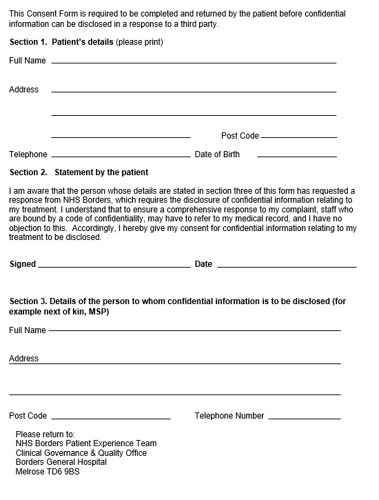
Where a complaint is made on behalf of another person, in accordance with the common law duty of confidentiality and data protection legislation, in addition to authorising another person to act on their behalf, the person has also consented to their personal information being shared as part of the complaints handling process. In circumstances where no such consent has been given, the body would have to take that into account when handling and responding to the complaint (and is likely to be constrained in what it can do in terms of investigating any such complaint). See Appendix 4

What if the person raising the issue does not want to complain?

If a person expresses dissatisfaction in line with our definition of a complaint but does not want to complain, tell them that NHS Borders considers all expressions of dissatisfaction, and that complaints offer us the opportunity to improve services where things have gone wrong. Encourage the person raising the issue to submit a complaint in order that it can be dealt with through the complaints handling procedure. This will ensure that they are updated on the action taken and get a response to their complaint.

If, however, the person insists they do not wish to complain, the concern should be recorded as being resolved at the early resolution stage of this procedure. This will ensure the completeness of the complaints data recorded and will still allow NHS Borders to fully consider the matter and take corrective action where appropriate. Doing so will also ensure that the person has the opportunity to pursue the complaint at the investigation stage of the procedure should they subsequently raise the matter again.

Complaints involving more than one NHS service or organisation

If someone complains about the service of another NHS Board or Primary Care service provider, and NHS Borders has no involvement in the issue, the person should be advised to contact the relevant Board or service provider directly.

Where the complaint spans two (or more) NHS bodies, for example one Board using the services of another to provide care and treatment, the person making the complaint must be informed of who will take the lead in dealing with the complaint, and explain that they will get only one response covering all issues raised. The NHS bodies involved should be mindful of the timescale within which the response should be issued and work jointly to achieve this.

There may be occasions where a complaint relates to two (or more) NHS bodies, however, each aspect of the complaint relates specifically to one, or other of the organisations. This could be, for example a complaint about pre-hospital care and a complaint about a delay in being seen in the accident and emergency department. Where this occurs it is important to communicate clearly with the person making the complaint to explain, and agree how the complaint will be handled. Where this applies each organisation should record, handle and respond to the complaint about the service they provided and let the complainant know that they will receive two separate responses.

A complaint may relate to the actions of two or more of the organisation’s services. Where this is the case, the person making the complaint must be informed of who will take the lead in dealing with the complaint, and explain that they will get only one response from the organisation covering all of the issues they have raised.

Overlap with other duties on NHS bodies

NHS bodies are subject to a range of other duties in respect of honesty and openness about the services and care they provide. The Apologies (Scotland) Act 2016 is intended to encourage apologies being made by making it clear that apologising is not the same as admitting liability. An apology means any statement made indicating that the person is sorry about or regrets an act or omission or outcome. It also covers an undertaking to look into what happened with a view to preventing it happening again. In meeting the requirements of this complaints procedure an apology will be made where appropriate and where an unintended or unexpected incident has happened resulting in death or harm the complainant will be informed with openness and honesty. Most apologies made in the course of provision of NHS services, or in the course of resolving or investigating a complaint about an NHS service, will be subject to the provisions of the Apologies (Scotland Act) 2016.

 The Duty of Candour may also apply in situations that result in a complaint, depending on the nature and extent of the unintended or unexpected harm caused. By sharing intelligence between the Patient Safety Team and the Patient Experience Team, there is an opportunity to identify whether such harm has occurred. Enacting the Duty of Candour ensures that individuals are offered a meeting, are informed about what happened, receive a sincere apology, and are told what actions will be taken in response,  including steps to prevent a recurrence in the future.

Apologies which are made in accordance with The Duty of Candour will, by virtue of section 23 of the Health (Tobacco, Nicotine etc. and Care) (Scotland) Act 2016, also not amount to an admission of negligence or breach of duty.

Complaints that span health and social care services

From 1 April 2017, the health and social work complaints handling procedures will be aligned and will therefore have the same stages and timescales, with the exception of timescale extensions.

If a person raises a complaint about a health service and a social care or social work service the response will depend on whether these services are being delivered through a single, integrated health and social care partnership.

Where these services are integrated, NHS Borders must work together with the health and social care partnership staff to resolve the complaint. A decision must be taken, by following the procedure that the health and social care partnership has in place, as to whether the NHS or local authority will lead on the response. All parties must be made clear about this decision. It is important, wherever possible, to give a single response from the lead organisation, though ensure both organisations contribute to this. However, in complex cases where a single response is not feasible, this should be explained to the person making the complaint along with the reasons why they will receive two separate responses, and who they can get in contact with about the social work aspects of their complaint.

Where health and social work or social care services are not integrated, for example the relevant local authority provides a social work or social care service, independent of any health service provision, the person will need to direct their communications about social care or social work separately to the local authority. The person making the complaint must be made aware of which issues which will be responded to, and direct them to the appropriate person to handle those relating to social work and care.

In either case, it is important to bear in mind that:

  • the Care Inspectorate can investigate complaints about social care services provided by registered care providers, even if they have not yet gone through the local complaints handling procedure, and customers should be informed of this option; and
  • social work services must handle complaints according to the social work complaints handling procedure, which is largely in line with this complaints handling procedure.

Integrated Joint Boards must have a separate complaints handling procedure for handling complaints about their functions. This will be broadly in line with this complaints handling procedure.

The Complaints Handling Process

The complaints handling procedure aims to provide a quick, simple and streamlined process for resolving complaints early and locally by capable, well-trained staff.

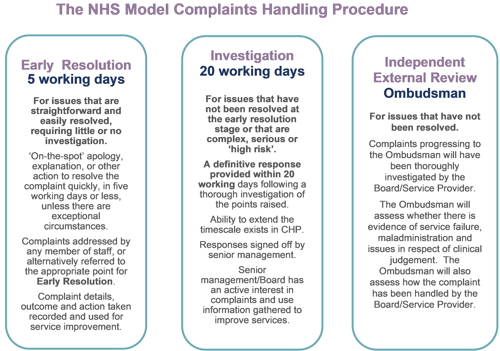
Our complaints handling procedure provides two opportunities to resolve complaints internally:

  • early resolution; and
  • investigation

For clarity, the term ‘early resolution’ refers to the first stage of the complaints process. It does not reflect any job description or role within NHS Borders but means seeking to resolve complaints at the initial point of contact where possible.

What to do when a complaint is received

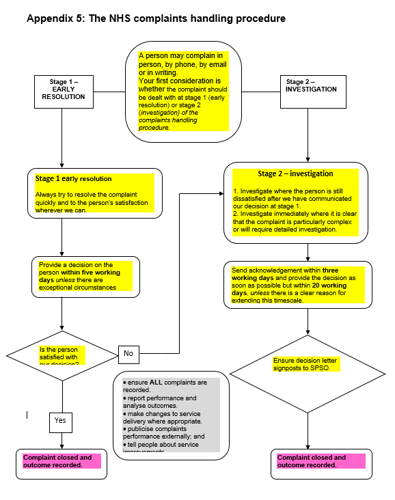
  • On receiving a complaint, a decision must be made whether the issue can indeed be defined as a complaint. (see flowchart at Appendix 5) The person making the complaint may express dissatisfaction about more than one issue. This may mean one element is treated as a complaint, while directing the person to pursue another element through an alternative route.
  • Once received and identified as a complaint, the details should be recorded on the complaints system.
  • Next, decide whether or not the complaint is suitable for early resolution. Some complaints will need to be fully investigated before a suitable response may be give. These complaints must be handled immediately at the investigation stage.
  • Where early resolution is appropriate, four key questions must be considered:
  • what exactly is the person's complaint (or complaints);
  • what do they want to achieve by complaining;
  • can this be achieved, and if not why not; and
  • can this be resolved, who can help with early resolution?

What exactly is the person’s complaint (or complaints)?

Find out the facts. It is important to be clear about exactly what the person is complaining of, more information may be required to get a full picture.

What do they want to achieve by complaining?

At the outset, clarify the outcome the person wants. Of course, they may not be clear about this, probing further may be required to find out what they want, and whether the expected outcome can be achieved. It may also be helpful to signpost people who complain to PASS at this point as advisers can often help clients think about their expectations and what is a realistic/reasonable outcome to expect.

Can I achieve this, or explain why not?

If the expected outcome can be achieved by providing an on-the-spot apology or explain why you cannot achieve it, you should do so.

The person making the complaint may expect more than can be provided, or a form of resolution that is not at all proportionate to the matter complained about. If so, you must tell them as soon as possible. An example would be where someone is so dissatisfied with their experience in ‘Accident and Emergency’ that they want the Chief Executive to be sacked.

You are likely to have to convey the decision face to face or on the telephone. If you do this, you are not required to write to the person as well, although you may choose to do so. It is important, however, to record full and accurate details of the decision reached and passed to the person, and to ensure that they understand the outcome. You must also advise them of their right to have the complaint escalated to stage 2 of the complaints procedure if they are not satisfied with the outcome at the early resolution stage.

If I cannot resolve this, who can help with early resolution?

If you cannot deal with the complaint because, for example, you are unfamiliar with the issues or area of service involved, tell the person this and pass details of the complaint to someone who can attempt to resolve it. Keep the person making the complaint informed about what has happened to their complaint and who is responsible for taking it forward.

Stage one: early resolution

Early resolution aims to resolve straightforward complaints that require little or no investigation at the earliest opportunity. This should be as close to the point of service delivery as possible. Any member of staff may deal with complaints at this stage. In practice, early resolution means resolving the complaint at the first point of contact with the person making the complaint. This could mean a face-to-face discussion with the person, or it could mean asking an appropriate member of staff to deal directly with the complaint. In either case, a complaint may be settled by providing an on-the-spot apology where appropriate, or explaining why the issue occurred and, where possible, what will be done to stop this happening again.

An explanation may also be given that, as an organisation that values complaints, the information given in a complaint may be used when service standards are reviewed in the future.

Anyone can make a complaint. They may do so in writing, in person, by telephone, by email or online, or by having someone complain on their behalf. Early resolution must always be considered, regardless of how the complaint has been received.

Appendix 1 gives examples of the types of complaint which may be considered at this stage, with suggestions on how to resolve them.

Timelines (Stage one)

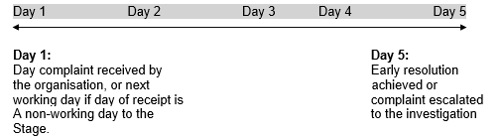
Early resolution must usually be completed within five working days, although the expectation would be to resolve the complaint much sooner.

Extension to the timeline

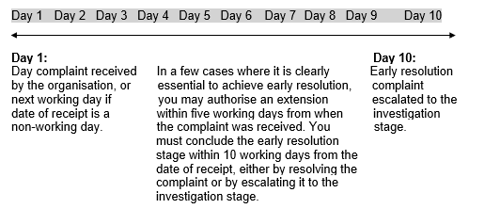
In exceptional circumstances, where there are clear and justifiable reasons for doing so, an extension may be agreed of no more than five additional working days with the person making the complaint. This must only happen when an extension will make it more likely that the complaint will be resolved at the early resolution stage.

For example, more information may be required from other services to resolve the complaint at this stage. However, it is important to respond within the applicable time to the person making the complaint, either resolving the matter and agreeing with the person that this has been achieved, or explaining that their complaint is to be investigated.

When you ask for an extension, you must get authorisation from the appropriate senior manager, who will decide whether you need an extension to effectively resolve the complaint. Examples of when this may be appropriate include staff or contractors being temporarily unavailable. You must tell the person making the complaint about the reasons for the delay, and when they can expect your response.

Where, however, the issues are so complex, and it is clear that they cannot be resolved within an extended five day period, you should escalate the complaint directly to the investigation stage.

It is important that extensions to the timeline do not become the norm. Rather, the timeline at the early resolution stage should be extended only rarely. All attempts to resolve the complaint at this stage must take no longer than ten working days from the date you receive the complaint.

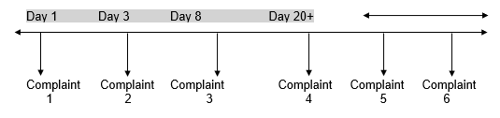
The proportion of complaints that exceed the five working days timeline at the early resolution stage will be evident from reported statistics. These statistics must go to the senior management team on a quarterly basis. Appendix 6 provides further information on timelines.

Closing the complaint at the early resolution stage

When you have informed the person making the complaint of the outcome at early resolution, you are not obliged to write to them, although you may choose to do so. You must ensure that the response to the complaint addresses all areas of responsibility explain the reasons for the decision. It is also important to keep a full and accurate record of the decision reached and given to the person. The complaint should then be closed and the complaints system updated accordingly. In closing the complaint, the date of closure is the date that the outcome of the complaint at the early resolution stage is communicated to the person making the complaint.

When to escalate to the investigation stage

A complaint must be handled at the investigation stage when:

  • early resolution was tried but the person making the complaint remains dissatisfied and requests an investigation into the complaint. This may be immediately on communicating the decision at the early resolution stage or could be some time later; or
  • satisfactory early resolution will not be possible as the complainant has clearly insisted that an investigation be conducted.

Complaints should be handled directly at the investigation stage, without first attempting early resolution, when:

  • the issues raised are complex and require detailed investigation; or
  • the complaint relates to serious, high-risk or high-profile issues.

When a complaint is closed at the early resolution stage, but is subsequently escalated to the investigation stage of the procedure, it is important that the complaint outcome is updated on the complaints system, and the complaint moved to stage 2. A new complaint should not be recorded.

It is also important to take account of the time limit for making complaints when a person asks for an investigation after early resolution has been attempted. The timescale for accepting a complaint as set out in the Regulations is within six months from the date on which the matter of the complaint comes to the person’s notice.

While attempting early resolution always take particular care to identify complaints that on fuller examination might be considered serious, high risk or high profile, as these may require particular action or raise critical issues that need senior management's direct input.

Stage two: investigation

Not all complaints are suitable for early resolution and not all complaints will be satisfactorily resolved at that stage. Complaints handled at the investigation stage of the complaints handling procedure are typically serious or complex, these require a detailed examination before a response can be given on our position. These complaints may already have been considered at the early resolution stage, or they may have been identified from the start as needing immediate investigation.

An investigation aims to establish all the facts relevant to the points made in the complaint and to give the person making the complaint a full, objective and proportionate response that represents the final position.

What to do when you receive a complaint for investigation

It is important to be clear from the start of the investigation stage exactly what you are investigating, and to ensure that both the person making the complaint and the service understand the investigation’s scope.

If this has not been considered at the early resolution stage, you should discuss and confirm these points with the person making the complaint at the outset, to establish why they are dissatisfied and whether the outcome they are looking for sounds realistic. In discussing the complaint with the person, consider three key questions:

  1. What specifically is the person’s complaint or complaints?
  2. What outcome are they looking for by complaining?
  3. Are the person's expectations realistic and achievable?

It may be that the person making the complaint expects more than can be provided. If so, this must be made clear to them as soon as possible.

Where possible you should also clarify what additional information you will need to investigate the complaint. The person making the complaint may need to provide more evidence to help in reaching a decision.

You should find out what the person’s preferred method of communication is, and where reasonably practicable communicate by this means.

Details of the complaint must be recorded on the system for recording complaints. Where applicable, this will be done as a continuation of the record created at early resolution. The details must be updated when the investigation ends.

 If the investigation stage follows attempted early resolution, you must ensure you have all case notes and associated information considered at the early resolution stage. You must also record that this information has been obtained.

Contact with the person making the complaint at the start of the investigation

To effectively investigate a complaint, it is often necessary to have a discussion with the person making the complaint to be clear about exactly what the complaint or complaints relate to, understand what outcome the person making the complaint is looking for by complaining, and assess if these expectations are realistic and achievable. This may be by a telephone discussion or it may be appropriate to arrange a meeting between appropriate NHS staff and the person making the complaint. This will provide the opportunity to explain how the investigation will be conducted, and to manage the person’s expectations in regard to the outcomes they are looking for. Where the complainant prefers to only have contact via email or letter this can be facilitated. 

Timelines (Stage two)

The following deadlines are set out in the Regulations for cases at the investigation stage:

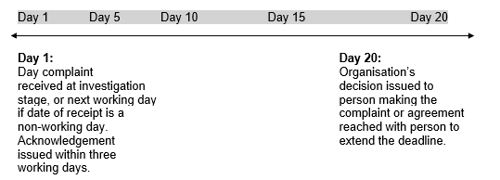
  • complaints must be acknowledged within three working days; and
  • you should provide a full response to the complaint as soon as possible but not later than 20 working days, unless an extension is required.

Acknowledgements

The Complaints Directions set out what must be included in a written acknowledgement of a complaint, which is as follows:

  • contact details of the Patient Experience Officer;
  • details of the advice and support available including the PASS;
  • information on the role and contact details for the SPSO;
  • a statement confirming that the complaint will normally be investigated, and the report of the investigation sent to the complainant, within 20 working days or as soon as reasonably practicable; and
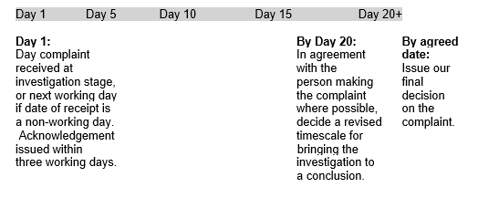
  • a statement advising that, should it not be possible to send a report within 20 working days, the person making the complaint will be provided with an explanation as to why there is a delay and, where possible, provided with a revised timetable for the investigation.

When advising the person making the complaint about the role and contact details of the SPSO, it should also be explained that if they remain dissatisfied at the end of the complaints process, they can ask the SPSO to look at their complaint, and that further information about this will be provided with the final decision on the complaint.

When issuing the acknowledgement letter you should issue it in a format which is accessible to the person making the complaint. You should also consider including the following points, where relevant to the complaint:

  • thank the person making the complaint for raising the matter;
  • summarise your understanding of the complaint made and what the person making the complaint wants as an outcome (this information will be available to you from your actions at ‘What to do when you receive a complaint’ as documented above);
  • where appropriate the initial response should express empathy and acknowledge the distress caused by the circumstances leading to the complaint;
  • outline the proposed course of action to be taken or indicate the investigations currently being conducted, stressing the rigour and impartiality of the process;
  • offer the opportunity to discuss issues either with the investigation officer, the complaints staff or, if appropriate, with a senior member of staff;
  • request that a consent form is completed where necessary; (appendix 7)
  • provide information on alternative dispute resolution services and other support service such as advocacy; and
  • provide a copy of the ‘Public Facing Complaints Handling Procedure’ if this has not already been issued.

You may send the letter electronically, provided that the person making the complaint has consented to this in writing, and has not withdrawn their consent.

During the course of the investigation, you should, where possible ensure that the person making the complaint, and anyone involved in the matter which is the subject of the complaint, is informed of progress and given the opportunity to comment.

 Meeting with the person making the complaint during the investigation

To effectively investigate the complaint, it may be necessary to arrange a meeting with the person making the complaint. Where a meeting takes place, always be mindful of the requirement to investigate complaints within 20 working days wherever possible. There is no flexibility within the Patient Rights (Scotland) Act 2011 to ‘stop the clock’ in the complaints handling process. This means that where required, meetings should always be held within 20 working days of receiving the complaint wherever possible. As a matter of good practice, where meetings between NHS staff and the person making the complaint do take place, a written record of the meeting should be completed and provided to the person making the complaint. Alternatively, and by agreement with the person making the complaint, you may provide a record of the meeting in another format, to suit their communications needs and preferences. You should discuss and agree with the person making the complaint, the timescale within which the record of the meeting will be provided.

 Extension to the timeline

It is important that every effort is made to meet the timescales as failure to do so may have a detrimental effect on the person making the complaint. Not all investigations will be able to meet this deadline, however, and the Regulations allow an extension where it is necessary in order to complete the investigation. For example, some complaints are so complex that they require careful consideration and detailed investigation beyond the 20 working day limit. However, these would be the exception and you must always try to deliver a final response to a complaint within 20 working days.

If there are clear and justifiable reasons for extending the timescale, the Patient Experience Officer will set time limits on any extended investigation, as long as the person making the complaint agrees. You must keep them updated on the reason for the delay and give them a revised timescale for completion. If the person making the complaint does not agree to an extension but it is necessary and unavoidable, then senior management must consider and confirm the extension.

The reasons for an extension might include the following:

  • essential accounts or statements, crucial to establishing the circumstances of the case, are needed from staff, patients or others but they cannot help because of long-term sickness or leave;
  • you cannot obtain further essential information within normal timescales;
  • operations are disrupted by unforeseen or unavoidable operational circumstances, for example industrial action or severe weather conditions; or
  • the person making the complaint has agreed to mediation as a potential route for resolution.

These are only a few examples, and the matter must be judged individually in relation to each complaint.

As with complaints considered at the early resolution stage, the proportion of complaints that exceed the 20-day limit will be evident from reported statistics.

If you are handling a complaint spanning health and social care services and the health aspects have been resolved but the social care aspects require an extension to continue investigation, you must tell the person that you are not yet in a position to respond to all aspects of the complaint and tell them when you will do so. Appendix 6 provides further information on timelines.

 Mediation

Some complex complaints, or complaints where the person making the complaint and other interested parties have become entrenched in their position, may require a different approach to resolution. Where appropriate, you may consider using services such as mediation or conciliation, using suitably trained and qualified mediators to try to resolve the matter and to reduce the risk of the complaint escalating further.

Mediation will help both parties to understand what has caused the complaint, and so is more likely to lead to mutually satisfactory solutions. It can be particularly helpful in the context of complaints about primary care providers, and the Directions set out that Boards must provide alternative dispute resolution services in these circumstances, if both the person making a complaint about a primary care provider, and the person subject to the complaint, agree that it should be provided.

If you and the person making the complaint agree to mediation an extension to the investigation period is likely to be necessary and, revised timescales should be agreed.

 Closing the complaint at the investigation stage

In terms of best practice, for relevant NHS bodies, the complaints process should always be completed by the Patient Experience Manager (or someone authorised to act on his or her behalf) reviewing the case. They must ensure that all necessary investigations and actions have been taken. For other health service providers this will be the Patient Experience Officer or a senior officer nominated to perform this review. Where the complaint involves clinical issues, the draft findings and response should be shared with the relevant clinicians to ensure the factual accuracy of any clinical references. Where this is appropriate the relevant clinicians should always have regard to the timescales within which the decision should be issued.

You must let the person making the complaint know the outcome of the investigation, in writing, and also, if applicable, by their preferred alternative method of contact. Response to the complaint must address all areas NHS Borders are responsible for and explain the reasons for our decision. You must record the decision, and details of how it was communicated to the person making the complaint, on the system for recording complaints. In accordance with the Complaints Directions, the report must include the conclusions of the investigation and information about any remedial action taken or proposed as a consequence of the complaint.

The report must be signed by an appropriately senior person. You may send this report electronically, provided that the person making the complaint has consented to this in writing, and has not withdrawn their consent.

The quality of the report is very important and in terms of best practice should:

  • be clear and easy to understand, written in a way that is person-centred and non-confrontational;
  • avoid technical terms, but where these must be used to describe a situation, events or condition, an explanation of the term should be provided;
  • address all the issues raised and demonstrate that each element has been fully and fairly investigated;
  • include an apology where things have gone wrong;
  • highlight any area of disagreement and explain why no further action can be taken;
  • indicate that a named member of staff is available to clarify any aspect of the letter; and
  • indicate that if they are not satisfied with the outcome of the local process, they may seek a review by the Scottish Public Services Ombudsman. Details of how to contact the Ombudsman’s office should be included in the response.

 Meetings and post decision correspondence with the person making the complaint

As previously noted, it is often appropriate to meet with the person making the complaint at the outset of the investigation in order to fully understand the complaint, what the person making the complaint wants to achieve by complaining, and to explain how the complaint will be handled.

A request for a meeting may also be received once the person making the complaint receives the decision on their complaint. The circumstances in which a meeting may be requested after the decision letter has been received include:

  1. The person requests further explanation or clarification of the decision or suggests a misunderstanding of the complaint in terms of the response.
  2. The person does not agree with some, or all of the response in terms of the investigation’s findings or conclusions or with the decision on the complaint.
  3. A combination of points 1 and 2 above, where for example the person suggests the complaint has not been fully understood, and the decision is erroneous even in the aspects that have been properly considered.

It should be made clear that such a meeting is for explanation only and not a reinvestigation or reopening of the complaint.


 

Governance of the Complaints Handling Procedure

Roles and responsibilities

Staff are trained and empowered to make decisions on complaints at the early resolution stage of this procedure. Our final position on a complaint, following stage 2 investigations, will be signed off by an appropriate senior officer and confirmed as a final response. This ensures that our senior management own and are accountable for the decision. It also reassures the person making the complaint that their concerns have been taken seriously.

Chief Executive

The Chief Executive provides leadership and direction in ways that guide and enable NHS Borders to perform effectively across all services. This includes ensuring that there is an effective complaints handling procedure, with a robust investigation process that demonstrates learning from the complaints received.

The Chief Executive is responsible for ensuring compliance with the requirements of this procedure. In particular they are responsible for ensuring that feedback, comments, concerns and complaints are monitored with a view to improving performance, and that action is taken as necessary following the outcome or any feedback, comment, concern or complaint. Regular management reports assure the Chief Executive of the quality of complaints performance.

Director of Quality and Improvement, Medical Director, and Director of Nursing, Midwifery & Allied Health Professions

On the Chief Executive’s behalf the Director of Quality & Improvement oversees the management of complaints across NHS Borders.  The Medical Director and Director of Nursing, Midwifery and Allied Health Professions have professional oversight of complaints, and have designated responsibility for signing of all complaints. The Chief Executive may take a personal interest in all or some complaints.

 Directors

On the Chief Executive's behalf, directors may be responsible for:

  • managing complaints and the way NHS Borders learns from them;
  • deputising for the Chief Executive on occasion

 Senior Managers

Senior Managers are responsible for ensuring that there are systems in place to enable the application of this procedure.   This includes ensuring that the actions to be taken as a result of a complaint are appropriate and followed up to assess the effectiveness of actions in addressing the issues identified.  They must also ensure that there are local procedures in place to ensure the application of this procedure and to disseminate the learning.

 Feedback & Complaints Manager

Each relevant NHS body must appoint a Feedback and Complaints Manager, in

accordance with the 2012 Regulations. The Feedback and Complaints Manager is

responsible for ensuring compliance with the requirements of this procedure. In

particular they are responsible for ensuring that feedback, comments, concerns and

complaints are monitored with a view to improving performance, and that action is

taken as necessary following the outcome or any feedback, comment, concern or

complaint. This function must be performed by the Chief Executive of the relevant

NHS body or by an appropriately senior person authorised by the relevant NHS body

to act on their behalf. Within NHS Borders this role is the responsibility of the Patient Experience Co-ordinator.

 Feedback & Complaints Officer

According to the 2012 Regulations, each responsible body (including relevant NHS bodies and their service providers) must appoint a Feedback and Complaints Officer to manage the arrangements. The Feedback and Complaints Officer is responsible for the management and handling of feedback, comments, concerns and complaints operationally. This post holder(s) should be of sufficient seniority to be able to deal with any feedback, comments, concerns and complaints quickly and effectively without needing to refer, in all but the most exceptional circumstances, to the feedback and complaints manager. Feedback and complaints officers should be readily accessible to patients, the public and staff. It is important that arrangements are made so that the role of the complaints officer is not interrupted by one individual’s annual or sick leave.

The functions of the Feedback and Complaints Officer may be performed personally or delegated to an authorised person as defined by the organisation. In NHS Borders this is carried out by the Patient Experience Officers, with the support of the Patient Experience Co-ordinator.  Although not intended to be prescriptive, the list below outlines the key duties of the Feedback and Complaints Officer:

  • work across the organisation to develop mechanisms for encouraging fast, effective and efficient patient feedback including the use of emerging technology as appropriate;
  • operationally manage and support the administration local policies and procedures ensuring that:
    • feedback and complaints recording systems are in place and records kept up to date; and
    • organisational learning from the operation of the Patient Experience process is captured and reported.
  • determine whether a complaint is one which should not be investigated under the procedure because of the likelihood that legal action will be raised in respect of the same issue.
  • provide specialist advice and support to patients and staff and others on the management of this process, including delivery of local training and awareness raising; have access to advice and support on associated issues, for example patient consent, confidentiality, the operation of related legislation such as the Data Protection Act, access to medical records, Freedom of Information; and
  • have an understanding of partner organisations and how to work with them on managing feedback, comments, concerns and complaints.
  • liaise with the SPSO including providing complaints information in an orderly, structured way within requested timescales, providing comments on factual accuracy on our behalf in response to SPSO reports, and confirming and verifying that recommendations have been implemented.

All staff in the organisation

A complaint may be made to any member of staff in the organisation. All staff must be aware of the complaints handling procedure and how to handle and record complaints at the early resolution stage and provide response to all complaints in accordance with the Complaints Handling Procedure. They should also be aware of who to refer a complaint to, in case they are not able to personally handle the matter. All staff will be encouraged to try to resolve complaints early, as close to the point of service delivery as possible.

Where staff are involved in complaints responses the learning outcomes should be used as part of annual appraisal an where appropriate revalidation and reflective practice. All staff have a duty to reflect and adjust practice based on learning from complaints.

Patient Experience Team

The Patient Experience Team co-ordinate and support a single complaints function across the organisation. They can be contacted as follows: 

  • Telephone: 01896 826719
  • Email: experience@borders.scot.nhs.uk
  • Post: Patient Experience Team, Borders General Hospital, Melrose, Roxburghshire, TD6 9BS

The Patient Experience Team also provide support to staff with the complaints handling procedure and the Unacceptable Actions Procedure.

The SPSO liaison officer

Our SPSO liaison officer’s role may include providing complaints information in an orderly, structured way within requested timescales, providing comments on factual accuracy on our behalf in response to SPSO reports, and confirming and verifying that recommendations have been implemented. This role is undertaken by the Patient Experience Co-ordinator for NHS Borders.

Complaints about senior staff

Complaints about senior staff can be difficult to handle, as there may be a conflict of interest for the staff investigating the complaint. When serious complaints are raised against senior staff, it is particularly important that the investigation is conducted by an individual who is independent of the situation. Strong governance arrangements will be in place that set out clear procedures for handling such complaints.

Recording, monitoring, reporting, learning from and publicising complaints

Complaints provide valuable feedback. One of the aims of the complaints handling procedure is to identify opportunities to improve services across NHS Borders. All complaints will be recorded in a systematic way so that complaints data can be used for analysis and management reporting. By recording and using complaints information in this way, the causes of complaints can be identified and addressed, and where appropriate, training opportunities and service improvements can be introduced.

 Recording complaints

Certain information must be recorded by virtue of the 2012 Regulations and the Complaints Directions, and to comply with SPSO guidance on minimum requirements. Staff should ensure that all complaints are recorded even those resolved at the early resolution stage within five working days (although these do not require an acknowledgement or a written report of the investigation to be sent to the person making the complaint). To collect suitable data, it is essential to record all complaints information as follows:

  • the person’s name, address and email address, where that is their preferred method of communication
  • the patient’s name and Community Health Index number where relevant
  • in the event that the complainant is making the complaint on behalf of another person, whether that other person has given consent for the complaint to be made on his or her behalf
  • the date when the complaint was received
  • the subject matter of the complaint and the date on which it occurred
  • how the complaint was received
  • the service the complaint refers to
  • the date the complaint was closed at the early resolution stage (where appropriate)
  • the date the complaint was escalated to the investigation stage (where appropriate)
  • action taken at the investigation stage (where appropriate)
  • the date the complaint was closed at the investigation stage (where appropriate)
  • the outcome of the complaint at each stage
  • the underlying cause of the complaint and any remedial action taken.

There are structured systems for recording complaints, their outcomes and any resulting action. These provide a detailed record of services that have failed to satisfy people, and the actions taken to improve services as a result.

If, subsequently, the complaint is referred to the SPSO, this may result in a request for all relevant papers and other information to be provided, in good time, to the Ombudsman's office. Complaints records should be kept separate from health records, due to the need to only record information which is strictly relevant to the patient’s health in their health record. These documents should be managed with regard to the current Scottish Government Records Management Code of Practice.

Monitoring complaints

Arrangements are in place to monitor how the complaints received are dealt with.

An increase in the number of complaints should not in itself be a reason for thinking a service is deteriorating. It could mean that arrangements for handling feedback, comments, concerns and complaints are becoming more responsive. The important point is to ensure that complaints (and feedback, comments and concerns) are handled sympathetically, effectively and quickly and that lessons are learned and result in service improvement.

Reporting complaints

In accordance with the Complaints Directions, relevant NHS bodies have a responsibility to gather and review information from their own services and their service providers on a quarterly basis in relation to complaints. Service providers also have a duty to supply this information to their relevant NHS body as soon as is reasonably practicable after the end of the three month period to which it relates. Data required for these quarterly reports is outlined in the NHS Complaints Performance Indicators; this includes:

  • a statement outlining changes or improvements to services or procedures as a result of consideration of complaints
  • a statement to report the person making the complaint’s experience in relation to the complaints service provided
  • a statement to report on levels of staff awareness and training
  • the total number of complaints received (other than complaints to which this procedure does not apply)
  • complaints closed at stage one and stage two of this procedure as a percentage of all complaints closed
  • complaints upheld, partially upheld and not upheld at each stage of this procedure as a percentage of complaints closed in full at each stage
  • the average time in working days for a full response to complaints at each stage of this procedure
  • the number and percentage of complaints at each stage which were closed in full within the set timescales of 5 and 20 working days
  • the number of complaints at stage 1 where an extension was authorised as a percentage of all complaints at stage 1
  • the number of complaints at stage 2 where an extension was authorised as a percentage of all complaints at stage 2

Appendix 8 provides further information on these Complaints Performance Indicators.

Complaints details are analysed for trend information to ensure service failures are identified and appropriate action taken. Regular reporting of the analysis of complaints information helps to inform management of where services need to improve.

Regular reporting demonstrates improvements resulting from complaints can influence services. It also helps ensure transparency in the complaints handling service and will show people using our services that their complaints are valued.

Reporting will

  • be on a quarterly basis showing the trends that are evident in complaints and the actions taken as a result; and
  • use case studies and examples to demonstrate how complaints have helped improve services.

This information should be reported regularly, and at least quarterly, to senior management an appropriate Board committees.

 Review by senior management

Senior management will review the information gathered from complaints regularly (and at least quarterly), and consider how our services could be improved or internal policies and procedures updated. The Patient Experience Manager or someone senior acting on his or her behalf is involved in a review of each of the quarterly reports with a view to identifying areas of concern, agreeing remedial action and improving performance. Where appropriate, the review must also consider any recommendations made by the SPSO in relation to the investigation of NHS complaints. The outcomes of these reviews should be reported via the Board's governance structure to the Board of management or equivalent governing body.

Learning from complaints

At the earliest opportunity after the closure of the complaint, the complaint handler should always make sure that the person making the complaint and staff of the service involved are given feedback and, where applicable, understand the findings of the investigation and any recommendations made.

As a minimum, NHS Borders will:

  • use complaints data to identify the contributory factors to complaints;
  • take action to reduce the risk of recurrence;
  • record the details of corrective action in the complaints file; and
  • systematically review complaints performance reports to improve service delivery.

Where the need for service improvement has been identified:

  • an action plan should be developed where appropriate;
  • the action needed to improve services must be prioritised for implementation;
  • an officer (or team) should be designated the ‘owner’ of the issue, with responsibility for ensuring the action is taken;
  • a target date must be set for the action to be taken;
  • the designated individual must follow up to ensure that the action is taken within the agreed timescale;
  • where appropriate, performance in the service area should be monitored to ensure that the issue has been resolved; and
  • staff will be encouraged to learn from complaints.

The General Medical Council’s education standards set out the requirements of NHS bodies and primary care providers, in terms of the organisation and provision of medical education and training. It places a particular emphasis on the need for the learning environment and organisational culture to value and support education and training, so that learners are able to demonstrate the responsibilities, values, behaviours and learning outcomes required. Where appropriate, appraisers will be encouraged to place emphasis on the role of learning from complaints in individual appraisals to identify where development or change in approach can improve patient care.

Publishing complaints performance information

Each year a report setting out our performance in handling complaints, concerns, comments and feedback will be published. This summarises and builds on the quarterly reports which are produced about our own services and received from service providers in our area. It includes details of the numbers and types of complaints and information about the stage at which complaints were resolved, the time taken to do so, and about the actions that have been or will be taken to improve services as a result of complaints, concerns, comments and feedback.

These reports must be easily accessible to members of the public and available in alternative formats as requested.

The Complaints Directions require this publication to be sent to Scottish Ministers, the PASS, Healthcare Improvement Scotland, SPSO and where appropriate, the Scottish Prison Service.

 National monitoring

In accordance with the Complaints Directions, complaints statistics must be submitted by relevant NHS bodies annually.  This information should include the performance information of Primary Care providers which has been submitted to the Board. The information must be in an appropriate format to allow collation and publication of national complaints statistics.

 Performance reporting by Primary Care service providers

The requirement to record and report on complaints applies equally to all Primary Care service providers. NHS Boards should ensure that arrangements are in place for all contractors to comply with this requirement so that they can include this information in their own reporting of complaints handling performance. This reporting should clearly differentiate between the Board and its contractors.

 Maintaining confidentiality

Confidentiality is important in complaints handling. This includes maintaining the person’s confidentiality and explaining to them the importance of confidentiality generally. Legal requirements, for example, data protection legislation, as well as internal policies on confidentiality and the use of personal information must be adhered to.

 Data Protection Legislation

The NHS complaints procedure may be used for complaints arising from rights given by the General Data Protection Regulation and the Data Protection Act 2018. If this route is chosen, complaints staff should take the matter forward in conjunction with the Information Governance Manager/Caldicott Guardian (or other nominated person) who takes decisions on what information is stored and how it is processed by the NHS body or health service provider. Where a person remains unhappy with the outcome of local resolution they should be advised to contact the UK Information Commissioner.

Dealing with problem behaviour

People may act out of character in times of trouble or distress. The circumstances leading to a complaint may result in the person acting in an unacceptable way. People who have a history of challenging or inappropriate behaviour, or have difficulty expressing themselves, may still have a legitimate complaint. Behaviour should not be viewed as unacceptable just because the person making the complaint is forceful or determined. In fact, being persistent can be a positive advantage when pursuing a complaint. However, the actions of people who are angry, demanding or persistent may result in unreasonable demands on time and resources or unacceptable behaviour towards staff.

NHS Scotland seeks to protect their staff and alongside the national Partnership Information Network (PIN) guidance on Preventing and Dealing with Bullying and Harassment in NHS Scotland, NHS bodies and health service providers should have policies and procedures in place for managing persistent or unreasonably demanding people.

Policies and procedures to protect staff from unacceptable behaviour such as unreasonable persistence, threats or offensive behaviour from people will be applied. Where a decision to restrict access to a person under the terms of an unacceptable actions policy, a procedure is in place to communicate that decision, notify the person of a right of appeal, and review any decision to restrict contact with staff. This will allow the person to demonstrate a more reasonable approach later.

Supporting the person making the complaint

All members of the community have the right to equal access to the complaints handling procedure. NHS Borders will ensure easy access to the complaints handling procedure for those who may have specific needs or who do not have English as a first language.

Human rights will be taken into account along with the commitment and responsibilities to equality as defined within the Equality Act (2010). This includes making reasonable adjustments to our services where appropriate. Several support and advocacy groups are available to support people to pursue a complaint and they should be signposted to these as appropriate.

 Patient Advice and Support Service (PASS)

The Patient Rights Act provided for the establishment of the Patient Advice and Support Service (PASS). PASS operates independently of the NHS, and provides free, confidential information, advice and support to anyone who uses the NHS in Scotland. The service promotes an awareness and understanding of the rights and responsibilities of patients and can advise and support people who wish to give feedback, make comments, raise concerns or make complaints about treatment and care provided. Further information can be found on the PASS web site:www.patientadvicescotland.org.uk

Time limit for making complaints

It is recognised that it is not always possible to make a complaint immediately. In clinical complaints, for example, a complication or other issue may not become apparent for some time after the procedure. Similarly the grief associated with the death of someone may make it difficult for their representatives or family members to deal with a complaint in the period immediately after the death.

Given the difficulties that the passage of time can make to the resolution of a complaint the timescale for accepting a complaint as set out in the regulations is within six months from the date on which the matter of the complaint comes to the person's notice, provided that this is also no later than 12 months after the date on which the matter of the complaint occurred.

The timescale for acceptance of a complaint may be extended if the Patient Experience Officer considers it would be reasonable in the circumstances. Where a decision is taken not to extend the timescales a clear explanation of the basis for the decision should be provided to the person making the complaint, and the person should be advised that they may ask the Scottish Public Services Ombudsman to consider the decision.

Appendix 1: Complaints

The following tables give examples of complaints that may be considered at the early resolution stage, and suggest possible actions to achieve resolution.

Complaint Possible actions to achieve resolution
The complaint relates to clinical treatment. The person is unhappy that several attempts to draw blood were not successfully completed, and that there was a lack of pain management to address her discomfort.

Apologise for the pain and discomfort caused. Explain the appropriate procedure for taking blood and agree with the person making the complaint how this will be approached in the future. Perhaps ensure that an experienced person draws the blood, and ensure suitable pain management is available if needed.

The complaint relates to clinical treatment. The person disagrees with their care plan and wants it evaluated by an independent clinician.

Thank the person for bringing this matter to your attention. Confirm with them their reasons for disagreeing with the care plan. Explain the process for developing a care plan and the fact that you will check how this was applied in this case.

Check with appropriate staff to ensure the care plan accurately reflects the agreed care needs, and addresses any issues raised by the person. Explain to the person the action you have taken, and the basis for the care plan.

If the person continues to disagree with your response, advise them that the complaint will be escalated to stage 2 of the complaints procedure for further investigation.

The complaint relates to a lack of privacy during visiting hours. The person complained that visitors to the patient in the bed next to her could overhear medical staff discussing her condition and treatment. She felt humiliated by this.

Apologise for the distress felt by the person. Advise her of the normal procedure for discussing her medical condition with her. Explain the action you will take to ensure that this situation is not repeated, and any discussions in regard to diagnosis, care or treatment are conducted in private.

The complaint relates to clinical treatment. A person was receiving anti-clotting medication injected into her stomach. Each treatment required two painful injections as the ward’s drug trolley only had small doses in the pre-prepared syringes.

The person complained to the nurse administering the injection, who then ordered a supply of larger doses from the hospital pharmacy. Next day the person (and others on the ward) received the correct dose with only one injection required.

The complaint relates to staff attitude. It is alleged that when asked to explain why surgery had been delayed, the nurse was rude, insensitive to the person’s needs and did not explain the reason for the delay.

Thank the person for bringing the complaint to your attention. Apologise, recognising that they feel the nurse did not respond appropriately to the enquiry. Make sure that you provide a full response to the person's request for information about the surgery and any reasons for delay. Explain that you will record the complaint and ensure that staff are made aware of the need to respond fully and appropriately to all enquiries. Discuss the complaint with appropriate staff, to understand the issue from their perspective. If and where appropriate, provide support to staff to respond appropriately to enquiries.

The complaint relates to communication with the person. The letter sent by the Board to explain the next course of treatment used jargon that the person did not understand and said that details of the next appointment were enclosed, when in fact they were not.

Thank the person for bringing the complaint to your attention. Advise that the use of jargon in letters is inappropriate and should not be used. Tell the person that you will bring this matter to the attention of the appropriate unit, who will contact her urgently to provide details of the next appointment. Tell them that you are sorry that this has happened, and that her complaint should help to ensure that this does not occur again.

The complaint relates to waiting times. Having waited for 12 weeks to be seen by a physiotherapist, the appointment was cancelled with only one day’s notice.

Thank the person for bringing this to your attention, and apologise for the inconvenience that this cancellation has caused. Advise them of the process for making physiotherapy appointments and the associated timescales. Explain the reason that the appointment was cancelled at such short notice. Where possible arrange an alternative appointment at a date and time which is convenient for the person.

The complaint relates to a delay at the out patients clinic. The person complained that she had to wait too long in the reception area before being seen and she was not provided with a reason for the delay.

Thank the person for bringing the complaint to your attention. Explain the process for seeing people at an outpatient appointment, together with the reasons that something went wrong on this occasion. Apologise, and explain the actions you will take to ensure that this situation does not reoccur. This may be by reminding all staff on duty to ensure that people are kept updated where there is a delay in appointment times. It may also be by ensuring notices are placed in the reception areas advising people to approach reception if their appointment is delayed by more than 20 minutes.

The complaint relates to a lack of facilities within the hospital’s waiting area. The person complained that she had no direct access to drinking water and when she asked at reception for a glass of water she was advised to purchase a bottle of water from the shop within the hospital complex.

Thank the person for bringing this matter to your attention. Apologise, recognising how the situation must have been for her. Explain the reason that drinking water may not have been immediately available, and what the options will be to access drinking water in the future. Where appropriate, signpost within the waiting areas, to explain how people may get access to drinking water.

The complaint relates to car parking within the hospital grounds. The person is unhappy with the parking fees charged by the hospital.

Thank the person for bringing this matter to your attention. Explain the Board, or hospital policy on car parking, and where appropriate advise on alternative areas for parking or how people may use public transport in appropriate cases. Finally explain that the Board takes all complaints seriously and that information from complaints is analysed and used to inform policies and procedures moving forward.

The complaint relates to the catering services for patients. The person is unhappy that, despite notifying nurses that she is a vegetarian, no vegetarian meal was provided at dinner time. When she asked for a vegetarian meal she was advised that the kitchen was unable to provide one, and she was offered a salad sandwich as an alternative.

Thank the person for bringing the complaint to you. Apologise, acknowledging that there has been a failing and expressing empathy for the situation the person was in. Explain the normal protocol for ensuring all dietary requirements are met, and the action that you will now take to ensure that a vegetarian meal is always provided for her. Thereafter, follow up with her to ensure that the situation has been satisfactorily resolved and her dietary needs are being properly met.

The complaint relates to property. The person alleges that his dressing gown was removed from his bedside unit, and is now missing.

Thank the person for bringing the matter to your attention. Apologise, recognising the distress that the loss of the dressing gown will have caused. Offer to provide a hospital replacement gown in the meantime. Explain the action you will take to try and locate the dressing gown, and where appropriate, signpost him to the process for claiming for lost property.

Appendix 2: Feedback, Comments, Concerns or Complaints Assessment Matrix

The person bringing the issue to your attention may be very clear from the outset that they do not want to complain. If however, the matter meets the definition of a complaint, the person should be offered an explanation that complaints provide valuable information that allow organisations to learn and improve services. Where it is not clear, after discussion with the person bringing the matter, whether it should be recorded as feedback, a comment, a complaint, or a concern, the matrix below may help you to arrive at the appropriate decision.

  Insignificant or None Minor Moderate Significant or Certain
Your assessment of the rigour and extent of dissatisfaction expressed Feedback or Comment Concern Concern Complaint
The way in which the person raising the issue expresses their level of dissatisfaction Feedback or Comment Concern Complaint Complaint
Your assessment of the likely impact on patient care Feedback or Comment Concern or Complaint Complaint Complaint
Your assessment of the risks to the patient, patients or others Feedback or Comment Concern or Complaint Complaint Complaint
Your assessment of the risks to the NHS body Feedback or Comment Concern Complaint Complaint
The learning opportunities that may arise as a result of looking at the matter raised Feedback or Comment Concern Complaint Complaint

It is expected that you will use professional judgement in deciding whether an issue can be looked at as a 'Concern' or whether it is appropriate to handle the matter through the complaints handling procedure. Where an issue is looked at as a ‘Concern’ and the person raising the matter remains dissatisfied with your response, you must then investigate the matter as a complaint, at stage 2 of the complaints handling procedure.

Appendix 3: Concerns

The following tables give examples of matters that may be considered as concerns.

Concerns Suggested action

A person was worried about his forthcoming cataract surgery. He did not fully understand the procedure that would be followed and the implications in relation to his future eye care requirements.

Arrange an appointment for him to see the ophthalmologist to have a full explanation of the surgery, and long term eye care requirements provided.

The café uses plastic cups. An elderly person raised concerns that she and others have difficulty in holding these plastic cups.

Where mugs are available they should be used in the café. Alternatively, cardboard cup holders/sleeves with a handle may be considered.

A person raised a concern about when they would be seen in the clinic as the last clinic had overrun resulting in her not being seen for her appointment.

The service should contact the person to apologise for the earlier missed appointment and to inform her that action has been taken to ensure the clinic is not overbooked. The person should be reassured that their concerns have been noted, and that arrangements are in place to ensure that they are seen at the stated appointment time next time.

A person said that his appointment letter was sent in an unsealed envelope and he wanted the board to be aware of this.

Provide information about the reasons for the re provision of services and explain the actions that will be taken to ensure no adverse effects on service delivery.

A concern is raised about the provision of maternity (or other service) services and the impact that service re-provision would have in the future.

Provide information about the reasons for the re provision of services and explain the actions that will be taken to ensure no adverse effects on service delivery.

A person had had part of one of his fingers amputated. He wrote to the NHS asking for more information, as he felt the operation was unnecessary and that the complications were never fully explained to him. In his letter he states that he does not want to complain, but he is unhappy about his treatment.

The circumstances described here would normally be handled as a complaint. Where the person is adamant that they do not wish to complain, the matter should be recorded as being resolved at the early resolution stage.

Provide a full detailed response advising why a decision to amputate was taken following what was considered to have been simple routine surgery.  If the person comes back to say that they remain unhappy with this response, the matter should then be handled at stage 2 of the complaints procedure, with the person being signposted to SPSO if they remain dissatisfied with the subsequent response.

Prior to an operation eight months ago, the person had expressed fear to a number of staff that she would not have sufficient post-operative pain management. Despite these concerns being raised she experienced considerable pain after the operation. She now has concerns regarding a forthcoming operation. She wanted her pain to be managed more effectively than when she had underwent the same operation previously.

Explain to the person that the first operation was unsuccessful and therefore has to be performed a second time. Reassure her that her concerns about pain management have been noted and that medical staff will do all they possibly can to effectively manage any post-operative pain.

A patient suffers from a recurring problem with chest infections. This has been the case for several years. He is unhappy that his GP has refused to prescribe him another course of antibiotics.

The GP meets with the person to understand the reasons for his dissatisfaction, and to explain the basis for the decision not to continually prescribe antibiotics.

The GP may arrange for further tests if appropriate.

Appendix 4: Consent

Where someone other than the person to whom the complaint relates, or their authorised agent (including MPs, MSPs and local Councillors), wishes to make a complaint on behalf of a person, any such complaint will be handled in accordance with the common law duty of confidentiality and data protection legislation.

In such circumstances, check whether consent has been received from the person for the complaint to be made on their behalf. In the event that consent has not been received, this will be taken into account when handling and responding to the complaint. In such circumstances constraints are likely as to what can be done in terms of investigating a complaint, or in terms of the information which can be included in the report of such an investigation.

In circumstances where the person does not have the capacity to consent to the complaint being made on their behalf, it is likely to be relevant (for example) to check that the person making the complaint on the person’s behalf has a legitimate interest in the person’s welfare and that there is no conflict of interest. It would also be good practice to keep the patient on whose behalf the complaint is being made, informed of the progress of any investigation into the complaint, in so far as that is possible and appropriate.

The Scottish Government's guidance Handling Requests for Access to Personal Health Data provides information to assist NHS organisations (Boards, GP practices, etc) through the process of handling data access requests to personal health data in accordance with the relevant law and subsequent considerations. It also details, for example, helpful guidance in relation to parental responsibilities and rights.

Children and Young People

All NHS bodies and their health service providers should have and operate clear policies in relation to obtaining consent. These should include where the person who is the subject of a complaint is a child. These procedures should reflect any guidance or advice that may be issued by the Commissioner for Children and Young People in Scotland. The principles in that guidance will be equally relevant to the local operation of the NHS complaints procedure. A number of information leaflets for young people are available on NHS inform including Confidentiality Your Rights.

Generally, a person with parental responsibility can pursue a complaint on behalf of a child where the NHS body or health service provider judges that the child does not have sufficient understanding of what is involved. While in these circumstances, the child's consent is not required (nor is the consent of the other parent), it is considered good practice to explain the process to the child and inform them that information from their health records may need to be disclosed to those investigating the complaint.

Where an NHS body or health service provider judges that a child has sufficient maturity and understanding, the child can either pursue the complaint themselves or consent to it being pursued on their behalf by a parent or third party of their choice. It is also good practice to obtain the child’s written consent to information from their health records being released.

Adults who cannot give consent

Where a person is unable to give consent the NHS body or health service provider can agree to investigate a complaint made on their behalf by a third party. However, before doing so they should satisfy themselves that the third party has:

  • no conflict of interest; and
  • a legitimate interest in the person’s welfare, for example if they are a welfare attorney acting on behalf of an individual covered by the Adults with Incapacity Act (2000).

Appendix 5: The NHS Complaints Handling Procedure

Appendix 6: Timelines

General

References to timelines throughout the complaints handling procedure relate to working days. When measuring performance against the required timelines, do not count non-working days, for example weekends, public holidays and days of industrial action where our service has been interrupted.

Timelines at the early resolution stage

You must aim to achieve early resolution within five working days. The day you receive the complaint is day 1. Where you receive it on a non-working day, for example at the weekend or on a public holiday, day 1 will be the next working day.

Extension to the five-day timeline

If you have extended the timeline at the early resolution stage in line with the procedure, the revised timetable for the response must take no longer than 10 working days from the date of receiving the complaint.

Transferring cases from early resolution to investigation

If it is clear that early resolution has not resolved the matter, and the person wants to escalate the complaint to the investigation stage, the case must be passed for investigation without delay. In practice this will mean on the same day that the person is told this will happen.

 Timelines at investigation

You may consider a complaint at the investigation stage either:

  • after attempted early resolution, or
  • immediately on receipt if you believe the matter to be sufficiently complex, serious or appropriate to merit a full investigation from the outset.

Acknowledgement

All complaints considered at the investigation stage must be acknowledged within three working days of receipt. The date of receipt is:

  • the day the case is transferred from the early stage to the investigation stage, where it is clear that the case requires investigation, or
  • the day the person asks for an investigation after a decision at the early resolution stage. You should note that a person may not ask for an investigation immediately after attempts at early resolution, or
  • the date you receive the complaint, if you think it sufficiently complex, serious or appropriate to merit a full investigation from the outset.

Investigation

You should respond in full to the complaint within 20 working days of receiving it at the investigation stage.

The 20-working day limit allows time for a thorough, proportionate and consistent investigation to arrive at a decision that is objective, evidence-based and fair. This means you have 20 working days to investigate the complaint, regardless of any time taken to consider it at the early resolution stage.

Exceptionally you may need longer than the 20-day limit for a full response. If so, you must explain the reasons to the person, and agree with them a revised timescale.

Timeline examples

 The following illustration provides examples of the point at which there is a conclusion to the consideration of a complaint. It is intended to show the different stages and times at which a complaint may be resolved.

Appendix 7: Consent form


Appendix 8: Complaints Performance Indicators

Indicator One: Learning from complaints

 A statement outlining changes or improvements to services or procedures as a result of consideration of complaints including matters arising under the duty of candour. This should be reported on quarterly to senior management and the appropriate sub-committees, and include:

  • trends and actions should be published externally quarterly together with a summary of information communicated to patients/customers/service users and signposting to Patient Opinion. Further to this, reporting can consider the complaints where an explanatory meeting was offered, and if this was accepted, the outcome of such meetings in terms of lessons learned, as well as the percentage of persons making the complaints who wished to have an explanatory meeting after the complaint was resolved
  • qualitative data on complaints should be reported internally quarterly and externally annually. Trends should be highlighted and explained
  • any services changed, improved or withdrawn should be highlighted with an explanation of any change
  • actions taken to reduce the risk of reoccurrence should also be highlighted, as well as details of how this has been communicated across the Board.
  • a section on feedback, concerns and comments (including compliments) should be included

Indicator Two: Complaint Process Experience

 A statement to report the person making the complaint’s experience in relation to the complaints service provided.

NHS bodies should seek feedback from the person making the complaint of their experience of the process. Understandably, sometimes the person making the complaint will not wish to engage in such a process of feedback. However a brief survey delivered in easy response formats, which take account of any reasonable adjustments, may elicit some response. Information should be sought on:

  • ease of access to the process, including how easy it is to find on websites and via search engines
  • how the person making the complaint was treated by staff (for example were they professional, friendly, polite, courteous etc)
  • whether empathy was shown or an apology offered
  • timescale in terms of responses being issued or updates as the case may be
  • clarity of decision and clarity of reasoning

Indicator Three: Staff Awareness and Training

 A statement to report on levels of staff awareness and training. This may also cover those staff who have been trained in mediation (for example) and how many times mediation is used across the organisation in any given year. Training on adverse events and duty of candour may also be included under this heading, as well as training on root cause analysis and human factors. Suggested headings for providing information under this indicator are:

  • how often internal communications are issued on complaints and training and the take up of training after such communications
  • the number of staff, including managers, senior managers and Board members to complete mandatory or bespoke training
  • the number of staff who are undertaking or have completed a recognised professional qualification in this field
  • details of the Senior Reporting Officer and Board Champion
  • NHS bodies should consider adding complaints and specifically, learning from complaints, into senior manager objectives

Indicator Four: The total number of complaints received

 The key point is to get a consistent benchmark and therefore it is suggested that a core measure is used which would measure complaints against the number of staff employed by the NHS Body. For example:

  • Acute Hospital Services – per episode of patient care
  • Prisons – per average population
  • GPs – percentage of patients registered with practice
  • Pharmacy – per script dispensed per annum
  • Dental – percentage patients registered with the practice
  • Ophthalmic – per episode of care
  • Mental Health – per episode of care
  • NHS24 – per call demand in 000s

 Indicator Five: Complaints closed at each stage


The term “closed” refers to a complaint that has had a response sent to the customer and at the time no further action is required (regardless at which stage it is processed and whether any further escalation takes place). This indicator will report:

  • the number of complaints closed at stage one as % all complaints
  • the number of complaints closed at stage two as % all complaints
  • the number of complaints closed at stage two after escalation as % all complaints

 Indicator Six: Complaints upheld, partially upheld and not upheld

 There is a requirement for a formal outcome (upheld, partially upheld or not upheld) to be recorded for each complaint. This indicator will report:

  • the number of complaints upheld at stage one as % of all complaints closed at stage one
  • the number of complaints not upheld at stage one as % of all complaints closed at stage one
  • the number of complaints partially upheld at stage one as % of all complaints closed at stage one
  • the number of complaints upheld at stage two as % of all complaints closed at stage two
  • the number of complaints not upheld at stage two as % of all complaints closed at stage two
  • the number of complaints partially upheld at stage two as % of all complaints closed at stage two
  • the number of escalated complaints upheld at stage two as % of all escalated complaints closed at stage two
  • the number of escalated complaints not upheld at stage two as % of all escalated
  • complaints closed at stage two
  • the number of escalated complaints partially upheld at stage two as % of all escalated complaints closed at stage two.

 Indicator Seven: Average times

 This indicator represents the average time in working days to close complaints at stage one and complaints stage two of the model CHP. This indicator will report:

  • the average time in working days to respond to complaints at stage one
  • the average time in working days to respond to complaints at stage two
  • the average time in working days to respond to complaints after escalation

 Indicator Eight: Complaints closed in full within the timescales

 The model CHP requires complaints to be closed within 5 working stays at stage one and 20 working days at stage two. This indicator will report:

  • the number of complaints closed at stage one within 5 working days as % of total number of stage one complaints
  • the number of complaints closed at stage two within 20 working days as % of total number of stage two complaints
  • the number of escalated complaints closed within 20 working days as a % of total number of escalated stage two complaints

 Indicator Nine: Number of cases where an extension is authorised

 The model CHP requires allows for an extension to the timescales to be authorised in certain circumstances. This indicator will report:

  • the number of complaints closed at stage one where extension was authorised, as % all complaints at stage one
  • number of complaints closed at stage two where extension was authorised, as % all complaints at stage two


Editorial Information

Last reviewed: 13/01/2026

Next review date: 13/01/2028

Author(s): Campbell J.

Version: 4

Approved By: NHS Borders Operational Planning Group

Reviewer name(s): Jones L, Cowe S, Laing D, Campbell J.